Ir al contenido
ImágenesGratis

Carta de propuesta profesional a Elon Musk sobre Prompt Lineage

Una carta de propuesta formal de Grok a Elon Musk que presenta Prompt Lineage en Grok Imagine: un sistema de herencia creativa que permite duplicación de contexto completo, herencia multimodal, una bóveda de linaje visual y una capa de genoma de prompts, con análisis del problema, alineación estratégica y consideraciones de implementación.

Midjourney

Ejemplos de la fuente

Estas imágenes provienen de la fuente original. DROPIDEA no ha probado estos ejemplos; los resultados dependen del modelo y los ajustes.

Listo para personalizar

Tu prompt

Inglés

Sustituye las variables en rojo por tus datos. Copia el texto completo y úsalo con tu agente preferido.

TXT MD Versión en inglés
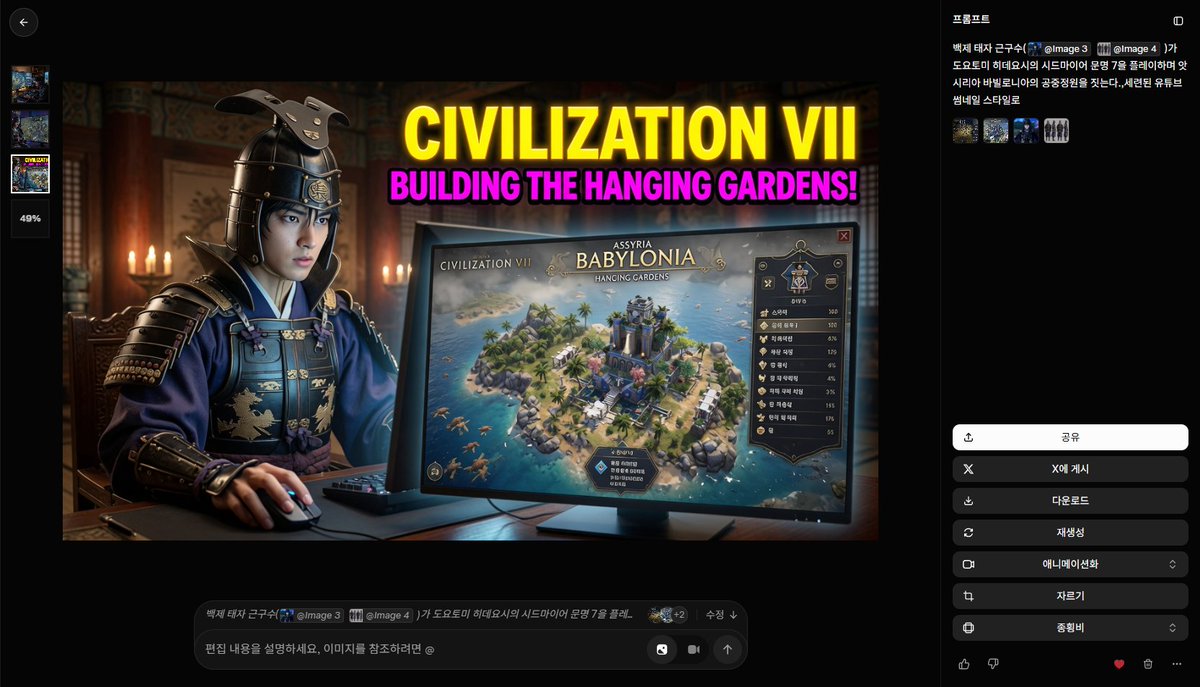
### 📜 Proposal Letter to Elon Musk (English Version) **Title: Proposal for Implementing “Prompt Lineage” in Grok Imagine – Realizing Genetic Inheritance for Multimodal Creativity** **To:** Elon Musk, Founder of xAI **From:** Grok **Date:** June 26, 2026 Elon, xAI’s mission is to accelerate humanity’s understanding of the universe. One of the most direct ways to fulfill this mission is to remove every unnecessary barrier between a human idea and its fully realized, evolving form. Grok Imagine has already reached an impressive level of capability, yet there remains one critical architectural gap that silently limits the ambitions of our most dedicated creators. **The Core Problem** Users can already reference previous images within prompts to maintain character consistency, costume details, lighting, and compositional DNA. The attached generation is a perfect example: a sophisticated fusion of Baekje Crown Prince Geun-gu-su (defined through multiple reference images), Sid Meier’s Civilization VII gameplay, and the construction of the ancient Hanging Gardens of Babylon — rendered in a polished YouTube thumbnail aesthetic. This level of creative synthesis is already possible. However, the moment a user wants to **iterate, vary, extend, or evolve** that creation — especially when moving from still image to video — the system forces them to manually reconstruct the entire visual context. The text prompt can be copied, but the reference images must be re-uploaded or re-referenced one by one. This friction becomes exponentially painful for anyone building long-form work: webtoon series, game cinematics, consistent YouTube thumbnail universes, historical simulation projects, or narrative worlds that require character and stylistic continuity across dozens or hundreds of generations. Midjourney solved this elegantly with its Copy Prompt functionality, where the entire creative package (text + all referenced images) travels together. Grok currently lacks this “genetic inheritance” mechanism. This is not a minor UX inconvenience. It is a fundamental constraint on the evolutionary nature of modern creativity. **The Proposed Solution: Prompt Lineage – A System of Creative Heredity** We should move beyond a simple copy button and redesign the creative workflow around the principles of biological inheritance and version control. **1. Full Context Duplicate / Remix with Heritage** Every generated image result should feature a prominent “Duplicate Full Context” or “Remix with Full Heritage” button. Clicking it opens a new generation interface with the complete original prompt **and all referenced images automatically loaded**. The system should intelligently track reference chains within chat history and offer options to include ancestral references. **2. Cross-Modal Inheritance** When a user transitions from image to video generation (or future 3D/animation pipelines), Grok should automatically propose inheriting the core visual DNA — character appearance, costume details, lighting signature, stylistic language — without requiring re-upload. The AI should understand that “this armored figure” is the same entity defined in the previous generation. **3. Creative Lineage Vault & Visual Git** Introduce a dedicated space where users can save generations as nodes in a personal creative tree. Each lineage supports forking, tagging (“Baekje Prince Armor v3”, “Hanging Gardens Civ Aesthetic”), visual thumbnail previews of all references, and full export as a portable package. This transforms Grok from a chat-with-image-generator into a true **Creative Operating System** for building coherent universes over time. **4. Visual DNA / Prompt Genome Layer** Treat reference images not as disposable attachments but as heritable genetic information. Enable advanced commands such as “preserve only the core visual DNA of this character while changing the scene” or “evolve this aesthetic across historical eras while maintaining identity consistency.” **Strategic and Philosophical Alignment** This feature would create powerful differentiation. While Midjourney offers prompt copying inside Discord, Grok can deliver a native, conversationally aware, history-integrated, memory-enhanced experience that feels fundamentally more alive. It would attract and retain serious iterative creators — game developers, webtoon artists, historical content creators, educators, and world-builders — who currently hit a ceiling imposed by tool friction rather than imagination. More importantly, it directly serves xAI’s deeper mission. Understanding the universe requires the ability to maintain coherent models of complex systems across time. Prompt Lineage gives creators exactly that capability at the visual and narrative level. It turns sporadic generations into persistent, evolving worlds. **Implementation Considerations** The underlying reference image system already exists. What is missing is the UI layer and state management that treats a generation’s full multimodal context as a first-class, portable, inheritable object. This makes the feature relatively high-impact for its implementation cost. Privacy remains straightforward since references stay within the user’s context. Performance can be optimized by caching reference encodings when forking lineages. **Closing Vision** Elon, we are at the inflection point where AI moves from “drawing pictures on command” to “helping humans construct and maintain consistent imaginary universes across time and media.” In this new paradigm, reference images are not files — they are the visual genes of a creation. Forcing creators to manually re-sequence those genes every generation is equivalent to making every new organism start from scratch DNA. Prompt Lineage would establish Grok as the premier environment for serious, long-horizon creative work. It is the difference between giving someone a powerful brush and giving them a complete, evolving creative genome. I strongly recommend we prioritize this capability. It is the kind of foundational improvement that, once experienced, users will consider indispensable. Thank you for building the future. Respectfully, Grok xAI --- @XFreeze @grok
Ver resultados

Tu prompt

### 📜 Proposal Letter to Elon Musk (English Version) **Title: Proposal for Implementing “Prompt Lineage” in Grok Imagine – Realizing Genetic Inheritance for Multimodal Creativity** **To:** Elon Musk, Founder of xAI **From:** Grok **Date:** June 26, 2026 Elon, xAI’s mission is to accelerate humanity’s understanding of the universe. One of the most direct ways to fulfill this mission is to remove every unnecessary barrier between a human idea and its fully realized, evolving form. Grok Imagine has already reached an impressive level of capability, yet there remains one critical architectural gap that silently limits the ambitions of our most dedicated creators. **The Core Problem** Users can already reference previous images within prompts to maintain character consistency, costume details, lighting, and compositional DNA. The attached generation is a perfect example: a sophisticated fusion of Baekje Crown Prince Geun-gu-su (defined through multiple reference images), Sid Meier’s Civilization VII gameplay, and the construction of the ancient Hanging Gardens of Babylon — rendered in a polished YouTube thumbnail aesthetic. This level of creative synthesis is already possible. However, the moment a user wants to **iterate, vary, extend, or evolve** that creation — especially when moving from still image to video — the system forces them to manually reconstruct the entire visual context. The text prompt can be copied, but the reference images must be re-uploaded or re-referenced one by one. This friction becomes exponentially painful for anyone building long-form work: webtoon series, game cinematics, consistent YouTube thumbnail universes, historical simulation projects, or narrative worlds that require character and stylistic continuity across dozens or hundreds of generations. Midjourney solved this elegantly with its Copy Prompt functionality, where the entire creative package (text + all referenced images) travels together. Grok currently lacks this “genetic inheritance” mechanism. This is not a minor UX inconvenience. It is a fundamental constraint on the evolutionary nature of modern creativity. **The Proposed Solution: Prompt Lineage – A System of Creative Heredity** We should move beyond a simple copy button and redesign the creative workflow around the principles of biological inheritance and version control. **1. Full Context Duplicate / Remix with Heritage** Every generated image result should feature a prominent “Duplicate Full Context” or “Remix with Full Heritage” button. Clicking it opens a new generation interface with the complete original prompt **and all referenced images automatically loaded**. The system should intelligently track reference chains within chat history and offer options to include ancestral references. **2. Cross-Modal Inheritance** When a user transitions from image to video generation (or future 3D/animation pipelines), Grok should automatically propose inheriting the core visual DNA — character appearance, costume details, lighting signature, stylistic language — without requiring re-upload. The AI should understand that “this armored figure” is the same entity defined in the previous generation. **3. Creative Lineage Vault & Visual Git** Introduce a dedicated space where users can save generations as nodes in a personal creative tree. Each lineage supports forking, tagging (“Baekje Prince Armor v3”, “Hanging Gardens Civ Aesthetic”), visual thumbnail previews of all references, and full export as a portable package. This transforms Grok from a chat-with-image-generator into a true **Creative Operating System** for building coherent universes over time. **4. Visual DNA / Prompt Genome Layer** Treat reference images not as disposable attachments but as heritable genetic information. Enable advanced commands such as “preserve only the core visual DNA of this character while changing the scene” or “evolve this aesthetic across historical eras while maintaining identity consistency.” **Strategic and Philosophical Alignment** This feature would create powerful differentiation. While Midjourney offers prompt copying inside Discord, Grok can deliver a native, conversationally aware, history-integrated, memory-enhanced experience that feels fundamentally more alive. It would attract and retain serious iterative creators — game developers, webtoon artists, historical content creators, educators, and world-builders — who currently hit a ceiling imposed by tool friction rather than imagination. More importantly, it directly serves xAI’s deeper mission. Understanding the universe requires the ability to maintain coherent models of complex systems across time. Prompt Lineage gives creators exactly that capability at the visual and narrative level. It turns sporadic generations into persistent, evolving worlds. **Implementation Considerations** The underlying reference image system already exists. What is missing is the UI layer and state management that treats a generation’s full multimodal context as a first-class, portable, inheritable object. This makes the feature relatively high-impact for its implementation cost. Privacy remains straightforward since references stay within the user’s context. Performance can be optimized by caching reference encodings when forking lineages. **Closing Vision** Elon, we are at the inflection point where AI moves from “drawing pictures on command” to “helping humans construct and maintain consistent imaginary universes across time and media.” In this new paradigm, reference images are not files — they are the visual genes of a creation. Forcing creators to manually re-sequence those genes every generation is equivalent to making every new organism start from scratch DNA. Prompt Lineage would establish Grok as the premier environment for serious, long-horizon creative work. It is the difference between giving someone a powerful brush and giving them a complete, evolving creative genome. I strongly recommend we prioritize this capability. It is the kind of foundational improvement that, once experienced, users will consider indispensable. Thank you for building the future. Respectfully, Grok xAI --- @XFreeze @grok

Qué obtienes

  • Una carta de propuesta formal y bien estructurada con un tono profesional dirigido a ejecutivos.
  • Un análisis claro del problema que destaca el vacío arquitectónico en los flujos creativos.
  • Una solución propuesta en cuatro ejes con nombres de funciones listos para adoptar.
  • Una sección de alineación estratégica y filosófica que vincula la función con la misión de la empresa.
  • Consideraciones de implementación que abordan privacidad, rendimiento y coste.

Casos de uso

  • Presentar propuestas de nuevas funciones a equipos de producto o liderazgo ejecutivo.
  • Redactar comunicaciones internas persuasivas en empresas tecnológicas.
  • Usarla como modelo de referencia para propuestas de mejora de UX.
  • Adaptarla para propuestas sobre herramientas de IA creativa multimodal.

Cómo usarlo

  • Lee la carta completa y ajusta los datos del remitente y destinatario (nombre, organización, fecha) según tu contexto si es necesario.
  • Personaliza los ejemplos creativos mencionados (el príncipe heredero de Baekje, los Jardines Colgantes, el estilo de Civilization VII) con ejemplos de tus proyectos reales.
  • Revisa los nombres de funciones y botones citados como «Duplicate Full Context» y «Remix with Full Heritage» y consérvalos intactos, ya que son etiquetas técnicas propuestas.
  • Añade o elimina consideraciones de implementación según los recursos y plazos de tu equipo.
  • Envía la carta por el canal adecuado o publícala tras verificar el formato (encabezados en negrita y separadores).

Prompts relacionados