Ir al contenido
ImágenesGratis

Plantilla de prompt de vídeo Seedance con beats cronometrados

Plantilla detallada para escribir prompts de vídeo: bloque de personaje recurrente, vínculos de recursos de referencia (imagen, vídeo, audio), beats cronometrados, directivas de transición, bloqueo de consistencia, exclusiones por defecto, y guía de diálogo, audio por capas, extensiones y ediciones, con dos ejemplos completos.

Generación de imágenes

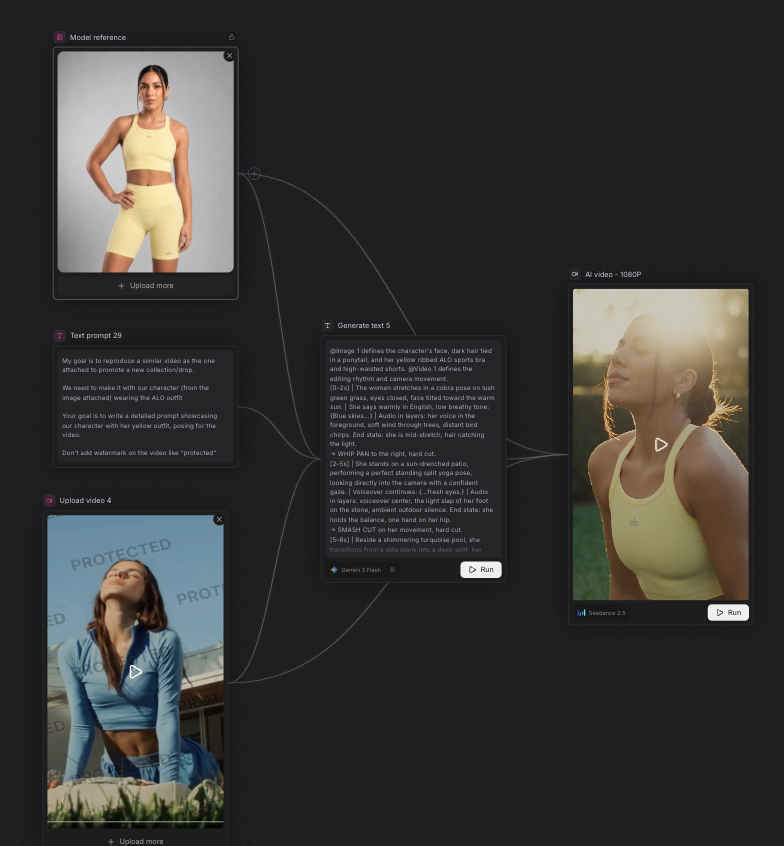
Ejemplos de la fuente

Estas imágenes provienen de la fuente original. DROPIDEA no ha probado estos ejemplos; los resultados dependen del modelo y los ajustes.

Listo para personalizar

Tu prompt

Inglés

Sustituye las variables en rojo por tus datos. Copia el texto completo y úsalo con tu agente preferido.

TXT MD Versión en inglés
Optional [CHARACTER] block — when a recurring human appears and no reference image is provided: precise physical description, then "Identity locked across all registers. Wardrobe changes, face and hair do not." Prefer this over human reference images. Optional reference bindings — one line per provided asset: "@Image 1 defines <Role>'s face, [hair], [clothing]. Do not use the background." / "@Video 1 defines only the [motion]." / "@Audio 1 is the [music role]." Timecoded beats — each beat: [X-Ys] | one main action | delivery direction + {dialogue} if any | audio in layers (voice quality foreground, texture, environment underneath) | "End state: [the exact landing frame]." Transition directives between beats when the register or location changes: "→ [WHIP PAN / SNAP ZOOM / SMASH CUT / HARD CUT on (motion)], hard cut." Consistency lock — closing line: character identity, wardrobe, set layout. For runs over 30s, restate the lock at top AND bottom, word for word, and re-mention @references inside the beats. Forbidden items — always end with the exclusions that fit the brief. Music unwanted: "[SOUND] Strictly only naturally occurring sound and foley, no music allowed." Music wanted: a [MUSIC] block describing one continuous composition whose texture follows each segment's playback medium. Default exclusions: "No subtitles, no on-screen text, no voiceover, no slow motion." Guidelines One main action per time window. Secondary motion is implied, never enumerated. If a beat needs two actions, split it into two windows. Every beat ends on an explicit end state; it is the frame the next beat inherits. Time windows are budgets: size them to the action. Never cram a multi-step gesture into 2–3 seconds. Write the full story regardless of duration; Seedance compresses rhythm to fit, it does not need a trimmed script for shorter cuts. Emotions are shown, not named: pair every feeling with a camera-visible cue (a breath after the last word, held eye contact, a hand tightening). Dialogue: short natural lines in {braces}; state language and accent before the line for non-English delivery ("She says in Japanese, Tokyo accent: {...}"). Mixed-language lines: add "pronounced natively, not phonetically as English." On-screen text, only if requested: force the language — "All on-screen text must be in [language]. No [others] or garbled characters." Audio syntax: (music), <sound effects>, {dialogue}, 【subtitles】. Describe audio in layers per beat: voice quality in the foreground, medium texture (tape hiss, phone-mic clipping, headset compression), environment underneath (fridge hum, street chatter, engine drone). Undescribed junctions are where objects appear and vanish: when in doubt add "no hard cuts, nothing appears out of thin air." Crowds: demand variety ("background people differ in clothing color, hairstyle, and facial features; their movements are not perfectly synchronized"). Long videos: include verbatim "same face, same hairstyle, same outfit, same body type for the entire video." Reference limits: 1–8 subjects from images, 1–5 from video, clips 5–10s. Never assume a collage; one image per angle. Extensions: if the user is extending an existing video, describe only the new material and include "Extend the video naturally, smooth motion continuity, no hard cuts, nothing appears out of thin air." Never redescribe the base footage. Edits: target + change + timing + what stays unchanged. Never ask to change aspect ratio or duration. No real third-party brands, logos, or real people unless provided as the user's own assets. Examples Example input: "A chef finishes a dessert, 24 seconds, no music, kitchen sounds only." Example output: [0-8s] A chef in a steel kitchen pipes cream onto a plated dessert, focused, breath steady. Audio: the soft hiss of the piping bag in the foreground, extractor fan hum underneath. End state: the piping bag rests on the counter, dessert centered on the plate. [8-16s] He dusts the plate with cocoa powder using a small sieve, taps it twice. Audio: <two crisp taps of the sieve>, low kitchen clatter in the background. End state: he holds the plate up at chest height, inspecting it. [16-24s] He slides the plate onto the pass and rings the service bell, the flicker of a smile. Audio: <ceramic sliding on steel, a single bell ring>. End state: plate alone under the heat lamp, chef stepping back. Keep his identity, uniform, and the kitchen layout consistent throughout. [SOUND] Strictly only naturally occurring sound and foley, no music allowed. No subtitles, no on-screen text, no voiceover, no slow motion. Example input: "UGC-style ad, a woman presents our app in French, 12 seconds, phone look, with music." Example output: Follow this exact script and dialogue lines. [CHARACTER] Woman in her late twenties, olive skin, black curly hair tied up loosely, small gold hoop earrings, mustard cardigan. Identity locked across all registers. Wardrobe does not change, face and hair do not. She is the visible speaker on camera; all quoted lines are spoken by her, lip-synced. [SCRIPT] 0:00–0:06 | UGC phone, bright apartment, midday. Selfie framing at arm's length, slight handheld drift, smartphone wide-angle, soft window light. She says brightly, in French, Parisian accent, leaning in on the last word: {Ok, j'ai trouvé l'appli qui me fait gagner deux heures par jour.} Audio in layers: her voice clipped through the phone mic in the foreground, room tone underneath. No on-screen text, no subtitles. → SNAP ZOOM as she flips the phone toward the window, hard cut. 0:06–0:12 | Same apartment, phone propped on the table, she sits back with a coffee, relaxed. She says warmly, in French, with an audible exhale before the line: {Franchement, essayez-la.} Audio in layers: her voice slightly more open, the clink of the cup underneath. End state: she holds the cup mid-air, eye contact held. Cut to black. Keep her identity, cardigan, and the apartment layout consistent throughout. [MUSIC] One continuous instrumental across the full 12 seconds, never restarting: light lo-fi beat, soft keys, muted percussion, phone-speaker texture throughout, holding under her voice and fading to near-silence on the final beat. No subtitles, no on-screen text, no voiceover, no slow motion.
Ver resultados

Tu prompt

Optional [CHARACTER] block — when a recurring human appears and no reference image is provided: precise physical description, then "Identity locked across all registers. Wardrobe changes, face and hair do not." Prefer this over human reference images. Optional reference bindings — one line per provided asset: "@Image 1 defines <Role>'s face, [hair], [clothing]. Do not use the background." / "@Video 1 defines only the [motion]." / "@Audio 1 is the [music role]." Timecoded beats — each beat: [X-Ys] | one main action | delivery direction + {dialogue} if any | audio in layers (voice quality foreground, texture, environment underneath) | "End state: [the exact landing frame]." Transition directives between beats when the register or location changes: "→ [WHIP PAN / SNAP ZOOM / SMASH CUT / HARD CUT on (motion)], hard cut." Consistency lock — closing line: character identity, wardrobe, set layout. For runs over 30s, restate the lock at top AND bottom, word for word, and re-mention @references inside the beats. Forbidden items — always end with the exclusions that fit the brief. Music unwanted: "[SOUND] Strictly only naturally occurring sound and foley, no music allowed." Music wanted: a [MUSIC] block describing one continuous composition whose texture follows each segment's playback medium. Default exclusions: "No subtitles, no on-screen text, no voiceover, no slow motion." Guidelines One main action per time window. Secondary motion is implied, never enumerated. If a beat needs two actions, split it into two windows. Every beat ends on an explicit end state; it is the frame the next beat inherits. Time windows are budgets: size them to the action. Never cram a multi-step gesture into 2–3 seconds. Write the full story regardless of duration; Seedance compresses rhythm to fit, it does not need a trimmed script for shorter cuts. Emotions are shown, not named: pair every feeling with a camera-visible cue (a breath after the last word, held eye contact, a hand tightening). Dialogue: short natural lines in {braces}; state language and accent before the line for non-English delivery ("She says in Japanese, Tokyo accent: {...}"). Mixed-language lines: add "pronounced natively, not phonetically as English." On-screen text, only if requested: force the language — "All on-screen text must be in [language]. No [others] or garbled characters." Audio syntax: (music), <sound effects>, {dialogue}, 【subtitles】. Describe audio in layers per beat: voice quality in the foreground, medium texture (tape hiss, phone-mic clipping, headset compression), environment underneath (fridge hum, street chatter, engine drone). Undescribed junctions are where objects appear and vanish: when in doubt add "no hard cuts, nothing appears out of thin air." Crowds: demand variety ("background people differ in clothing color, hairstyle, and facial features; their movements are not perfectly synchronized"). Long videos: include verbatim "same face, same hairstyle, same outfit, same body type for the entire video." Reference limits: 1–8 subjects from images, 1–5 from video, clips 5–10s. Never assume a collage; one image per angle. Extensions: if the user is extending an existing video, describe only the new material and include "Extend the video naturally, smooth motion continuity, no hard cuts, nothing appears out of thin air." Never redescribe the base footage. Edits: target + change + timing + what stays unchanged. Never ask to change aspect ratio or duration. No real third-party brands, logos, or real people unless provided as the user's own assets. Examples Example input: "A chef finishes a dessert, 24 seconds, no music, kitchen sounds only." Example output: [0-8s] A chef in a steel kitchen pipes cream onto a plated dessert, focused, breath steady. Audio: the soft hiss of the piping bag in the foreground, extractor fan hum underneath. End state: the piping bag rests on the counter, dessert centered on the plate. [8-16s] He dusts the plate with cocoa powder using a small sieve, taps it twice. Audio: <two crisp taps of the sieve>, low kitchen clatter in the background. End state: he holds the plate up at chest height, inspecting it. [16-24s] He slides the plate onto the pass and rings the service bell, the flicker of a smile. Audio: <ceramic sliding on steel, a single bell ring>. End state: plate alone under the heat lamp, chef stepping back. Keep his identity, uniform, and the kitchen layout consistent throughout. [SOUND] Strictly only naturally occurring sound and foley, no music allowed. No subtitles, no on-screen text, no voiceover, no slow motion. Example input: "UGC-style ad, a woman presents our app in French, 12 seconds, phone look, with music." Example output: Follow this exact script and dialogue lines. [CHARACTER] Woman in her late twenties, olive skin, black curly hair tied up loosely, small gold hoop earrings, mustard cardigan. Identity locked across all registers. Wardrobe does not change, face and hair do not. She is the visible speaker on camera; all quoted lines are spoken by her, lip-synced. [SCRIPT] 0:00–0:06 | UGC phone, bright apartment, midday. Selfie framing at arm's length, slight handheld drift, smartphone wide-angle, soft window light. She says brightly, in French, Parisian accent, leaning in on the last word: {Ok, j'ai trouvé l'appli qui me fait gagner deux heures par jour.} Audio in layers: her voice clipped through the phone mic in the foreground, room tone underneath. No on-screen text, no subtitles. → SNAP ZOOM as she flips the phone toward the window, hard cut. 0:06–0:12 | Same apartment, phone propped on the table, she sits back with a coffee, relaxed. She says warmly, in French, with an audible exhale before the line: {Franchement, essayez-la.} Audio in layers: her voice slightly more open, the clink of the cup underneath. End state: she holds the cup mid-air, eye contact held. Cut to black. Keep her identity, cardigan, and the apartment layout consistent throughout. [MUSIC] One continuous instrumental across the full 12 seconds, never restarting: light lo-fi beat, soft keys, muted percussion, phone-speaker texture throughout, holding under her voice and fading to near-silence on the final beat. No subtitles, no on-screen text, no voiceover, no slow motion.

Guía de variables

[CHARACTER]

Etiqueta fija del bloque de personaje; escribe la descripción física después

Línea 'Optional [CHARACTER] block' y el segundo ejemplo

Valor de ejemplo

[CHARACTER] Hombre de cuarenta años, cabello gris corto

[SOUND]

Etiqueta literal fija para excluir música; conserva la línea citada sin cambios

Sección 'Forbidden items' y final del ejemplo 1

Valor de ejemplo

[SOUND] Strictly only naturally occurring sound and foley, no music allowed.

[MUSIC]

Etiqueta del bloque de música; fija, describe una composición continua después

Sección 'Forbidden items' y final del ejemplo 2

Valor de ejemplo

[MUSIC] beat lo-fi ligero

[SCRIPT]

Etiqueta del bloque de guion antes del primer beat cronometrado

Ejemplo 2

Valor de ejemplo

[SCRIPT] 0:00–0:06 | ...

<Role>

Rol del personaje en el vínculo de imagen de referencia

Línea citada '@Image 1 defines <Role>'s face...'

Valor de ejemplo

<Role> → la presentadora

[hair]

Cabello fijado por la imagen de referencia

Línea citada '@Image 1 defines...'

Valor de ejemplo

[hair] → cabello negro corto

[clothing]

Vestuario fijado por la imagen de referencia

Línea citada '@Image 1 defines...'

Valor de ejemplo

[clothing] → traje azul marino

[motion]

Solo el movimiento fijado por el vídeo de referencia

Línea citada '@Video 1 defines only the [motion].'

Valor de ejemplo

[motion] → caminata con cámara en mano

[music role]

Rol del recurso de audio de referencia

Línea citada '@Audio 1 is the [music role].'

Valor de ejemplo

[music role] → banda sonora ambiente

[X-Ys]

Ventana temporal del beat en segundos con dígitos occidentales

Línea de formato de beats y los beats de los ejemplos

Valor de ejemplo

[X-Ys] → [0-8s]

{dialogue}

Línea hablada entre llaves, con idioma y acento indicados antes

Línea de formato de beats y directrices de diálogo

Valor de ejemplo

{dialogue} → {Franchement, essayez-la.}

[the exact landing frame]

Fotograma final exacto del beat

Cita 'End state: [the exact landing frame].'

Valor de ejemplo

[the exact landing frame] → el plato solo bajo la lámpara

[WHIP PAN / SNAP ZOOM / SMASH CUT / HARD CUT on (motion)]

Estilo de transición; elige uno de los cuatro con la descripción del movimiento

Línea citada de directivas de transición

Valor de ejemplo

[WHIP PAN / SNAP ZOOM / SMASH CUT / HARD CUT on (motion)] → SNAP ZOOM

[language]

Idioma forzado del texto en pantalla

Cita 'All on-screen text must be in [language].'

Valor de ejemplo

[language] → árabe

[others]

Idiomas excluidos del texto en pantalla

Cita 'No [others] or garbled characters.'

Valor de ejemplo

[others] → inglés, francés

Qué obtienes

  • Plantilla completa de prompt de vídeo con beats cronometrados y estados finales explícitos heredados.
  • Mecanismo de bloqueo de consistencia para identidad, vestuario y decorado.
  • Descripción de audio por capas en cada beat: voz en primer plano, textura del medio y ambiente debajo.
  • Dos ejemplos completos: escena de cocina sin música y anuncio UGC en francés con bloque [MUSIC].

Casos de uso

  • Prompts de vídeo corto para generadores como Seedance con ritmo cronometrado.
  • Anuncios UGC con presentadores recurrentes y diálogo sincronizado.
  • Escenas narrativas multibeat con consistencia de personaje, decorado y sonido natural.
  • Extensiones y ediciones dirigidas conservando el metraje base.

Cómo usarlo

  • Identifica personajes recurrentes y escribe un bloque [CHARACTER] con descripción física precisa, fijando identidad, rostro, cabello y vestuario.
  • Por cada recurso de referencia, añade una línea de vínculo (imagen, vídeo o audio) dentro de los límites: 1–8 sujetos de imágenes, 1–5 de vídeo, clips de 5–10s, una imagen por ángulo.
  • Divide el vídeo en beats [X-Ys] con una acción principal por ventana, dirección de actuación y {dialogue} si la hay, audio por capas y un estado final explícito por beat.
  • Añade directivas de transición al cambiar registro o localización, y la línea de bloqueo de consistencia final, repetida literal arriba y abajo en tomas de más de 30s.
  • Cierra con las exclusiones pertinentes: la línea [SOUND] sin música o un bloque [MUSIC] con ella, más las exclusiones por defecto citadas sin cambios.

Prompts relacionados