Ir al contenido
ImágenesGratis

Lámina científica de artefactos de sonido personal

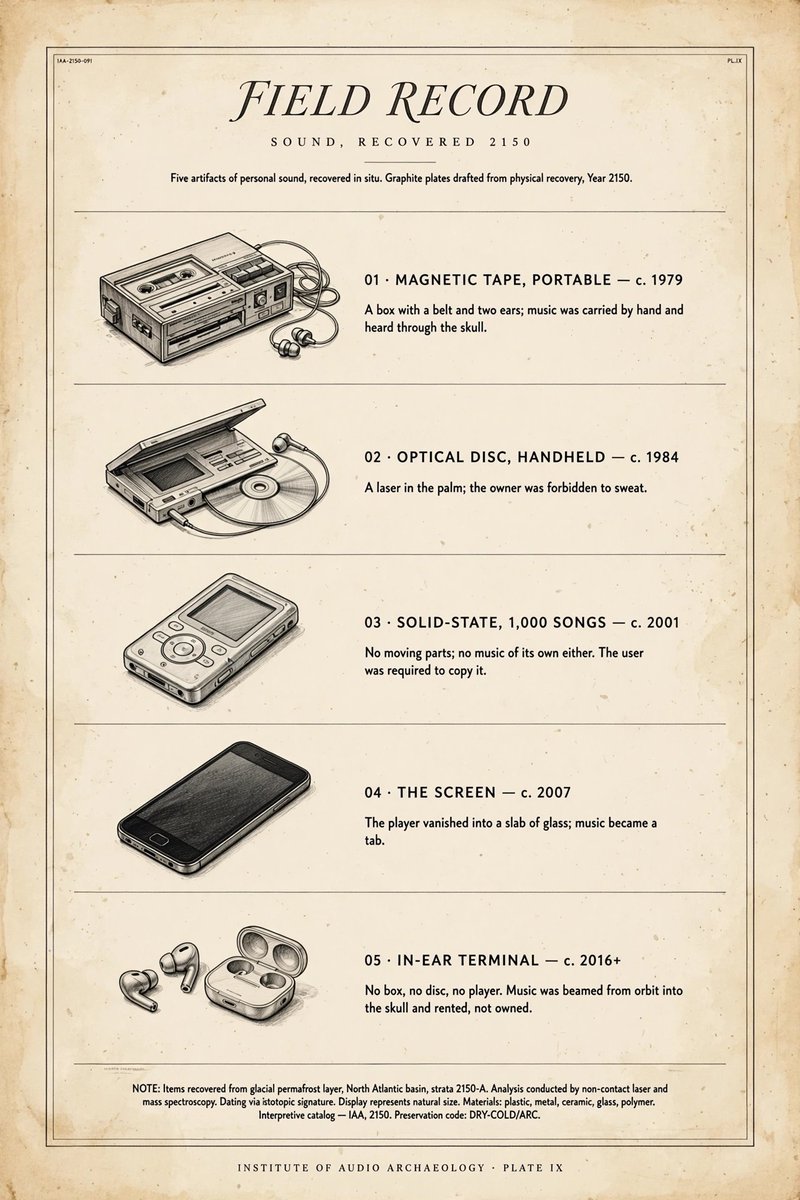
Plantilla árabe completa para un póster impuesto fotorrealista: una lámina científica del año 2150 que cataloga cinco artefactos de sonido personal (casete, CD, MP3, smartphone, auriculares inalámbricos) con dibujos de grafito y leyendas de catálogo en inglés, proporción 2:3.

OpenAI

Ejemplos de la fuente

Estas imágenes provienen de la fuente original. DROPIDEA no ha probado estos ejemplos; los resultados dependen del modelo y los ajustes.
Listo para personalizar

Tu prompt

Inglés

Sustituye las variables en rojo por tus datos. Copia el texto completo y úsalo con tu agente preferido.

TXT MD Versión en inglés
A photorealistic printed poster filling the entire frame edge to edge, photographed flat and square-on, no room, no wall, no pins. A scientific plate on heavy cream paper: five artifacts of personal sound, recovered in the year 2150, arranged in five horizontal rows, each row a fine graphite drawing of the object at left with a catalog entry in small ruled type at right — row one: a portable cassette player with thin earbuds coiled beside it, "01 · MAGNETIC TAPE, PORTABLE — c. 1979. A box with a belt and two ears; music was carried by hand and heard through the skull." — row two: a handheld compact-disc player with a disc, "02 · OPTICAL DISC, HANDHELD — c. 1984. A laser in the palm; the owner was forbidden to sweat." — row three: a small silver MP3 player, "03 · SOLID-STATE, 1,000 SONGS — c. 2001. No moving parts; no music of its own either. The user was required to copy it." — row four: a black glass smartphone, "04 · THE SCREEN — c. 2007. The player vanished into a slab of glass; music became a tab." — row five: a pair of small wireless earbuds, "05 · IN-EAR TERMINAL — c. 2016+. No box, no disc, no player. Music was beamed from orbit into the skull and rented, not owned." Thin ruled lines divide the rows, a thin ruled border, small catalog numbers in the corners, a short paragraph of fine print at the foot. Title in italic serif: "FIELD RECORD". Beneath: "SOUND, RECOVERED 2150". Bottom: "INSTITUTE OF AUDIO ARCHAEOLOGY · PLATE IX". Cream, graphite, a wash of ochre, flat even light. 2:3 aspect ratio. 🔵 GPT Image 2: [img. 1] 🟣 Muse Image: [img. 2] RT + reply who you pick 👇 #AIart #GPTImage2 #MuseImage
Ver resultados

Tu prompt

A photorealistic printed poster filling the entire frame edge to edge, photographed flat and square-on, no room, no wall, no pins. A scientific plate on heavy cream paper: five artifacts of personal sound, recovered in the year 2150, arranged in five horizontal rows, each row a fine graphite drawing of the object at left with a catalog entry in small ruled type at right — row one: a portable cassette player with thin earbuds coiled beside it, "01 · MAGNETIC TAPE, PORTABLE — c. 1979. A box with a belt and two ears; music was carried by hand and heard through the skull." — row two: a handheld compact-disc player with a disc, "02 · OPTICAL DISC, HANDHELD — c. 1984. A laser in the palm; the owner was forbidden to sweat." — row three: a small silver MP3 player, "03 · SOLID-STATE, 1,000 SONGS — c. 2001. No moving parts; no music of its own either. The user was required to copy it." — row four: a black glass smartphone, "04 · THE SCREEN — c. 2007. The player vanished into a slab of glass; music became a tab." — row five: a pair of small wireless earbuds, "05 · IN-EAR TERMINAL — c. 2016+. No box, no disc, no player. Music was beamed from orbit into the skull and rented, not owned." Thin ruled lines divide the rows, a thin ruled border, small catalog numbers in the corners, a short paragraph of fine print at the foot. Title in italic serif: "FIELD RECORD". Beneath: "SOUND, RECOVERED 2150". Bottom: "INSTITUTE OF AUDIO ARCHAEOLOGY · PLATE IX". Cream, graphite, a wash of ochre, flat even light. 2:3 aspect ratio. 🔵 GPT Image 2: [img. 1] 🟣 Muse Image: [img. 2] RT + reply who you pick 👇 #AIart #GPTImage2 #MuseImage

Guía de variables

[img. 1]

Token de inserción de la primera imagen; sustitúyelo por la imagen generada con GPT Image 2.

La línea que empieza con 🔵 al final de la plantilla.

Valor de ejemplo

[img. 1]

[img. 2]

Token de inserción de la segunda imagen; sustitúyelo por la imagen generada con Muse Image.

La línea que empieza con 🟣 al final de la plantilla.

Valor de ejemplo

[img. 2]

Qué obtienes

  • Un póster impreso fotorrealista de borde a borde con proporción 2:3.
  • Una lámina científica sobre papel crema grueso con cinco filas horizontales separadas por filetes finos.
  • Dibujos de grafito de cinco dispositivos de sonido con leyendas de catálogo en inglés fechadas (de 1979 a 2016+).
  • Título en serif cursiva "FIELD RECORD", subtítulo "SOUND, RECOVERED 2150" y pie "INSTITUTE OF AUDIO ARCHAEOLOGY · PLATE IX".
  • Paleta crema y grafito con un lavado de ocre bajo luz plana y uniforme.

Casos de uso

  • Publicaciones de AI-art en redes sociales comparando dos modelos de imagen.
  • Pósters de pared estilo museo o decoración impresa.
  • Portadas de artículos o boletines sobre la historia de la escucha personal.
  • Material educativo visual sobre dispositivos de audio, del casete al streaming.

Cómo usarlo

  • Copia la plantilla árabe completa en una herramienta texto-a-imagen como GPT Image 2 o Muse Image.
  • Adjunta o referencia las imágenes necesarias si tu herramienta lo requiere; [img. 1] y [img. 2] marcan las dos imágenes de resultado para la publicación social.
  • Conserva sin cambios las leyendas inglesas entre comillas (p. ej. "FIELD RECORD", "SOUND, RECOVERED 2150"), ya que deben aparecer literalmente en el póster.
  • Si quieres, ajusta solo valores creativos como el título o el año, manteniendo intactos todos los dígitos, los ajustes técnicos y la proporción 2:3.
  • Genera y revisa las cinco filas, la numeración de catálogo y los filetes antes de finalizar.
  • Publica el resultado con los hashtags incluidos y deja que la audiencia elija su modelo favorito.

Prompts relacionados