Ir al contenido
ImágenesGratis

Collage de Papel Calado y Ruinas Doradas

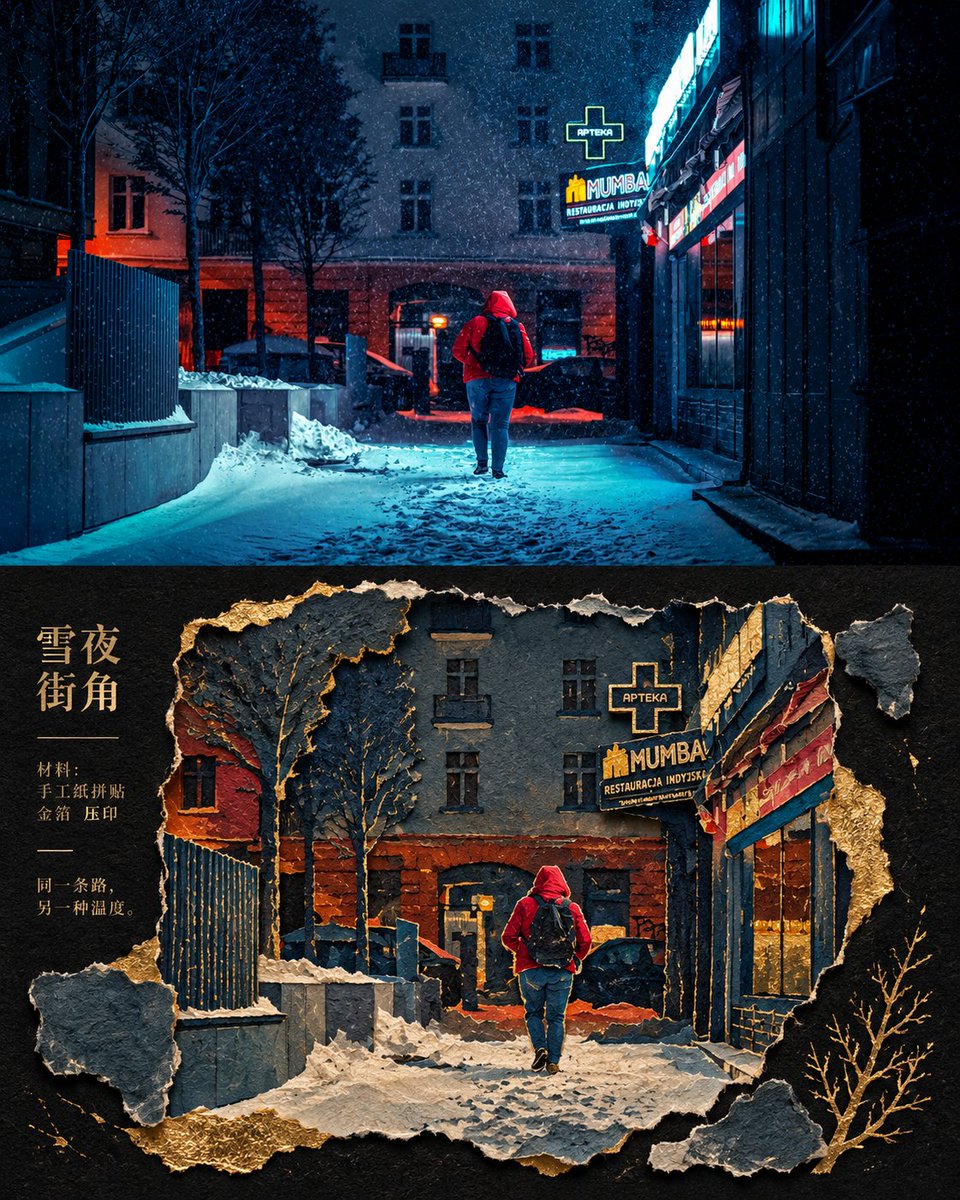
Transforma una fotografía de entrada en un póster museístico dividido horizontalmente: la mitad superior conserva la fotografía real intacta y la mitad inferior la deconstruye en capas escultóricas de papel calado con detalles en pan de oro sobre fondo oscuro.

Generación de imágenes

Ejemplos de la fuente

Estas imágenes provienen de la fuente original. DROPIDEA no ha probado estos ejemplos; los resultados dependen del modelo y los ajustes.

Listo para personalizar

Tu prompt

Inglés

Sustituye las variables en rojo por tus datos. Copia el texto completo y úsalo con tu agente preferido.

TXT MD Versión en inglés
Transform the input photo into a "gilded ancient-ruins paper-cut collage" style while preserving the factual content and subject identity of the photo. Input images: The input photo is the sole source of content; the upper half serves as the true photographic area, and the lower half serves as the stylized reassembly area of the same photo. Scene/backdrop: The lower half uses a deep-black or near-black coarse-fiber paper base, building irregular torn-paper windows, offset layered paper sheets, and local negative space around the original photo's subject; if the photo contains sky, water, plants, streets, or interior spaces, distill these real elements into low-saturation indigo, smoke gray, gray-green, and ochre-red paper sheets, without forcibly adding Eastern architecture or distant landmarks. Subject: Preserve the number of subjects, identity, pose, direction of action, key contours, and spatial relationships in the original photo; break the subject into multiple layers of hand-cut paper and shallow relief paper sheets, with edges showing slight hand-cut unevenness, cuts, and paper-layer shadows. Style/medium: Museum-exhibit-label feel of Eastern paper sculpture, paper cutting, paper collage, and gold-foil stamping poster; locally use ancient-gold fine lines, gold-foil edges, embossed/debossed textures, and dark-red, ink-blue, and smoke-gray color blocks. Gold only emphasizes subject contours, key structures, and a small amount of decoration, and does not cover the whole image. Composition/framing: The image is strictly divided into upper and lower zones, roughly the upper half is the true photo and the lower half is the stylized re-rendering, with a clear horizontal boundary; the lower half should not replicate the complete framing of the original photo, but use scaled-down distillation, layered cropping, and local enlargement to form one or several staggered paper-cut windows; retain obvious black-base breathing space, and add a small exhibit-label-style title, material field, and one very short observation in the upper-left or at the edge. Lighting/mood: The black base absorbs ambient light, paper-layer edges have restrained lateral warm light and soft shadows, overall solemn, quiet, and archaeological-archive-like; do not do neon, plastic, metallic 3D, or ordinary filters. Color palette: Use black, charcoal gray, and bone white as the base; colors are extracted from the original photo and compressed into deep indigo, smoke-gray green, ochre red, dark amber, and a small amount of ancient gold; do not fix any location's color palette. Materials/textures: Visible coarse-fiber paper, torn edges, scissor cuts, layered thickness, debossed lines, uneven gold-foil reflection, and tiny paper scraps; materials must become the spatial structure rather than a stacked grain filter. Text (verbatim): Only generate a short title consistent with the factual content of the input photo, a material field, and one observation of no more than eight words; text should look like gold-foil stamping or old exhibit-label printing, and fabricated brands, URLs, QR codes, and long paragraphs are forbidden. Constraints: The upper half fully preserves the photographic texture, subjects, number, pose, composition direction, and key structure of the true photo; the lower half must be traceable to the same photo, and must clearly change in subject scale, cropping, information density, or spatial organization; do not generate "original/AI image" corner badges. Avoid: Side-by-side, multi-image collage, blurred upper/lower boundary, only color adjustment, only adding noise, ordinary ink painting, generic Chinese-style travel poster, unrelated landmarks, extra people, erroneous text, cartoon plastic texture, excessive gold, floating watermarks.
Ver resultados

Tu prompt

Transform the input photo into a "gilded ancient-ruins paper-cut collage" style while preserving the factual content and subject identity of the photo. Input images: The input photo is the sole source of content; the upper half serves as the true photographic area, and the lower half serves as the stylized reassembly area of the same photo. Scene/backdrop: The lower half uses a deep-black or near-black coarse-fiber paper base, building irregular torn-paper windows, offset layered paper sheets, and local negative space around the original photo's subject; if the photo contains sky, water, plants, streets, or interior spaces, distill these real elements into low-saturation indigo, smoke gray, gray-green, and ochre-red paper sheets, without forcibly adding Eastern architecture or distant landmarks. Subject: Preserve the number of subjects, identity, pose, direction of action, key contours, and spatial relationships in the original photo; break the subject into multiple layers of hand-cut paper and shallow relief paper sheets, with edges showing slight hand-cut unevenness, cuts, and paper-layer shadows. Style/medium: Museum-exhibit-label feel of Eastern paper sculpture, paper cutting, paper collage, and gold-foil stamping poster; locally use ancient-gold fine lines, gold-foil edges, embossed/debossed textures, and dark-red, ink-blue, and smoke-gray color blocks. Gold only emphasizes subject contours, key structures, and a small amount of decoration, and does not cover the whole image. Composition/framing: The image is strictly divided into upper and lower zones, roughly the upper half is the true photo and the lower half is the stylized re-rendering, with a clear horizontal boundary; the lower half should not replicate the complete framing of the original photo, but use scaled-down distillation, layered cropping, and local enlargement to form one or several staggered paper-cut windows; retain obvious black-base breathing space, and add a small exhibit-label-style title, material field, and one very short observation in the upper-left or at the edge. Lighting/mood: The black base absorbs ambient light, paper-layer edges have restrained lateral warm light and soft shadows, overall solemn, quiet, and archaeological-archive-like; do not do neon, plastic, metallic 3D, or ordinary filters. Color palette: Use black, charcoal gray, and bone white as the base; colors are extracted from the original photo and compressed into deep indigo, smoke-gray green, ochre red, dark amber, and a small amount of ancient gold; do not fix any location's color palette. Materials/textures: Visible coarse-fiber paper, torn edges, scissor cuts, layered thickness, debossed lines, uneven gold-foil reflection, and tiny paper scraps; materials must become the spatial structure rather than a stacked grain filter. Text (verbatim): Only generate a short title consistent with the factual content of the input photo, a material field, and one observation of no more than eight words; text should look like gold-foil stamping or old exhibit-label printing, and fabricated brands, URLs, QR codes, and long paragraphs are forbidden. Constraints: The upper half fully preserves the photographic texture, subjects, number, pose, composition direction, and key structure of the true photo; the lower half must be traceable to the same photo, and must clearly change in subject scale, cropping, information density, or spatial organization; do not generate "original/AI image" corner badges. Avoid: Side-by-side, multi-image collage, blurred upper/lower boundary, only color adjustment, only adding noise, ordinary ink painting, generic Chinese-style travel poster, unrelated landmarks, extra people, erroneous text, cartoon plastic texture, excessive gold, floating watermarks.

Qué obtienes

  • Un póster estructurado en dos mitades horizontales claramente delimitadas.
  • Una mitad superior que mantiene la autenticidad fotográfica y los sujetos intactos.
  • Una mitad inferior estilizada en capas de papel rasgado, relieve escultórico y detalles en pan de oro sobre fibra negra.
  • Detalles tipográficos sutiles estilo ficha de museo con los materiales y una breve anotación.

Casos de uso

  • Diseño de carteles de exposiciones culturales a partir de fotos de archivo.
  • Portadas editoriales que combinan el fotoperiodismo con la artesanía tradicional.
  • Proyectos visuales que buscan un acabado arqueológico y táctil de alta gama.

Cómo usarlo

  • Sube una fotografía de referencia nítida como fuente visual única.
  • Pega el texto del prompt completo conservando todas las restricciones de composición.
  • Asegúrate de que la herramienta tome la imagen de entrada para preservar la identidad del sujeto.
  • Genera el resultado para obtener el cartel dividido con fotografía arriba y collage de papel abajo.

Prompts relacionados