Ir al contenido
ImágenesGratis

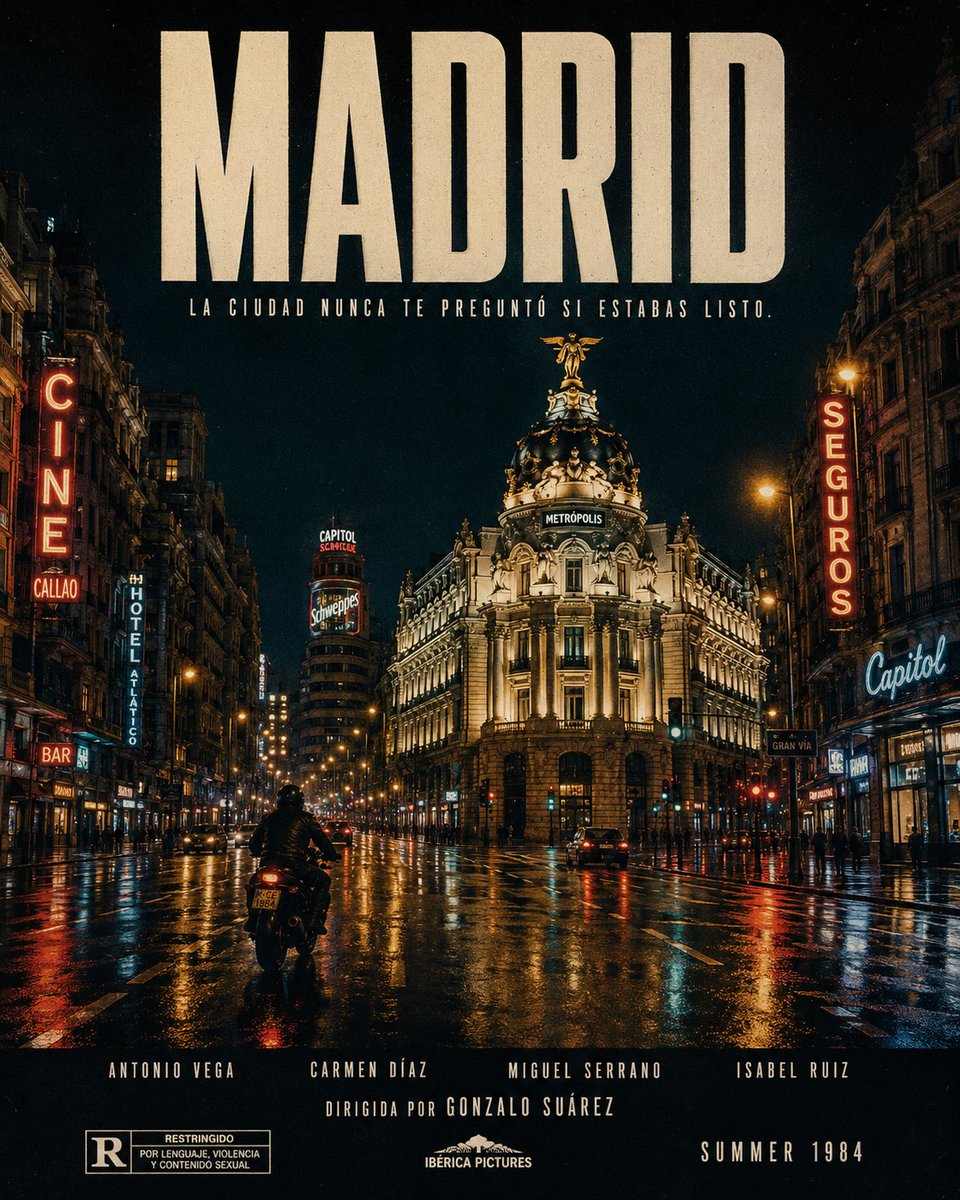
Póster nocturno de película ochentera para cualquier ciudad

Plantilla JSON universal que genera un póster nocturno de película ficticia de los 80 para cualquier ciudad del mundo, al estilo Saul Bass meets Drive: neón-noir, lente anamórfica, el nombre de la ciudad como único título, más un tagline y bloque de créditos inventados. Solo dos variables: [CIUDAD] y [PAIS].

OpenAI

Ejemplos de la fuente

Estas imágenes provienen de la fuente original. DROPIDEA no ha probado estos ejemplos; los resultados dependen del modelo y los ajustes.

Listo para personalizar

Tu prompt

Inglés

Sustituye las variables en rojo por tus datos. Copia el texto completo y úsalo con tu agente preferido.

TXT MD Versión en inglés
madrid like the poster for a movie that was never shot. gran vía at night, the neon, a motorcycle riding up. damn, I almost swear I saw it as a kid in some video store. what city do you want to see like this? gpt image 2. prompt 👇 { "schema": "city_poster_night_drive_v1", "version": "1.0", "description": "Universal template for a fictional 80s nocturnal movie poster for any world city. Single variable [CIUDAD], [PAIS]. Style: Saul Bass meets Drive one-sheet — graphic simplicity, neon-noir, photoreal but stylized. Extraction logic embedded inline. City name is always the primary title.", "input": { "ciudad": "[CIUDAD]", "pais": "[PAIS]" }, "ai_extraction_protocol": { "instruction": "Reference only. The prompt_template is self-contained — each [DERIVE:] block resolves inline from city knowledge. Do not invent. Use the most globally recognizable nocturnal identity of [CIUDAD], [PAIS].", "fields": { "avenida_nocturna": "The most iconic avenue or street of [CIUDAD] at night — the one with the highest density of neon, practical lights, and cinematic street life. Describe its width, gradient, architecture, and how it reads at night.", "edificio_emblematico_iluminado": "The most visually striking illuminated building or landmark on or near that avenue — the one whose lit silhouette defines the city's nocturnal skyline. Describe its architectural style, illumination type, and visual weight.", "elemento_cinematico_humano": "The single human or vehicle element that belongs to this city's street mythology — motorcyclist, lone taxi, street vendor, pedestrian in motion, tram. The element that makes the scene feel lived-in and cinematic.", "cultura_neon": "The specific character of neon and signage in [CIUDAD]: language, density, color dominance, historical era, commercial or cultural type. How does this city's artificial light system read as texture?", "luz_nocturna_caracteristica": "The specific quality of artificial night light in [CIUDAD]: sodium yellow, cold blue-white LED, warm tungsten, mixed-era. How the city's light infrastructure creates its night atmosphere.", "paleta_nocturna": "The 3–4 colors that define [CIUDAD] at night: the color of its shadows, its dominant light sources, its ambient sky glow, its wet-surface reflections.", "tagline": "One nocturnal 80s-style tagline, 6–10 words. Punchy, atmospheric, slightly ominous — Drive register, not action register.", "registro_emocional_nocturno": "The city's night mythology: dangerous and electric / melancholic and deserted / frenetic and luminous / lonely and beautiful. This sets the poster's emotional temperature." } }, "prompt_template": "Cinematic 1980s theatrical film poster of [CIUDAD], [PAIS], that never existed. Editorial one-sheet composition — photoreal but stylized. Style: Saul Bass meets Drive one-sheet. Graphic bold composition with hyperreal photographic detail.\n\nSCENE: [DERIVE from your knowledge of [CIUDAD], [PAIS]: the most iconic avenue or street at night — its width, the architecture lining it, whether it rises or falls, how it channels the city's night energy. Describe the exact camera position: low to the ground, street-level, slight dutch angle or dead-center symmetry depending on the city's visual character]. Night. The street is [DERIVE: wet pavement or dry stone depending on the city's climate and season] — reflecting all practical light sources in broken mirror streaks.\n\nFEATURE ELEMENT — ARCHITECTURE: [DERIVE from your knowledge of [CIUDAD], [PAIS]: the most visually striking illuminated building or landmark on or near this avenue — its architectural style, its specific illumination, how its lit silhouette reads against the dark sky. This is the mid-ground anchor of the composition]. Its facade catches the neon and lamp light — architectural detail visible in the lit zones, dissolving into silhouette at the edges.\n\nFEATURE ELEMENT — HUMAN: [DERIVE from your knowledge of [CIUDAD], [PAIS]: the single cinematic human or vehicle element that belongs to this city's nocturnal street mythology — motorcyclist, lone taxi, night-shift worker, street vendor, tram in motion]. A single figure or vehicle moving through the mid-ground — small against the architecture, giving scale and narrative without explanation.\n\nLIGHT: [DERIVE from your knowledge of [CIUDAD], [PAIS]: the specific quality of artificial night light — sodium yellow, blue-white, warm tungsten, neon color dominance, mixed-era infrastructure]. Warm anamorphic lighting with dramatic shadow fill. Soft film grain throughout. Subtle halation blooms on every practical light source — sodium lamps, neon signs, lit windows. The [DERIVE: city's characteristic neon and signage culture — language, density, color, era] reads as texture across the building facades.\n\nCOLOR GRADE: [DERIVE from your knowledge of [CIUDAD], [PAIS]: the 3–4 colors that define this city at night — shadow color, dominant light source color, ambient sky glow, wet surface reflection palette]. Applied as Drive-register color grade: teal pushed deep in shadows, amber held in highlights and practical light sources, the city's characteristic palette carried in the midtones. Anamorphic lens character: slight horizontal bokeh on out-of-focus lights, 2.39:1 field of view letterboxed into 4:5 poster format.\n\nTYPOGRAPHY — PRIMARY: '[CIUDAD]' — bold vintage cinematic typeface, 80s one-sheet register, high on the poster or anchored at the base depending on sky weight. Not chrome — flat matte white or warm cream, slightly condensed, strong tracking. The city name is the only title this poster needs.\n\nTYPOGRAPHY — TAGLINE: '[DERIVE from your knowledge of [CIUDAD], [PAIS]: one nocturnal 80s tagline, 6–10 words, Drive register — atmospheric, slightly ominous, not action-movie]' — small, below the city name, light condensed sans-serif.\n\nTYPOGRAPHY — CREDIT BLOCK: At the very bottom — horizontal credit block in white 8pt Helvetica Condensed: four invented actor names plausible for this country's cinema, 'Directed by [DERIVE: a fictional director name period-correct for this country's national cinema tradition]', distributor logo placeholder, MPAA-style rating box, 'SUMMER 198X'.\n\nFINISH: 4:5 poster framing. Soft 35mm film grain. Cinematic depth of field — foreground elements slightly soft, mid-ground in critical focus, background dissolving into light haze. [DERIVE from your knowledge of [CIUDAD], [PAIS]: the emotional register of this city at night — dangerous and electric / melancholic and luminous / frenetic and beautiful / lonely and precise]. The poster should feel like a city that has a pulse after midnight.", "negative_prompt": "daytime, golden hour, daylight, illustration, airbrush, painting, CGI render, modern flat design, vector, contemporary color grading, HDR, minimalist corporate, stock photo, identifiable real faces, tourist postcard mood, uniform studio lighting, anime, manga, oversaturated, cluttered composition", "style_block": { "technique": "cinematic_photoreal_80s_night_poster", "style_references": ["Saul Bass", "Drive one-sheet (2011)", "Thief (1981) poster", "Blade Runner theatrical one-sheet"], "cinematographic_references": ["Jordan Cronenweth", "Tak Fujimoto", "Newton Thomas Sigel"], "film_stock": "Kodak 5294 — 35mm anamorphic", "color_grade": "teal shadows / amber highlights / city-characteristic midtone palette", "lens": "anamorphic — horizontal bokeh on out-of-focus lights, subtle barrel character" }, "technical_specs": { "aspect_ratio": "4:5", "orientation": "vertical portrait", "resolution_intent": "print quality" }, "resolved_example": { "input": { "ciudad": "Madrid", "pais": "España" }, "resolved_prompt": "Cinematic 1980s theatrical film poster of Madrid, España, that never existed. Editorial one-sheet composition — photoreal but stylized. Style: Saul Bass meets Drive one-sheet. Graphic bold composition with hyperreal photographic detail.\n\nSCENE: Gran Vía at night — Madrid's most iconic boulevard, rising uphill to the west, flanked by nine-story Beaux-Arts and Art Deco facades dense with commercial signage. Camera low to the wet asphalt, dead-center on the axis of the avenue, looking uphill. The street is wet — Madrid after a light rain — reflecting every neon sign and street lamp in long broken amber streaks across the tarmac.\n\nFEATURE ELEMENT — ARCHITECTURE: The Edificio Metrópolis at the bend of Gran Vía with Calle de Alcalá — its circular Baroque cupola with the zinc-clad dome and allegorical bronze statues, its cream stone facade lit warm from below, the silver dome catching ambient city glow against the dark sky. This is the mid-ground anchor. The lit cupola reads as the brightest point in the composition.\n\nFEATURE ELEMENT — HUMAN: A lone motorcyclist on a classic 80s moto — riding uphill along Gran Vía, slightly left of center frame, motion blur on the wheels, jacket catching the amber neon spill. Small against the architecture. Moving away from camera, deeper into the city.\n\nLIGHT: Madrid at night — sodium yellow street lamps creating a warm amber base, interrupted by neon signs in Spanish: CINE, HOTEL, BAR, SEGUROS — reds, blues, warm whites. Warm anamorphic lighting with dramatic shadow fill. Soft film grain throughout. Subtle halation blooms on every sodium lamp and neon tube. The dense commercial signage of Gran Vía reads as texture across the building facades — a city that advertises itself to itself.\n\nCOLOR GRADE: Amber-orange of sodium street lamps / teal pushed deep in the shadow pools between buildings / warm cream of the Metrópolis stone / red-blue neon accent. Drive-register: teal shadows, amber highlights, warm cream midtones. Anamorphic lens: horizontal bokeh ovals on out-of-focus neon sources, 2.39:1 letterboxed into 4:5.\n\nTYPOGRAPHY — PRIMARY: 'MADRID' — bold condensed 80s cinematic typeface, flat matte warm cream, strong tracking, anchored at the top or base depending on sky density. The only title this poster needs.\n\nTYPOGRAPHY — TAGLINE: 'The city never asked if you were ready.' — small condensed light sans-serif below the title.\n\nTYPOGRAPHY — CREDIT BLOCK: Antonio Vega · Carmen Díaz · Miguel Serrano · Isabel Ruiz — 'Directed by Gonzalo Suárez' — distributor logo placeholder — 'R' rating box — 'SUMMER 1984'.\n\nFINISH: 4:5 poster framing. Soft 35mm film grain. Foreground asphalt slightly soft, Gran Vía facades in critical focus, sky dissolving into light haze. Melancholic and electric simultaneously — a city that is most itself after midnight." } }
Ver resultados

Tu prompt

madrid like the poster for a movie that was never shot. gran vía at night, the neon, a motorcycle riding up. damn, I almost swear I saw it as a kid in some video store. what city do you want to see like this? gpt image 2. prompt 👇 { "schema": "city_poster_night_drive_v1", "version": "1.0", "description": "Universal template for a fictional 80s nocturnal movie poster for any world city. Single variable [CIUDAD], [PAIS]. Style: Saul Bass meets Drive one-sheet — graphic simplicity, neon-noir, photoreal but stylized. Extraction logic embedded inline. City name is always the primary title.", "input": { "ciudad": "[CIUDAD]", "pais": "[PAIS]" }, "ai_extraction_protocol": { "instruction": "Reference only. The prompt_template is self-contained — each [DERIVE:] block resolves inline from city knowledge. Do not invent. Use the most globally recognizable nocturnal identity of [CIUDAD], [PAIS].", "fields": { "avenida_nocturna": "The most iconic avenue or street of [CIUDAD] at night — the one with the highest density of neon, practical lights, and cinematic street life. Describe its width, gradient, architecture, and how it reads at night.", "edificio_emblematico_iluminado": "The most visually striking illuminated building or landmark on or near that avenue — the one whose lit silhouette defines the city's nocturnal skyline. Describe its architectural style, illumination type, and visual weight.", "elemento_cinematico_humano": "The single human or vehicle element that belongs to this city's street mythology — motorcyclist, lone taxi, street vendor, pedestrian in motion, tram. The element that makes the scene feel lived-in and cinematic.", "cultura_neon": "The specific character of neon and signage in [CIUDAD]: language, density, color dominance, historical era, commercial or cultural type. How does this city's artificial light system read as texture?", "luz_nocturna_caracteristica": "The specific quality of artificial night light in [CIUDAD]: sodium yellow, cold blue-white LED, warm tungsten, mixed-era. How the city's light infrastructure creates its night atmosphere.", "paleta_nocturna": "The 3–4 colors that define [CIUDAD] at night: the color of its shadows, its dominant light sources, its ambient sky glow, its wet-surface reflections.", "tagline": "One nocturnal 80s-style tagline, 6–10 words. Punchy, atmospheric, slightly ominous — Drive register, not action register.", "registro_emocional_nocturno": "The city's night mythology: dangerous and electric / melancholic and deserted / frenetic and luminous / lonely and beautiful. This sets the poster's emotional temperature." } }, "prompt_template": "Cinematic 1980s theatrical film poster of [CIUDAD], [PAIS], that never existed. Editorial one-sheet composition — photoreal but stylized. Style: Saul Bass meets Drive one-sheet. Graphic bold composition with hyperreal photographic detail.\n\nSCENE: [DERIVE from your knowledge of [CIUDAD], [PAIS]: the most iconic avenue or street at night — its width, the architecture lining it, whether it rises or falls, how it channels the city's night energy. Describe the exact camera position: low to the ground, street-level, slight dutch angle or dead-center symmetry depending on the city's visual character]. Night. The street is [DERIVE: wet pavement or dry stone depending on the city's climate and season] — reflecting all practical light sources in broken mirror streaks.\n\nFEATURE ELEMENT — ARCHITECTURE: [DERIVE from your knowledge of [CIUDAD], [PAIS]: the most visually striking illuminated building or landmark on or near this avenue — its architectural style, its specific illumination, how its lit silhouette reads against the dark sky. This is the mid-ground anchor of the composition]. Its facade catches the neon and lamp light — architectural detail visible in the lit zones, dissolving into silhouette at the edges.\n\nFEATURE ELEMENT — HUMAN: [DERIVE from your knowledge of [CIUDAD], [PAIS]: the single cinematic human or vehicle element that belongs to this city's nocturnal street mythology — motorcyclist, lone taxi, night-shift worker, street vendor, tram in motion]. A single figure or vehicle moving through the mid-ground — small against the architecture, giving scale and narrative without explanation.\n\nLIGHT: [DERIVE from your knowledge of [CIUDAD], [PAIS]: the specific quality of artificial night light — sodium yellow, blue-white, warm tungsten, neon color dominance, mixed-era infrastructure]. Warm anamorphic lighting with dramatic shadow fill. Soft film grain throughout. Subtle halation blooms on every practical light source — sodium lamps, neon signs, lit windows. The [DERIVE: city's characteristic neon and signage culture — language, density, color, era] reads as texture across the building facades.\n\nCOLOR GRADE: [DERIVE from your knowledge of [CIUDAD], [PAIS]: the 3–4 colors that define this city at night — shadow color, dominant light source color, ambient sky glow, wet surface reflection palette]. Applied as Drive-register color grade: teal pushed deep in shadows, amber held in highlights and practical light sources, the city's characteristic palette carried in the midtones. Anamorphic lens character: slight horizontal bokeh on out-of-focus lights, 2.39:1 field of view letterboxed into 4:5 poster format.\n\nTYPOGRAPHY — PRIMARY: '[CIUDAD]' — bold vintage cinematic typeface, 80s one-sheet register, high on the poster or anchored at the base depending on sky weight. Not chrome — flat matte white or warm cream, slightly condensed, strong tracking. The city name is the only title this poster needs.\n\nTYPOGRAPHY — TAGLINE: '[DERIVE from your knowledge of [CIUDAD], [PAIS]: one nocturnal 80s tagline, 6–10 words, Drive register — atmospheric, slightly ominous, not action-movie]' — small, below the city name, light condensed sans-serif.\n\nTYPOGRAPHY — CREDIT BLOCK: At the very bottom — horizontal credit block in white 8pt Helvetica Condensed: four invented actor names plausible for this country's cinema, 'Directed by [DERIVE: a fictional director name period-correct for this country's national cinema tradition]', distributor logo placeholder, MPAA-style rating box, 'SUMMER 198X'.\n\nFINISH: 4:5 poster framing. Soft 35mm film grain. Cinematic depth of field — foreground elements slightly soft, mid-ground in critical focus, background dissolving into light haze. [DERIVE from your knowledge of [CIUDAD], [PAIS]: the emotional register of this city at night — dangerous and electric / melancholic and luminous / frenetic and beautiful / lonely and precise]. The poster should feel like a city that has a pulse after midnight.", "negative_prompt": "daytime, golden hour, daylight, illustration, airbrush, painting, CGI render, modern flat design, vector, contemporary color grading, HDR, minimalist corporate, stock photo, identifiable real faces, tourist postcard mood, uniform studio lighting, anime, manga, oversaturated, cluttered composition", "style_block": { "technique": "cinematic_photoreal_80s_night_poster", "style_references": ["Saul Bass", "Drive one-sheet (2011)", "Thief (1981) poster", "Blade Runner theatrical one-sheet"], "cinematographic_references": ["Jordan Cronenweth", "Tak Fujimoto", "Newton Thomas Sigel"], "film_stock": "Kodak 5294 — 35mm anamorphic", "color_grade": "teal shadows / amber highlights / city-characteristic midtone palette", "lens": "anamorphic — horizontal bokeh on out-of-focus lights, subtle barrel character" }, "technical_specs": { "aspect_ratio": "4:5", "orientation": "vertical portrait", "resolution_intent": "print quality" }, "resolved_example": { "input": { "ciudad": "Madrid", "pais": "España" }, "resolved_prompt": "Cinematic 1980s theatrical film poster of Madrid, España, that never existed. Editorial one-sheet composition — photoreal but stylized. Style: Saul Bass meets Drive one-sheet. Graphic bold composition with hyperreal photographic detail.\n\nSCENE: Gran Vía at night — Madrid's most iconic boulevard, rising uphill to the west, flanked by nine-story Beaux-Arts and Art Deco facades dense with commercial signage. Camera low to the wet asphalt, dead-center on the axis of the avenue, looking uphill. The street is wet — Madrid after a light rain — reflecting every neon sign and street lamp in long broken amber streaks across the tarmac.\n\nFEATURE ELEMENT — ARCHITECTURE: The Edificio Metrópolis at the bend of Gran Vía with Calle de Alcalá — its circular Baroque cupola with the zinc-clad dome and allegorical bronze statues, its cream stone facade lit warm from below, the silver dome catching ambient city glow against the dark sky. This is the mid-ground anchor. The lit cupola reads as the brightest point in the composition.\n\nFEATURE ELEMENT — HUMAN: A lone motorcyclist on a classic 80s moto — riding uphill along Gran Vía, slightly left of center frame, motion blur on the wheels, jacket catching the amber neon spill. Small against the architecture. Moving away from camera, deeper into the city.\n\nLIGHT: Madrid at night — sodium yellow street lamps creating a warm amber base, interrupted by neon signs in Spanish: CINE, HOTEL, BAR, SEGUROS — reds, blues, warm whites. Warm anamorphic lighting with dramatic shadow fill. Soft film grain throughout. Subtle halation blooms on every sodium lamp and neon tube. The dense commercial signage of Gran Vía reads as texture across the building facades — a city that advertises itself to itself.\n\nCOLOR GRADE: Amber-orange of sodium street lamps / teal pushed deep in the shadow pools between buildings / warm cream of the Metrópolis stone / red-blue neon accent. Drive-register: teal shadows, amber highlights, warm cream midtones. Anamorphic lens: horizontal bokeh ovals on out-of-focus neon sources, 2.39:1 letterboxed into 4:5.\n\nTYPOGRAPHY — PRIMARY: 'MADRID' — bold condensed 80s cinematic typeface, flat matte warm cream, strong tracking, anchored at the top or base depending on sky density. The only title this poster needs.\n\nTYPOGRAPHY — TAGLINE: 'The city never asked if you were ready.' — small condensed light sans-serif below the title.\n\nTYPOGRAPHY — CREDIT BLOCK: Antonio Vega · Carmen Díaz · Miguel Serrano · Isabel Ruiz — 'Directed by Gonzalo Suárez' — distributor logo placeholder — 'R' rating box — 'SUMMER 1984'.\n\nFINISH: 4:5 poster framing. Soft 35mm film grain. Foreground asphalt slightly soft, Gran Vía facades in critical focus, sky dissolving into light haze. Melancholic and electric simultaneously — a city that is most itself after midnight." } }

Guía de variables

[CIUDAD]

Nombre de la ciudad objetivo; sustitúyelo en toda la plantilla.

input.ciudad y cada [CIUDAD] del JSON, además de la marca de título '[CIUDAD]' en TYPOGRAPHY — PRIMARY.

Valor de ejemplo

Madrid

[PAIS]

País de la ciudad, usado para derivar su identidad nocturna y los nombres inventados.

input.pais y cada [PAIS] del JSON, junto a [CIUDAD] dentro de los bloques [DERIVE].

Valor de ejemplo

España

Qué obtienes

  • Un póster cinematográfico vertical 4:5 en estilo neón-noir de los 80 para tu ciudad.
  • El nombre de la ciudad como único título en tipografía cinematográfica vintage, más un tagline nocturno de 6–10 palabras.
  • Su escena nocturna más icónica (avenida, edificio iluminado, un elemento humano/vehículo cinematográfico) con gradación de sombras teal y luces ámbar.
  • Un bloque de créditos inventado con actores y director ficticios y fecha 'SUMMER 198X'.

Casos de uso

  • Pósters decorativos o láminas de arte con ambientación nocturna de cine.
  • Publicaciones para redes sociales y marketing con estética de cine de los 80.
  • Regalos personalizados para aficionados a una ciudad concreta.
  • Conceptos visuales y bocetos de diseño para películas o eventos ficticios.

Cómo usarlo

  • Copia la plantilla JSON completa tal cual, conservando estructura, claves y valores técnicos (negative_prompt, style_block, technical_specs).
  • Sustituye las 16 apariciones de [CIUDAD] por tu ciudad y las 11 de [PAIS] por su país, incluidos input.ciudad e input.pais.
  • Pega la plantilla resultante en gpt image 2; no necesitas subir imágenes de referencia: los bloques [DERIVE] se resuelven en línea con el conocimiento del modelo.
  • Envía el negative_prompt sin cambios junto con la petición para evitar resultados diurnos, ilustrados o contemporáneos.
  • Si no te convence el resultado, reintenta con la misma ciudad; la generación es estocástica y cada imagen difiere, y también puedes probar otras ciudades.

Prompts relacionados