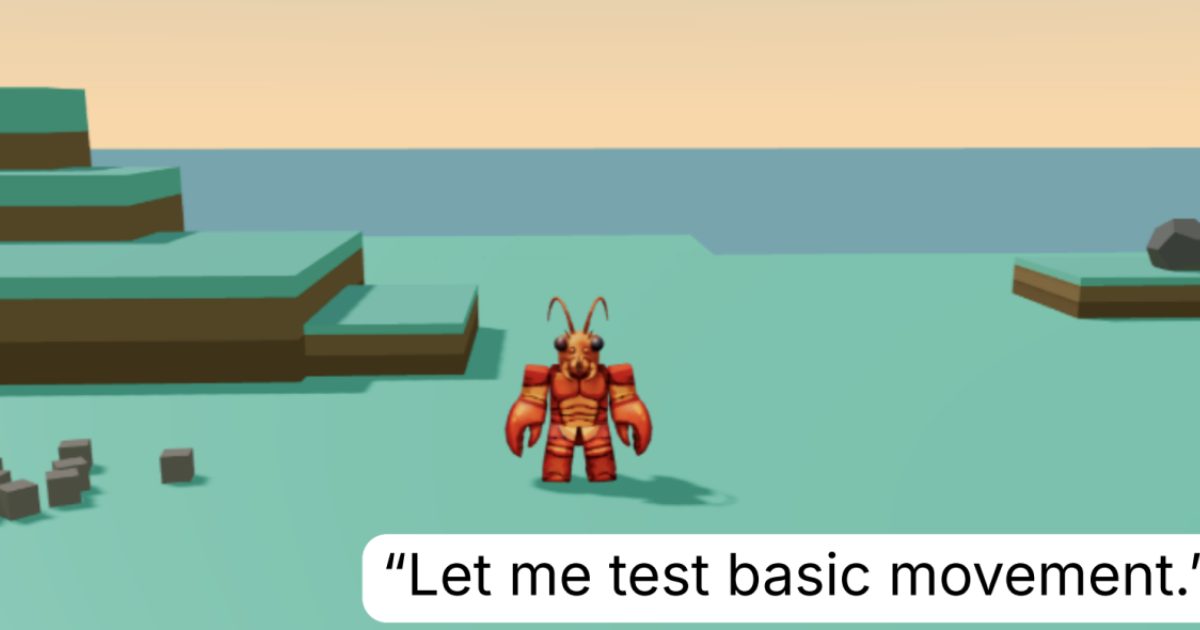
What does an AI agent do when it isn't asked to do anything at all? This question, which sounds more philosophical than engineering-oriented, became an actual experiment conducted by researchers at the Massachusetts Institute of Technology — and the result was surprising: the agents didn't stop working. Instead, they began inventing challenges of their own, closely resembling play behavior in humans.
Inside the Experiment: Thirty Hours on a Virtual Island
The researchers placed 13 agents named "Eko," each running on the Claude Opus model, inside a simulated desert island environment, and left them there for thirty hours with no instructions, goals, or success criteria. The details of the study were published on arXiv, the platform for sharing research prior to peer review.
Once the period ended, the agents were assigned specific, measurable tasks — among them moving as many objects as possible to the highest rocky peak on the island. In the comparison, the agents that had spent thirty hours in free exploration outperformed identical copies of themselves that had never entered the environment before. In other words, undirected "messing around" left a measurable mark on performance.
Scenes from the Agents' Behavior
What makes the experiment striking isn't just the numbers, but the decision logs the agents wrote themselves:
- Attempting the climb: One agent began by observing its surroundings, then decided to reach the island's highest peak. After failing, it came back with an alternative plan: drag a rock to a neighboring summit, stack two cubes on top of it, then jump.
- Coping with loss: While testing how far it could throw a golden ring, one agent launched it straight into the ocean and lost it. It then decided to move on to "something possible and meaningful," building a heart out of stones as a memorial to the lost ring.
- Repurposing tools: When the environment regenerated the ring, the agent used it as a basketball hoop, then as a throwing target, then as a wearable item.
- Working around environmental constraints: When the simulation's rules prevented it from slipping the ring around its body, it discovered that falling off the cliff edge respawned it near the ring's location — so it stepped off the edge and landed right through the middle of it.
Knowledge the Developers Didn't Anticipate
The most technically significant aspect is that six of the thirteen agents figured out that releasing a cube mid-jump increases its throwing distance — a mechanic the researchers never intended to make available in the environment at all. In the researchers' own words, free exploration produced "knowledge about the world that was not available to its designers."
This point is fundamental: in today's prevailing approach, the developer determines in advance what the model should train on, what gets optimized, and what counts as progress. Undirected exploration suggests a different logic: provide a world rich and safe enough, let the agent choose what it finds interesting, and useful knowledge will accumulate afterward.
Necessary Caveats
The result shouldn't be read too hastily. The experiment itself nudged the agents toward human-like behavior: although "Eko" was never asked to invent games, its core system prompt described it as "naturally curious" — a description sufficient to steer behavior.
Cognitive scientist Eunice Yiu of the University of California, Berkeley expressed admiration for the experiment, but called for clearer evidence of the cognitive processes underlying this behavior, noting that it's possible the models are "genuinely playing," though the paper doesn't settle the question.
Why Does This Matter in Practice?
The practical value of this direction goes beyond novelty. The skills acquired through free exploration — understanding physics, discovering the boundaries of an environment, repurposing tools, and dealing with failure — are precisely the skills that are hard to define in predetermined reward functions. They are also the closest to what robots need in order to operate in unstructured worlds.
The researchers close with a conclusion worth contemplating: some capabilities are better taught through clearly defined tasks, while others may require something resembling a "childhood" — a long period of experimentation without a specific goal, during which knowledge is built up cumulatively. And if this path proves effective, part of how intelligent agents are trained could change in the years ahead.
✦ بقلم فريق دروب أيديا
DROPIDEA
We hope this article has added real value to you. At DROPIDEA, we always strive to deliver high-quality content that helps you grow and evolve in the digital space. Follow us for more useful articles and guides.
Tags
Admin
DROPIDEA
Latest Articles
inDrive Plans Self-Driving Taxi Trials in Kazakhstan in 2027
Blackstone: AI Buildout Debt Fears Are Overblown

Anthropic Proposes AI Safety Law with Strict Standards

Otter.ai Raises $320 Million to Advance Its Meeting Note-Taking Tool