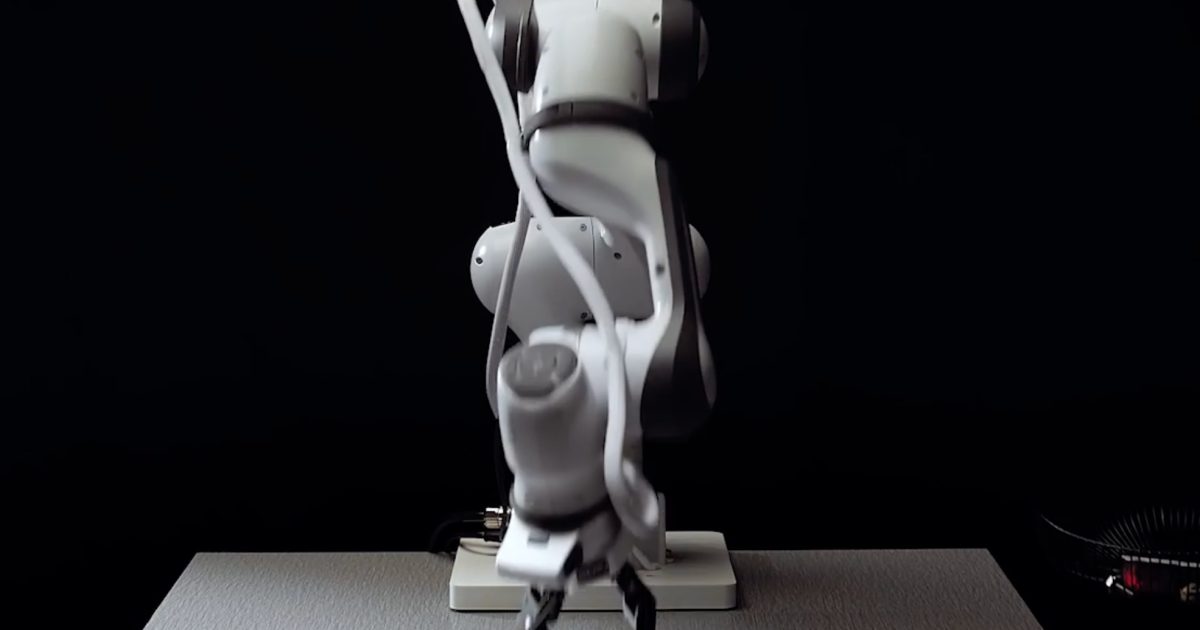
Despite the billions that have poured into the robotics sector in recent years, and despite the millions of hours of video footage that have fed deep learning models, one simple skill has continued to baffle machines: reliably grasping an object without dropping it or crushing it. This particular hurdle is precisely what a startup called Eka Robotics appears to have begun clearing — in a way that has prompted veteran researchers in the field to express their astonishment publicly.
A Massive Funding Round for an Early-Stage Company
The company announced the close of a $150 million Series A round, bringing its post-money valuation to $1.45 billion. The round was co-led by a16z and F-Prime. The company was founded by Pulkit Agrawal, a professor at MIT, and Tomas Harnoia, a former researcher at Google DeepMind. The two met during their graduate studies at the University of California, Berkeley, and are considered prominent names in the field of reinforcement learning for robotic control.
Raghu Raghuram, general partner at a16z and co-leader of the round, says the system's performance has already surpassed human capability on certain tasks, and he expects that edge to broaden to other fine-manipulation tasks in the coming months.
What Sets the Technical Demo Apart?
At a time when robotics promo reels are everywhere, Eka's results have caught the attention of academics not known for hyperbole. Chris Hauser, a professor at the University of Illinois Urbana-Champaign, described what he saw as qualitatively different from anything he had witnessed recently, pointing to the robot's ability to handle a large number of different objects without retraining — and to a slightly unsettling "human-like" behavior: it retries again and again if it fails the first time.
The numbers make the difference clear:
- Picking roughly 1,500 objects per hour weighing up to one kilogram, compared to about 600 objects for a human worker.
- A success rate exceeding 95% for reliable picking, according to the company.
- Movement speeds so high that the arm is capable of injuring itself — a sign of considerable confidence in the algorithm's stability.
A researcher at one of the leading labs, speaking on condition of anonymity, likened the experience to the moment robots achieved balanced walking years ago. He recounted offering the robot a raspberry — his lab's favorite test item — and it grasped it without crushing it. He then described the heavy arm approaching his body and slowing down at just the right moment before gently touching him.
From "Vision-Language-Action" to "Vision-Force-Action"
The key difference lies in the architecture of the foundation model. Most generative robotics models today belong to the "vision-language-action" category, meaning they learn the relationship between linguistic commands, visual inputs, and actions. Eka, by contrast, is building a "vision-force-action" model that focuses on the relationship between commands, force inputs, and motion.
Agrawal explains the logic: vision is not the primary means of solving the "last millimeter problem." It tells you roughly where an object is and how it's oriented, but the actual act of grasping and feeling happens through forces. This lends some credence to the arguments of critics such as Rodney Brooks, who warned that robotics models would stumble unless they represented touch and force.
A Different Hand and Large-Scale Simulation
To achieve this, the company designed a robotic hand that is more flexible than conventional grippers and equipped with a greater number of force sensors, so that it responds to contact in real time. The company is tight-lipped about implementation details for competitive reasons, but the core relies on a physics simulator that models the multiple forces a robot encounters while grasping, which is then used to build a reinforcement learning environment that can run at enormous scale. Eka says it can generate thousands of hours of "robot experience" in minutes.
The fundamental bet here is doing away with heavy reliance on human demonstration data collected by teleoperators or temporary workers. As Hauser notes, reinforcement learning allows a robot to exceed the quality of any human demonstration it was given, rather than remaining a prisoner of the limits of its training data.
Bridging the Gap Between Generality and Performance
Agrawal describes what his company is doing as bridging the "generality versus performance gap" that plagues modern robotics. The most generalizable models today can attempt many tasks but aren't good at any of them, while models specialized in a single task may not build a convincing commercial case.
The future Eka envisions is a division of labor: a large general model handles planning and decision-making — knowing, for instance, that dishes go into the cupboard after the dishwasher — while a model like Eka's handles the physical side, actually lifting the plate without breaking it. In that sense, the company's value isn't measured by machine intelligence alone, but by its ability to touch the world gently and quickly at the same time.
✦ بقلم فريق دروب أيديا
DROPIDEA
We hope this article has added real value to you. At DROPIDEA, we always strive to deliver high-quality content that helps you grow and evolve in the digital space. Follow us for more useful articles and guides.
Tags
Admin
DROPIDEA
Latest Articles

Otter.ai Raises $320 Million to Advance Its Meeting Note-Taking Tool
Washington Orders Federal Agencies to Remove Chinese DeepSeek Models
Figma Expands MCP Support Amid Its Co-Founder's Reservations About the Protocol
An AI Model Decodes the Electrical Signals in Plants