Talk of a "conversation" between humans and plants may sound like fiction, but a group of researchers and investors see it as a serious technological opportunity. Contrary to what we might assume, plants are not entirely silent organisms; fine electrical pulses run through their living tissues, shifting with thirst, insufficient light, or root stress. The question that captivated a startup called Electric Plant was: what if we could read these pulses and translate them into information a farmer can understand?
From a Passing Scientific Paper to a Startup
The story began when one of the founders came across a scientific paper describing a simple yet striking experiment: a houseplant connected to sensors and a moving platform. The electrical signals flowing through the plant's tissues were read by a control board, which pushed the platform toward the light source whenever the plant "asked" for more. That experiment became the launching point for a much broader project.
The founder later teamed up with a neuroscientist who had previously worked on projects linked to the U.S. Defense Advanced Research Projects Agency (DARPA). Together they launched the company, which spent three years gathering biological data to train a model they named "Bombadil" — a large model dedicated to interpreting bioelectrical signals in plants.
New Funding to Push the Technology to Market
The company raised a $11.2 million seed round led by Onto Ventures and Climactic, with participation from several funds and individual investors. The funding is expected to go toward scaling sensor production and commercializing the model among farmers and forest managers.
Why Aren't Existing Tools Enough?
Farmers today rely on tools such as soil probes, handheld spectrometers, and satellite imagery. These tools are engineered to a high standard, but they share a fundamental limitation: they measure the plant's external environment or its outward appearance, without reaching its internal state. The result is that information often arrives later than the moment the plant actually needs water or nutrients.
The idea the company puts forward is a shift from "indirect inference" to "direct reading" of the physiological state inside the stem.
How Do the Sensors Work?
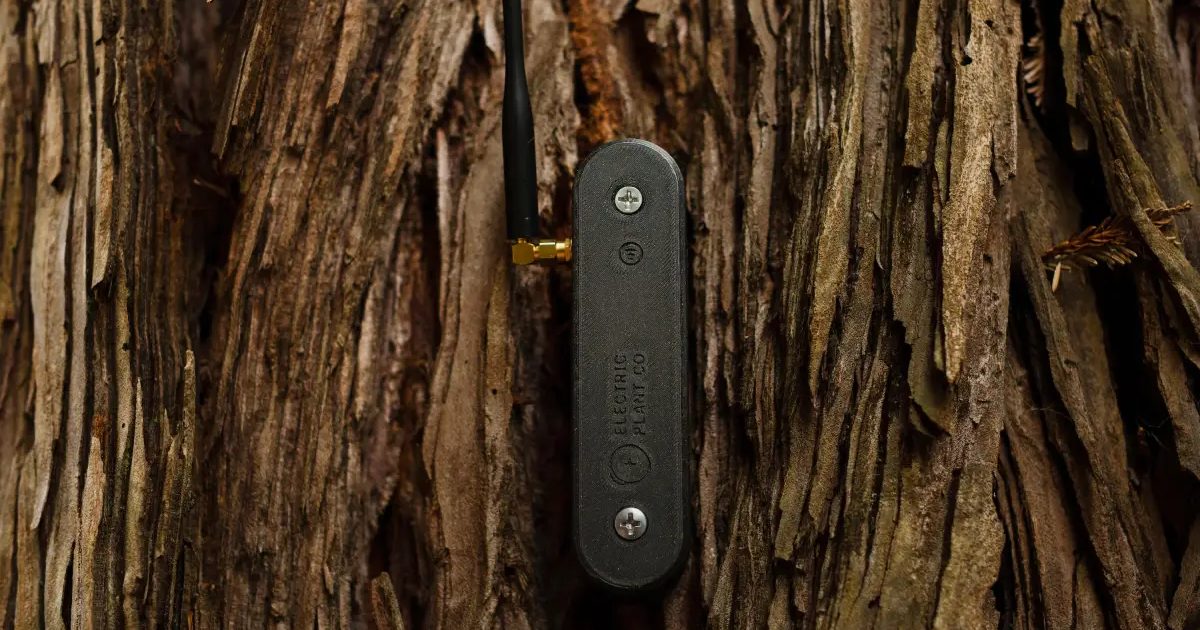
The device is about the size of a smartphone folded lengthwise, and it attaches to the plant with stainless steel screws. The screws must penetrate the cambium layer — the living tissue located directly beneath the bark — because that is where electrical changes are measured in microvolts. The readings are then transmitted to a base unit over a low-power wireless network, and from there to the cloud, where the model analyzes them and returns the results to the user.
- According to the company, just a few sensors per acre are enough to obtain accurate representative readings.
- The cost of a single sensor is measured in tens of dollars, compared with thousands of dollars for some conventional tools.
- The model was trained on roughly 125 plant species, ranging from ferns and sequoias to tomatoes and dahlias.
- The company speaks of the potential to improve yields while cutting water consumption by 20% or more.
A Striking Paradox in the Training
One methodological curiosity in this project is that the company had to use those very same conventional tools — soil probes and spectrometers — to generate the reference data for training the model. In other words, the new technology was built on the shoulders of the technologies it aspires to surpass, a recurring pattern in the development of applied AI systems.
A Cautious Reading of the Promises
The company describes its model as the most versatile to date in the field of bioelectrical signals. Even so, some questions remain open: the company has not disclosed the identity of its first customers, and the figures on yield improvement and water savings come from the company itself and have not yet been reviewed by independent parties. Verifying how well the technology generalizes across different climates and soil conditions remains an essential prerequisite before judging its viability.
What stands out in the statements is a measured restraint: the founders say they are "listening more than they are talking," and that listening is the first step. That is an accurate description of what is actually happening; this is an attempt to build a dictionary of biological signals, not a two-way dialogue with a plant.
Why Does This Direction Matter?
As pressures from water scarcity and climate change mount, agriculture is moving toward models built on more precise data and faster decisions. If this kind of inexpensive sensor succeeds in delivering reliable real-time readings, it could become a practical tool for optimizing irrigation and fertilization rather than merely an amusing scientific experiment. As for extending the approach to other living organisms, as the founders hint, that proposition needs considerably more evidence before it can be taken seriously.
✦ بقلم فريق دروب أيديا
DROPIDEA
We hope this article has added real value to you. At DROPIDEA, we always strive to deliver high-quality content that helps you grow and evolve in the digital space. Follow us for more useful articles and guides.
Tags
Admin
DROPIDEA
Latest Articles

Otter.ai Raises $320 Million to Advance Its Meeting Note-Taking Tool
Eka at $1.45 Billion: A Physical Model That Redefines the Robot's Grip

Washington Orders Federal Agencies to Remove Chinese DeepSeek Models

Figma Expands MCP Support Amid Its Co-Founder's Reservations About the Protocol