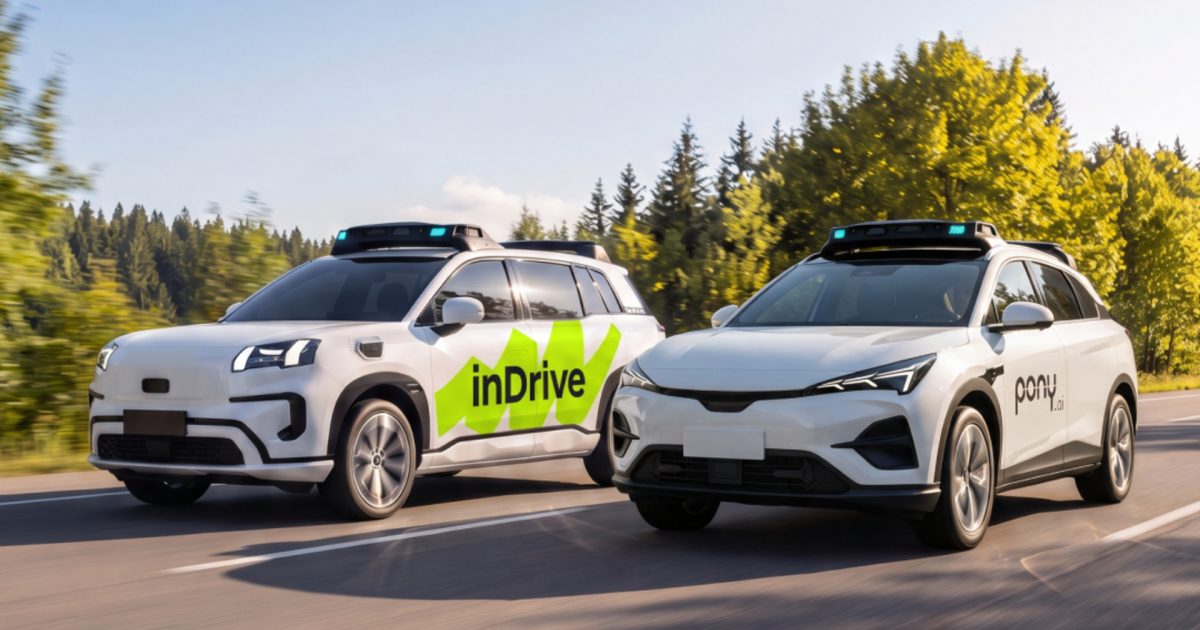
Autonomous driving technology is heading into new markets beyond the United States and China — this time across Central Asia. Smart mobility company inDrive — the well-known Uber rival that lets riders and drivers negotiate fares — has announced a joint plan with Chinese autonomous driving specialist Pony.ai and Nvidia to launch self-driving taxi (robotaxi) trials in Kazakhstan in 2027.
Details of the three-way agreement
The three parties signed a memorandum of understanding to explore integrating Pony.ai's autonomous vehicles into the inDrive platform. According to Yuri Mesnik, the company's chief technology officer, testing will begin in the capital, Astana, during the first half of 2027, with a safety operator on board during the initial phase, and the ultimate goal being fully driverless rides.
Responsibilities in the project break down as follows:
- Pony.ai: Supplying its seventh-generation fleet of vehicles purpose-built for autonomous operation.
- inDrive: Making rides available through its app and managing operations within Kazakhstan.
- Nvidia: Providing the underlying AI technology, including the Hyperion platform and the Halos safety system.
Why Astana specifically?
The choice of the Kazakh capital looks more calculated than a mere geographic courtesy. The city, home to roughly 1.7 million people, endures long months of snow and ice — conditions that pose a punishing test for the sensor and computer vision systems autonomous vehicles rely on.
Arsen Tomsky, inDrive's founder and CEO, believes that succeeding in such a demanding winter environment will give the company practical insights applicable to other cities facing similar climate challenges. In other words, what works in Astana will work in most cold-weather cities.
There's also an important regulatory factor: Kazakhstan recently announced a plan to operate autonomous transport services in 2027, with trials beginning in Astana and two other cities, and has approved a regulatory framework permitting autonomous vehicle testing on designated public roads.
Robotaxi economics in emerging markets
The biggest challenge in emerging markets isn't purely technical — it comes down to cost. Ride-hailing prices in these markets are already low, which means any autonomous service must compete on price, not just novelty.
This is where Nvidia's Hyperion platform comes in, offering companies a ready-made bundle of sensors and compute units instead of building and integrating every component from scratch — cutting development costs and time to market. Nvidia also provides tools for generating synthetic training data and testing driving systems across a wide range of scenarios, which is critical when dealing with rare edge cases such as ice-covered roads.
For its part, inDrive stresses that its model is inherently "capital-light": it prefers partnerships with specialized players in each market rather than owning fleets and developing technology in-house.
A widening autonomous driving race
The move is part of a broader wave of ride-hailing companies expanding into robotaxis. Uber has announced plans to test Pony.ai vehicles in London, alongside supervised autonomous ride trials with British company Wayve, as well as multiple partnerships in other markets, including the Middle East.
Pony.ai, meanwhile, is pushing beyond its home market, aiming to operate more than 3,500 autonomous vehicles across over 20 cities worldwide by the end of 2026 — up from a fleet of around 1,975 vehicles in the middle of last year.
Kazakhstan isn't inDrive's only stop in this space; the company has signed a separate agreement with a Saudi entity to explore operating autonomous vehicles built on Chinese company WeRide's technology, starting in Riyadh. inDrive says it is evaluating additional markets, while stressing that the first prerequisite for success is a cooperative regulatory environment that allows for safe, sustainable on-road testing.
Reading the signals
inDrive currently operates in more than 1,200 cities across 47 countries, and has expanded into delivery, intercity transport and financial services. In that light, its move into autonomous driving looks like a logical extension of its strategy rather than a standalone gamble.
More importantly, the partnership sends a clear signal: robotaxi technology is no longer the exclusive preserve of San Francisco and Shenzhen. As the cost of off-the-shelf technology platforms falls and regulatory frameworks take shape, markets such as Central Asia and the Gulf are becoming genuine testing grounds — and perhaps commercial operating markets sooner than expected.
✦ بقلم فريق دروب أيديا
DROPIDEA
We hope this article has added real value to you. At DROPIDEA, we always strive to deliver high-quality content that helps you grow and evolve in the digital space. Follow us for more useful articles and guides.
Tags
Admin
DROPIDEA
Latest Articles

When AI Agents Are Left Without a Task… They Start to Play

Blackstone: AI Buildout Debt Fears Are Overblown

Anthropic Proposes AI Safety Law with Strict Standards

Otter.ai Raises $320 Million to Advance Its Meeting Note-Taking Tool