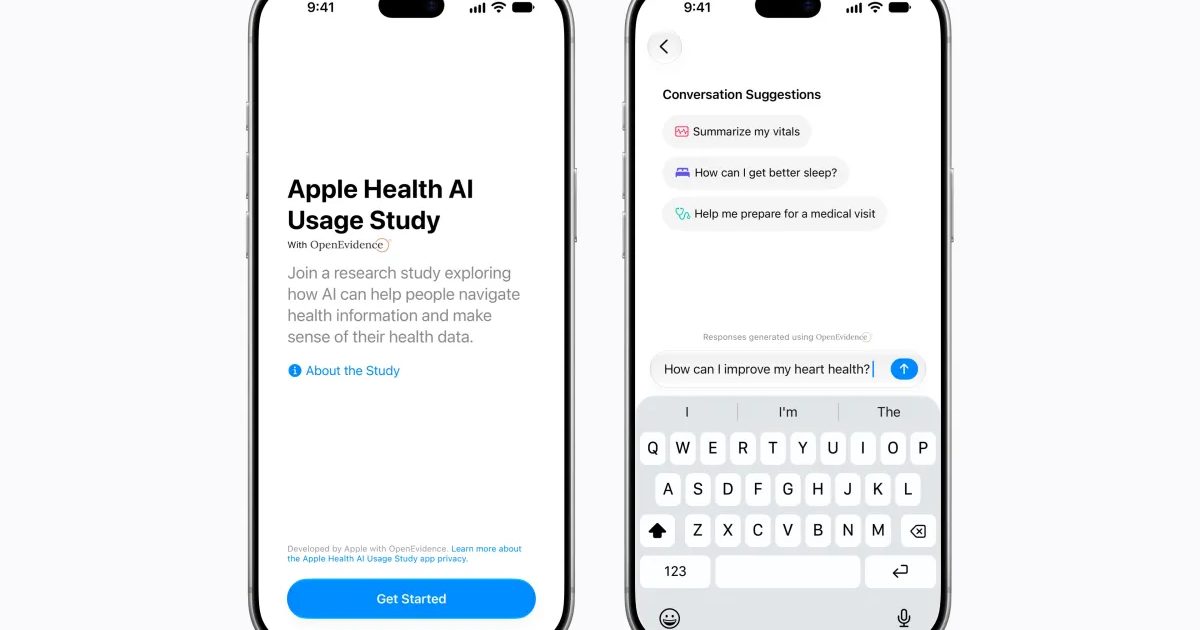
While major AI labs race to deliver chatbots capable of answering health questions, Apple has chosen a different path: starting with scientific research before the product. The company has announced a new study app aimed at understanding how people pose their health questions to AI systems, and how they interpret the answers and assess their reliability in daily life.
A Partnership with OpenEvidence
Apple is collaborating on this project with OpenEvidence, a company specializing in medical artificial intelligence. The app draws on documented clinical content grounded in well-known scientific references, including The New England Journal of Medicine, JAMA, and Nature, rather than relying solely on the output of a general-purpose language model that may produce inaccurate information.
The core idea here is not to offer a commercial health assistant, but to measure user behavior: What questions do people ask? Do simplified answers genuinely help them understand? And do they prompt them to take better health-related steps?
Participation Requirements
Apple has set out a number of requirements for joining the study:
- Residence in the United States and an age above 21.
- Use of an iPhone 15 or newer.
- Running iOS 26 or a later version.
- Apple Intelligence features enabled on the device.
The company hopes to enroll up to 200,000 participants, with the study running for more than twelve months, allowing for the collection of long-term data on usage patterns rather than mere snapshots.
How Does the App Work?
Participants can ask their health questions in the same way they would speak to any chatbot, then receive a simplified answer grounded in clinical sources. They are then asked to rate the answer and provide feedback on how clear and useful it was, in addition to taking part in monthly surveys.
Users can also choose to share data from the HealthKit platform, such as resting heart rate, physical activity levels, sleep patterns, and lab test results, in order to receive more personalized guidance. Apple says the app may also help users prepare for a doctor's visit with more precise questions, while directing them to specialists when medical concerns arise.
Privacy and Data Handling
Apple explained that data is stripped of identifying information before being sent to a secure third-party cloud provider, and that it will not be used to train any AI models. It added that OpenEvidence deletes question-and-answer data 24 hours after processing it.
Commenting on the project, Dr. Sumbul Desai, Apple's Vice President of Health and Fitness, affirmed that responsible innovation begins with scientific rigor and clinical grounding, and that because health is deeply personal, conducting a dedicated research study is the most sensible way to understand how people interact with and evaluate health AI. She noted that the study's findings will feed into the broader scientific conversation and help build trustworthy tools.
Reading the Timing and the Opportunity
The app is available to download in the United States starting today, but Apple has not yet clarified whether it intends to integrate these capabilities into the Health app or into its Siri assistant. Even so, the scale of demand points to an enormous opportunity: OpenAI reported earlier this year that users ask more than 300 million health questions every week.
The most significant aspect of Apple's move is its methodology: instead of rushing out a health assistant and competing on features, the company is choosing to gather publishable evidence about user behavior and quality of comprehension. It is a slower approach, but one that gives it a firmer regulatory and scientific foundation should it later decide to turn the experiment into a broad consumer product.
What Does This Mean for the Market?
Competition in health AI is shifting from the mere "ability to answer" toward "verifiability": where did the information come from, who is accountable for it, and how is user data protected. In that sense, Apple's study may set a benchmark for other companies looking to enter this sensitive field on the strength of user trust rather than sheer speed to launch.
✦ بقلم فريق دروب أيديا
DROPIDEA
We hope this article has added real value to you. At DROPIDEA, we always strive to deliver high-quality content that helps you grow and evolve in the digital space. Follow us for more useful articles and guides.
Tags
Admin
DROPIDEA
Latest Articles
Indian Startup Raises $24 Million for Smart Image Sensors

LangChain Valued at $3 Billion After New Funding Round

Jensen Huang's Departure Leaves a Funding Gap in the AI Startup Market

The Jensen Huang Crisis: A Personal Scandal Turns Into a National Security Case