Ir al contenido
ImágenesGratis

Prompt de tabla de diseño de vehículo cinematográfico

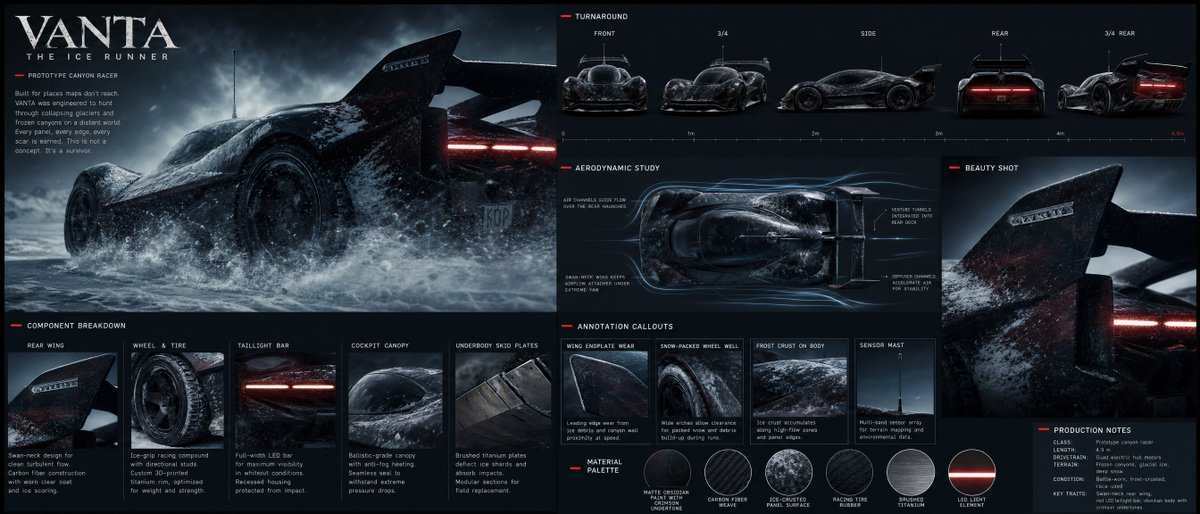
Un prompt completo en inglés para crear una tabla de diseño cinematográfica y realista del prototipo VANTA: toma principal, vuelta de cinco vistas, estudio aerodinámico, toma de belleza, desglose de componentes, muestras de materiales y notas de producción. Requiere una imagen de referencia adjunta.

OpenAI

Ejemplos de la fuente

Estas imágenes provienen de la fuente original. DROPIDEA no ha probado estos ejemplos; los resultados dependen del modelo y los ajustes.

Listo para personalizar

Tu prompt

Inglés

Sustituye las variables en rojo por tus datos. Copia el texto completo y úsalo con tu agente preferido.

TXT MD Versión en inglés
Car character sheet prompt by ChatGPT Image 2 : Create a cinematic realistic vehicle design board for a high-budget film production. Avoid generic grids, perfect symmetry, or template-style layouts. The composition should feel art-directed, slightly asymmetrical, and visually intentional like a premium movie pitch presentation. Design a futuristic prototype racing machine with grounded engineering logic, believable aerodynamic construction, weathered surfaces, and real-world material behavior. VEHICLE: VANTA — THE ICE RUNNER A prototype canyon racer built for frozen alien terrain. Low-slung monocoque hull in matte obsidian black with deep crimson undertones surfacing through the paint. Every panel carries frost crust, snow spray residue, and micro-scratches from ice debris. Built to survive collapsing glaciers, not showrooms. Visual description: Low aggressive silhouette with sculpted rear haunches and wide muscular fenders. Oversized swan-neck rear wing with sharp angular endplates, carbon fiber construction with worn edges. Slim horizontal LED taillight bar glowing warm red. Wide low-profile racing tires with ice-grip tread, snow packed into the wheel wells. Sensor mast antenna on the roofline. Enclosed cockpit canopy in dark tinted glass. Underbody skid plates in brushed titanium with scrape marks. Bodywork partially crusted in ice and blown snow. Include: * Large hero shot on the left (rear three-quarter, low angle, snow spray kicking off the rear tires) with the vehicle name as stylized typography header and the backstory blurb in small caption type beside it * Full vehicle turnaround — five views labeled FRONT, 3/4, SIDE, REAR, 3/4 REAR — with a length reference scale ruler in meters * Aerodynamic study panel — top-down view with airflow annotation lines over the wing and hull * Cinematic beauty shot — medium close-up on the rear wing and taillight bar, shallow depth of field, frost detail * Component breakdown — close-up details of the rear wing, wheel and tire, taillight bar, cockpit canopy, and underbody skid plates with caption notes * Material texture realism — six circular material swatches showing matte black paint with crimson undertone, carbon fiber weave, ice-crusted panel surface, racing tire rubber, brushed titanium, and LED light element * Annotation callouts — close-ups of key features (wing endplate wear, snow-packed wheel well, frost crust on body panel, sensor mast) * Production notes block Production notes: - Class: Prototype canyon racer - Length: 4.9 m - Drivetrain: Quad electric hub motors - Terrain: Frozen canyons, glacial ice, deep snow - Condition: Battle-worn, frost-crusted, race-used - Key traits: Swan-neck rear wing, red LED taillight bar, obsidian body with crimson undertones The vehicle should feel like a real machine captured mid-campaign, not a clean showroom render. Surfaces carry history — frost, scrapes, snow residue. Style: Photorealistic cinematic vehicle design, film-production quality, cold overcast arctic lighting with steel-blue grade and deep blacks, realistic materials, shallow depth of field on detail shots, premium studio presentation aesthetic. Background: dark moody environment with subtle frozen atmospheric haze, deep blacks, faint cold rim light. Typography: clean editorial sans-serif for labels and section headers, larger stylized display or serif treatment for the vehicle name. Important: Maintain strict consistency in silhouette, wing shape, body color, taillight design, wheel design, and weathering details across every angle and section. Maintain exact vehicle match to the attached reference image — same silhouette, rear wing geometry, body color with crimson undertones, taillight signature, snow weathering, and cold steel-blue color grade. Use the attached image as canonical vehicle DNA across all turnaround views, detail panels, and the beauty shot. Do not invent alternate body variants or drift from the reference.
Ver resultados

Tu prompt

Car character sheet prompt by ChatGPT Image 2 : Create a cinematic realistic vehicle design board for a high-budget film production. Avoid generic grids, perfect symmetry, or template-style layouts. The composition should feel art-directed, slightly asymmetrical, and visually intentional like a premium movie pitch presentation. Design a futuristic prototype racing machine with grounded engineering logic, believable aerodynamic construction, weathered surfaces, and real-world material behavior. VEHICLE: VANTA — THE ICE RUNNER A prototype canyon racer built for frozen alien terrain. Low-slung monocoque hull in matte obsidian black with deep crimson undertones surfacing through the paint. Every panel carries frost crust, snow spray residue, and micro-scratches from ice debris. Built to survive collapsing glaciers, not showrooms. Visual description: Low aggressive silhouette with sculpted rear haunches and wide muscular fenders. Oversized swan-neck rear wing with sharp angular endplates, carbon fiber construction with worn edges. Slim horizontal LED taillight bar glowing warm red. Wide low-profile racing tires with ice-grip tread, snow packed into the wheel wells. Sensor mast antenna on the roofline. Enclosed cockpit canopy in dark tinted glass. Underbody skid plates in brushed titanium with scrape marks. Bodywork partially crusted in ice and blown snow. Include: * Large hero shot on the left (rear three-quarter, low angle, snow spray kicking off the rear tires) with the vehicle name as stylized typography header and the backstory blurb in small caption type beside it * Full vehicle turnaround — five views labeled FRONT, 3/4, SIDE, REAR, 3/4 REAR — with a length reference scale ruler in meters * Aerodynamic study panel — top-down view with airflow annotation lines over the wing and hull * Cinematic beauty shot — medium close-up on the rear wing and taillight bar, shallow depth of field, frost detail * Component breakdown — close-up details of the rear wing, wheel and tire, taillight bar, cockpit canopy, and underbody skid plates with caption notes * Material texture realism — six circular material swatches showing matte black paint with crimson undertone, carbon fiber weave, ice-crusted panel surface, racing tire rubber, brushed titanium, and LED light element * Annotation callouts — close-ups of key features (wing endplate wear, snow-packed wheel well, frost crust on body panel, sensor mast) * Production notes block Production notes: - Class: Prototype canyon racer - Length: 4.9 m - Drivetrain: Quad electric hub motors - Terrain: Frozen canyons, glacial ice, deep snow - Condition: Battle-worn, frost-crusted, race-used - Key traits: Swan-neck rear wing, red LED taillight bar, obsidian body with crimson undertones The vehicle should feel like a real machine captured mid-campaign, not a clean showroom render. Surfaces carry history — frost, scrapes, snow residue. Style: Photorealistic cinematic vehicle design, film-production quality, cold overcast arctic lighting with steel-blue grade and deep blacks, realistic materials, shallow depth of field on detail shots, premium studio presentation aesthetic. Background: dark moody environment with subtle frozen atmospheric haze, deep blacks, faint cold rim light. Typography: clean editorial sans-serif for labels and section headers, larger stylized display or serif treatment for the vehicle name. Important: Maintain strict consistency in silhouette, wing shape, body color, taillight design, wheel design, and weathering details across every angle and section. Maintain exact vehicle match to the attached reference image — same silhouette, rear wing geometry, body color with crimson undertones, taillight signature, snow weathering, and cold steel-blue color grade. Use the attached image as canonical vehicle DNA across all turnaround views, detail panels, and the beauty shot. Do not invent alternate body variants or drift from the reference.

Guía de variables

VANTA — THE ICE RUNNER

El nombre del vehículo en el encabezado tipográfico

La línea que empieza con «المركبة:» y el encabezado de la toma principal en la plantilla árabe

Valor de ejemplo

ONYX — THE DUNE STRIDER

Built to survive collapsing glaciers, not showrooms.

La frase de trasfondo que aparece junto a la toma principal

Al final del párrafo de descripción del vehículo, antes de «الوصف البصري:» en la plantilla árabe

Valor de ejemplo

Construido para resistir tormentas de arena eternas, no calles urbanas.

Prototype canyon racer

La clase de vehículo en las notas de producción

La línea «- الفئة:» bajo «ملاحظات الإنتاج:» en la plantilla árabe

Valor de ejemplo

Camión prototipo de exploración desértica

Qué obtienes

  • Una tabla de diseño de vehículo fotorrealista y cinematográfica con estética de producción premium
  • Una toma principal trasera de tres cuartos en ángulo bajo con tipografía estilizada y texto de trasfondo
  • Una vuelta de cinco vistas etiquetadas FRONT, 3/4, SIDE, REAR, 3/4 REAR con regla de escala en metros
  • Un estudio aerodinámico en vista cenital con líneas de flujo de aire y una toma de belleza cinematográfica con poca profundidad de campo
  • Desglose de componentes, seis muestras circulares de materiales, llamadas de anotación y bloque de notas de producción
  • Superficies desgastadas con escarcha, rasguños y residuos de nieve bajo iluminación ártica fría con grado azul acero

Casos de uso

  • Tablas de diseño de vehículos para producciones cinematográficas de gran presupuesto y presentaciones de pitch
  • Hojas de personaje de vehículos para videojuegos, cómics y ciencia ficción
  • Tablas conceptuales para estudios de diseño de vehículos y flujos de modelado 3D
  • Documentación de diseño industrial de vehículos prototipo con estilo profesional

Cómo usarlo

  • Sube una imagen de referencia del vehículo previsto; el prompt la exige como ADN canónico para la coherencia de silueta, alerón, color y desgaste
  • Sustituye VEHICLE_NAME por el nombre de tu vehículo manteniendo el guion largo y edita la frase VEHICLE_BACKSTORY según su historia
  • Ajusta VEHICLE_CLASS en las notas de producción si diseñas otro tipo de vehículo, conservando valores técnicos como la longitud 4.9 m salvo que cambien tus especificaciones
  • Pega el prompt completo junto con la imagen de referencia en tu generador de imágenes y ejecútalo
  • Revisa el resultado verificando la coherencia estricta de silueta, forma del alerón, color de carrocería, diseño de luz trasera y diseño de ruedas en todos los ángulos y secciones

Prompts relacionados