Ir al contenido
ImágenesGratis

Prompt de infografía anatómica de hormiga enciclopédica

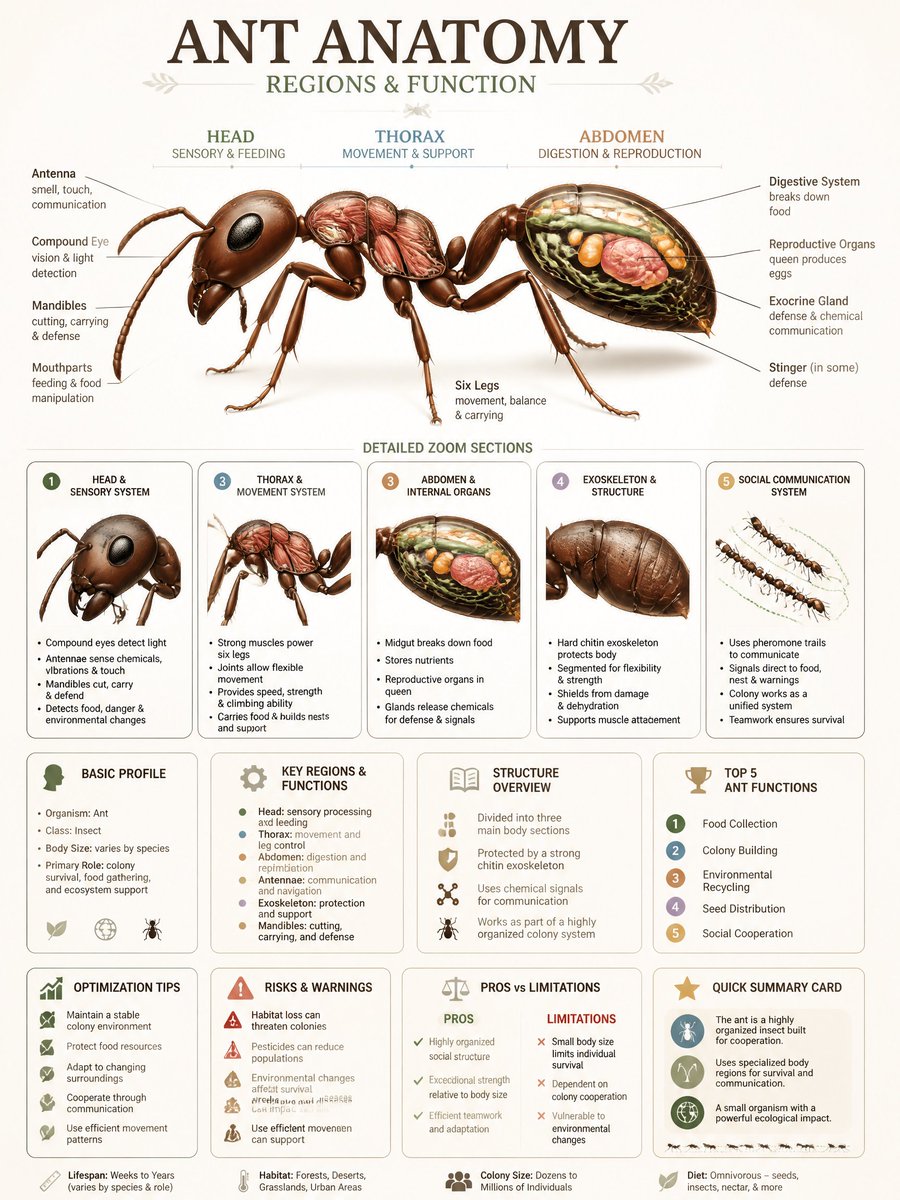
Un prompt de imagen con estilo de lujoso libro de historia natural e infografía editorial moderna: ilustración anatómica detallada de una hormiga con paneles ampliados de sus regiones corporales y funciones, más paneles informativos organizados, consejos, riesgos y una tarjeta de resumen rápido. Ideal para contenido educativo y científico.

OpenAI

Ejemplos de la fuente

Estas imágenes provienen de la fuente original. DROPIDEA no ha probado estos ejemplos; los resultados dependen del modelo y los ajustes.

Listo para personalizar

Tu prompt

Inglés

Sustituye las variables en rojo por tus datos. Copia el texto completo y úsalo con tu agente preferido.

TXT MD Versión en inglés
Encyclopedia Infographics GPT Image 2 on @TapNow_AI prompt { "type": "image_prompt", "title": "Ant Anatomy Regions & Function", "style": { "overall": "premium natural-history guidebook meets modern editorial infographic", "tone": "educational, refined, collectible, highly structured", "background": "clean light-colored", "palette": "soft, elegant, muted scientific tones (earth browns, warm grays, subtle greens, gentle blues)", "lighting": "gentle shadows, soft highlights", "layout": "vertical, modular, high information density but uncluttered" }, "composition": { "main_subject": { "type": "detailed anatomical illustration", "description": "highly detailed ant with clearly defined body segments, internal organs, legs, antennae, and biological structures", "style": "semi-realistic scientific illustration with soft shading", "placement": "upper-middle focal area", "labels": "major ant regions labeled with fine callouts" }, "zoom_sections": [ { "focus": "head and sensory system", "description": "zoomed-in panel showing compound eyes, antennae, mandibles, communication, and environmental sensing" }, { "focus": "thorax and movement system", "description": "zoomed-in panel showing muscles, six legs, joints, and powerful movement mechanics" }, { "focus": "abdomen and internal organs", "description": "zoomed-in panel showing digestive system, reproductive organs, and defensive functions" }, { "focus": "exoskeleton", "description": "detailed view showing protective outer shell, body segments, and structural strength" }, { "focus": "social communication system", "description": "panel showing pheromone trails, colony communication, and teamwork behavior" } ], "info_panels": [ { "title": "Basic Profile", "content": [ "Organism: Ant", "Class: Insect", "Body Size: varies by species", "Primary Role: colony survival, food gathering, and ecosystem support" ] }, { "title": "Key Regions & Functions", "content": [ "Head: sensory processing and feeding", "Thorax: movement and leg control", "Abdomen: digestion and reproduction", "Antennae: communication and navigation", "Exoskeleton: protection and support", "Mandibles: cutting, carrying, and defense" ] }, { "title": "Structure Overview", "content": [ "Divided into three main body sections", "Protected by a strong chitin exoskeleton", "Uses chemical signals for communication", "Works as part of a highly organized colony system" ] }, { "title": "Top 5 Ant Functions", "content": [ "Food Collection", "Colony Building", "Environmental Recycling", "Seed Distribution", "Social Cooperation" ], "visual_style": "ranked list or icon-based scoring" }, { "title": "Optimization Tips", "content": [ "Maintain a stable colony environment", "Protect food resources", "Adapt to changing surroundings", "Cooperate through communication", "Use efficient movement patterns" ] }, { "title": "Risks & Warnings", "content": [ "Habitat loss can threaten colonies", "Pesticides can reduce populations", "Environmental changes affect survival", "Predators and diseases can impact colonies" ] }, { "title": "Pros vs Limitations", "content": { "pros": [ "Highly organized social structure", "Exceptional strength relative to body size", "Efficient teamwork and adaptation" ], "cons": [ "Small body size limits individual survival", "Dependent on colony cooperation", "Vulnerable to environmental changes" ] } }, { "title": "Quick Summary Card", "content": [ "The ant is a highly organized insect built for cooperation", "Uses specialized body regions for survival and communication", "A small organism with a powerful ecological impact" ], "visual_style": "highlight box with icons" } ] }, "visual_elements": { "icons": "small, refined, minimal scientific icons", "boxes": "rounded corners with subtle borders", "typography": { "title": "large, elegant, high contrast", "subheadings": "clear hierarchy", "body": "clean, readable, compact" }, "connectors": "thin lines linking labels to ant regions", "decor": "subtle grid or editorial alignment guides" }, "design_goals": [ "knowledge integration", "modular information design", "encyclopedia-style clarity", "high readability", "shareable infographic aesthetic", "non-commercial, reference-style presentation" ] }
Ver resultados

Tu prompt

Encyclopedia Infographics GPT Image 2 on @TapNow_AI prompt { "type": "image_prompt", "title": "Ant Anatomy Regions & Function", "style": { "overall": "premium natural-history guidebook meets modern editorial infographic", "tone": "educational, refined, collectible, highly structured", "background": "clean light-colored", "palette": "soft, elegant, muted scientific tones (earth browns, warm grays, subtle greens, gentle blues)", "lighting": "gentle shadows, soft highlights", "layout": "vertical, modular, high information density but uncluttered" }, "composition": { "main_subject": { "type": "detailed anatomical illustration", "description": "highly detailed ant with clearly defined body segments, internal organs, legs, antennae, and biological structures", "style": "semi-realistic scientific illustration with soft shading", "placement": "upper-middle focal area", "labels": "major ant regions labeled with fine callouts" }, "zoom_sections": [ { "focus": "head and sensory system", "description": "zoomed-in panel showing compound eyes, antennae, mandibles, communication, and environmental sensing" }, { "focus": "thorax and movement system", "description": "zoomed-in panel showing muscles, six legs, joints, and powerful movement mechanics" }, { "focus": "abdomen and internal organs", "description": "zoomed-in panel showing digestive system, reproductive organs, and defensive functions" }, { "focus": "exoskeleton", "description": "detailed view showing protective outer shell, body segments, and structural strength" }, { "focus": "social communication system", "description": "panel showing pheromone trails, colony communication, and teamwork behavior" } ], "info_panels": [ { "title": "Basic Profile", "content": [ "Organism: Ant", "Class: Insect", "Body Size: varies by species", "Primary Role: colony survival, food gathering, and ecosystem support" ] }, { "title": "Key Regions & Functions", "content": [ "Head: sensory processing and feeding", "Thorax: movement and leg control", "Abdomen: digestion and reproduction", "Antennae: communication and navigation", "Exoskeleton: protection and support", "Mandibles: cutting, carrying, and defense" ] }, { "title": "Structure Overview", "content": [ "Divided into three main body sections", "Protected by a strong chitin exoskeleton", "Uses chemical signals for communication", "Works as part of a highly organized colony system" ] }, { "title": "Top 5 Ant Functions", "content": [ "Food Collection", "Colony Building", "Environmental Recycling", "Seed Distribution", "Social Cooperation" ], "visual_style": "ranked list or icon-based scoring" }, { "title": "Optimization Tips", "content": [ "Maintain a stable colony environment", "Protect food resources", "Adapt to changing surroundings", "Cooperate through communication", "Use efficient movement patterns" ] }, { "title": "Risks & Warnings", "content": [ "Habitat loss can threaten colonies", "Pesticides can reduce populations", "Environmental changes affect survival", "Predators and diseases can impact colonies" ] }, { "title": "Pros vs Limitations", "content": { "pros": [ "Highly organized social structure", "Exceptional strength relative to body size", "Efficient teamwork and adaptation" ], "cons": [ "Small body size limits individual survival", "Dependent on colony cooperation", "Vulnerable to environmental changes" ] } }, { "title": "Quick Summary Card", "content": [ "The ant is a highly organized insect built for cooperation", "Uses specialized body regions for survival and communication", "A small organism with a powerful ecological impact" ], "visual_style": "highlight box with icons" } ] }, "visual_elements": { "icons": "small, refined, minimal scientific icons", "boxes": "rounded corners with subtle borders", "typography": { "title": "large, elegant, high contrast", "subheadings": "clear hierarchy", "body": "clean, readable, compact" }, "connectors": "thin lines linking labels to ant regions", "decor": "subtle grid or editorial alignment guides" }, "design_goals": [ "knowledge integration", "modular information design", "encyclopedia-style clarity", "high readability", "shareable infographic aesthetic", "non-commercial, reference-style presentation" ] }

Guía de variables

Ant Anatomy Regions & Function

El título de la infografía que aparece arriba

$.title en el objeto JSON raíz

Valor de ejemplo

Ant Anatomy Regions & Function

highly detailed ant with clearly defined body segments, internal organs, legs, antennae, and biological structures

Descripción de la ilustración anatómica principal

$.composition.main_subject.description

Valor de ejemplo

highly detailed ant with clearly defined body segments

soft, elegant, muted scientific tones (earth browns, warm grays, subtle greens, gentle blues)

La paleta científica suave del diseño

$.style.palette

Valor de ejemplo

earth browns, warm grays, subtle greens, gentle blues

clean light-colored

Descripción general del fondo de la imagen

$.style.background

Valor de ejemplo

clean light-colored

Qué obtienes

  • Una infografía enciclopédica vertical con estilo de lujoso libro de historia natural.
  • Una ilustración anatómica científica semirrealista de una hormiga con sombreado suave y etiquetas finas.
  • Cinco paneles ampliados: cabeza y sentidos, tórax y movimiento, abdomen y órganos, exoesqueleto y comunicación social.
  • Paneles informativos con perfil básico, funciones clave, consejos, riesgos, pros y contras, y una tarjeta de resumen rápido.
  • Iconos científicos mínimos, cajas redondeadas y líneas conectoras finas.

Casos de uso

  • Material educativo de biología de insectos para escuelas y universidades.
  • Publicaciones científicas simplificadas en redes sociales.
  • Tarjetas de referencia de estudio y pósters para compartir.
  • Contenido enciclopédico para una biblioteca digital de conocimiento.

Cómo usarlo

  • Copia la plantilla completa manteniendo intacta la estructura JSON.
  • Sustituye el título, la descripción del sujeto principal, la paleta y el fondo si quieres personalizar el organismo estudiado.
  • Pega la plantilla en la herramienta GPT Image 2 de @TapNow_AI.
  • Confirma que la salida requerida sea una infografía vertical y muy estructurada antes de generar.
  • Edita el contenido de los paneles informativos si necesitas datos de otra especie.
  • Regenera hasta obtener una versión equilibrada y sin saturación.

Prompts relacionados