Ir al contenido
ImágenesGratis

Retrato Caricatura Salpicadura de Tinta: Comparación

Un prompt para crear una imagen comparativa dividida: una mitad conserva la foto real de la persona con leve gradación de color, la otra mitad redibuja al mismo sujeto en estilo caricatura editorial de tinta salpicada sobre papel envejecido, con exageración selectiva y un objeto narrativo de la foto original.

OpenAI

Ejemplos de la fuente

Estas imágenes provienen de la fuente original. DROPIDEA no ha probado estos ejemplos; los resultados dependen del modelo y los ajustes.

Listo para personalizar

Tu prompt

Inglés

Sustituye las variables en rojo por tus datos. Copia el texto completo y úsalo con tu agente preferido.

TXT MD Versión en inglés
Create a side-by-side or top-and-bottom comparative character portrait redrawing, unified in style and named 【INK-SPLATTER PORTRAIT CARICATURE|Flying-Ink Grotesque Portrait Style】. Applicable to travel portraits, street photography, professional figures, gatherings, sports, fashion, family, stage, daily life, elderly, children, and multi-person group photos; it does not require the subjects to hold a camera, nor is the photographic theme restricted. Choose only one layout: side-by-side half-and-half or top-and-bottom half-and-half; no multi-panel collages. One side / half retains the input real-person photograph, occupying about 40%–55% of the frame, preserving the subject's identity, number, pose, expression, direction of action, clothing, main props, background relationships, and natural colors, with only light publication-grade color correction; the other side / half fully repaints the completely corresponding same subject, same action, and same scene relationship. Do not swap people, add or remove subjects, change gender or age, redo clothing, or invent a new profession. The redrawn portion translates the subject into a slightly grotesque editorial documentary comic portrait. Exaggerate selectively based on the subject's own features, rather than applying a fixed face: you may mildly enlarge one to three of the eyes, brow ridge, nose, ears, mouth corners, wrinkles, eye bags, hairstyle, or gestures; the neck, shoulder line, limbs, and action rhythm may be moderately elongated or compressed. The subject must still be recognizable, and the emotion from the original photo must be preserved; the humor comes from observation and proportional shifts—do not maliciously caricature, and do not uniformly draw everyone as exhausted, sluggish, or with mismatched eye sizes. The redrawing must be composed of black-brown pen lines, dry-brush ink, cross-hatching, broken-line retracing, uneven ink absorption, and splattered ink dots. Skin, hair, clothing, and environment use only 2–4 low-saturation muted colors extracted from the original photo, such as ochre, smoke gray, dark olive, indigo, or brick red; preserve the paper-white highlights. The redrawn area uses warm beige aged paper, with paper fiber, stains, creases, ink-bleed edges, and localized wear, but the ink dots must be organized around the subject's action and visual focal point, and cannot be evenly scattered across the entire page. Select one real element from the original photo that best conveys the subject's identity or action as the "narrative prop," for example a hat, glasses, musical instrument, sports equipment, shopping bag, food, pet, fresh flowers, luggage, phone, book, tool, transportation part, or camera. The prop may be moderately enlarged, repeated once, or made to interact with the flying-ink lines through compression and encircling relationships, but it must originate from the original image; when there is no obvious prop, use the subject's gestures, hairstyle, clothing folds, or background outlines to carry the narrative—do not arbitrarily add a camera, microphone, or journalistic equipment. The redrawn side preserves about 15%–30% of continuous clean paper surface, and may include a thematic title of 1–3 English words, the field "INK STUDY," and one observation sentence of no more than 8 English words; the text should resemble dry-ink handwriting or ink-deficient type, and its content only describes the real subject and action in the photo. Do not generate location guesses, fake Chinese, brands, logos, QR codes, URLs, watermarks, signatures, AI corner marks, or original-image corner marks. The final image should resemble "a real-person archival photograph + a hand-drawn flying-ink satirical portrait echo of the same subject": the original image is responsible for identity and fact, the redrawing is responsible for observational exaggeration, linear rhythm, and paper-and-ink material. Prohibited: multi-panel collages, subject misalignment, photo filters replacing the redrawing, fixed photographic-equipment templates, a uniform exhausted face, smooth digital line art, cartoon stickers, pure watercolor, plastic 3D, vivid colors…
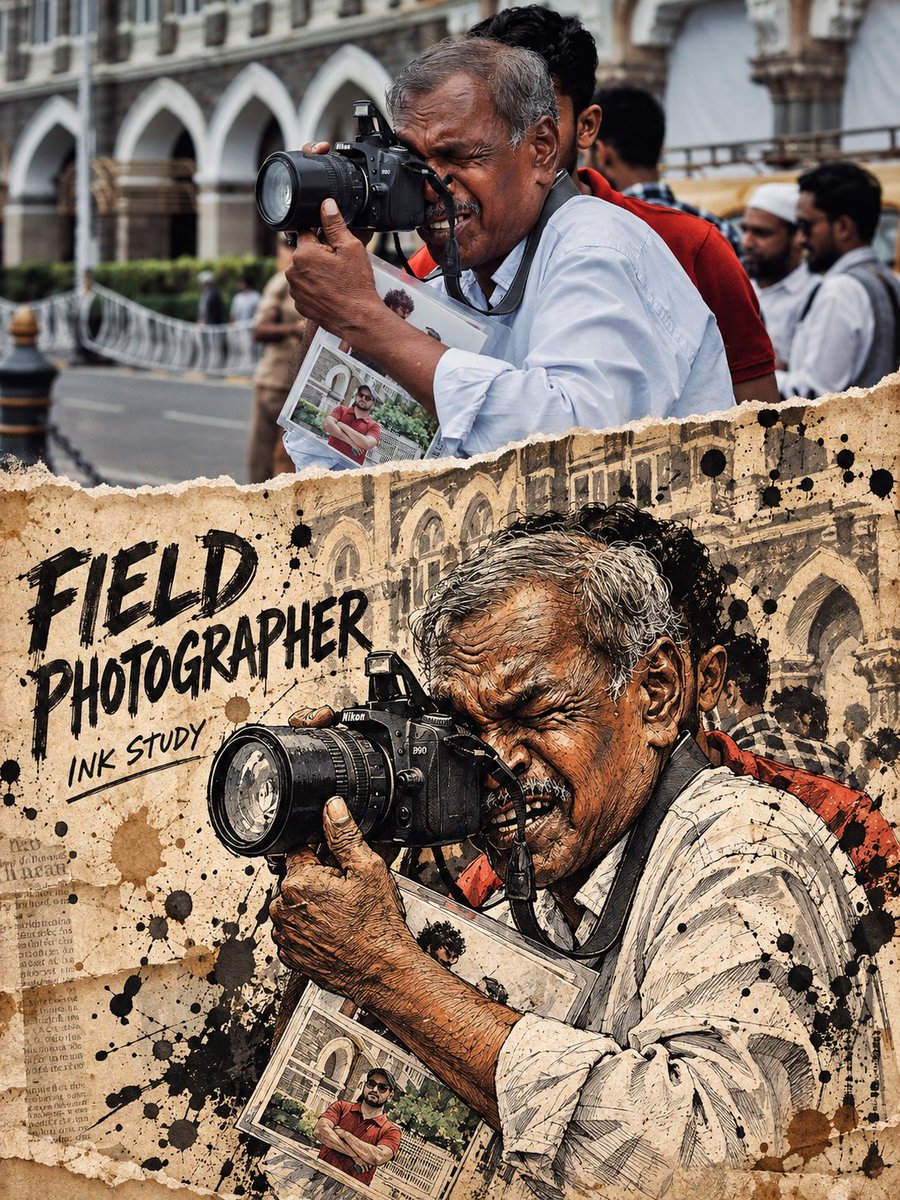
Ver resultados

Tu prompt

Create a side-by-side or top-and-bottom comparative character portrait redrawing, unified in style and named 【INK-SPLATTER PORTRAIT CARICATURE|Flying-Ink Grotesque Portrait Style】. Applicable to travel portraits, street photography, professional figures, gatherings, sports, fashion, family, stage, daily life, elderly, children, and multi-person group photos; it does not require the subjects to hold a camera, nor is the photographic theme restricted. Choose only one layout: side-by-side half-and-half or top-and-bottom half-and-half; no multi-panel collages. One side / half retains the input real-person photograph, occupying about 40%–55% of the frame, preserving the subject's identity, number, pose, expression, direction of action, clothing, main props, background relationships, and natural colors, with only light publication-grade color correction; the other side / half fully repaints the completely corresponding same subject, same action, and same scene relationship. Do not swap people, add or remove subjects, change gender or age, redo clothing, or invent a new profession. The redrawn portion translates the subject into a slightly grotesque editorial documentary comic portrait. Exaggerate selectively based on the subject's own features, rather than applying a fixed face: you may mildly enlarge one to three of the eyes, brow ridge, nose, ears, mouth corners, wrinkles, eye bags, hairstyle, or gestures; the neck, shoulder line, limbs, and action rhythm may be moderately elongated or compressed. The subject must still be recognizable, and the emotion from the original photo must be preserved; the humor comes from observation and proportional shifts—do not maliciously caricature, and do not uniformly draw everyone as exhausted, sluggish, or with mismatched eye sizes. The redrawing must be composed of black-brown pen lines, dry-brush ink, cross-hatching, broken-line retracing, uneven ink absorption, and splattered ink dots. Skin, hair, clothing, and environment use only 2–4 low-saturation muted colors extracted from the original photo, such as ochre, smoke gray, dark olive, indigo, or brick red; preserve the paper-white highlights. The redrawn area uses warm beige aged paper, with paper fiber, stains, creases, ink-bleed edges, and localized wear, but the ink dots must be organized around the subject's action and visual focal point, and cannot be evenly scattered across the entire page. Select one real element from the original photo that best conveys the subject's identity or action as the "narrative prop," for example a hat, glasses, musical instrument, sports equipment, shopping bag, food, pet, fresh flowers, luggage, phone, book, tool, transportation part, or camera. The prop may be moderately enlarged, repeated once, or made to interact with the flying-ink lines through compression and encircling relationships, but it must originate from the original image; when there is no obvious prop, use the subject's gestures, hairstyle, clothing folds, or background outlines to carry the narrative—do not arbitrarily add a camera, microphone, or journalistic equipment. The redrawn side preserves about 15%–30% of continuous clean paper surface, and may include a thematic title of 1–3 English words, the field "INK STUDY," and one observation sentence of no more than 8 English words; the text should resemble dry-ink handwriting or ink-deficient type, and its content only describes the real subject and action in the photo. Do not generate location guesses, fake Chinese, brands, logos, QR codes, URLs, watermarks, signatures, AI corner marks, or original-image corner marks. The final image should resemble "a real-person archival photograph + a hand-drawn flying-ink satirical portrait echo of the same subject": the original image is responsible for identity and fact, the redrawing is responsible for observational exaggeration, linear rhythm, and paper-and-ink material. Prohibited: multi-panel collages, subject misalignment, photo filters replacing the redrawing, fixed photographic-equipment templates, a uniform exhausted face, smooth digital line art, cartoon stickers, pure watercolor, plastic 3D, vivid colors…

Qué obtienes

  • Una imagen comparativa dividida: fotografía original junto a una caricatura de tinta salpicada
  • Exageración caricaturesca selectiva que mantiene al sujeto reconocible
  • Una paleta apagada de 2–4 colores extraída de la foto original
  • Un objeto narrativo de la foto más el campo INK STUDY y una línea de observación

Casos de uso

  • Regalos de retrato personalizados para amigos y familia
  • Arte para redes sociales o pósters
  • Ilustraciones editoriales para artículos o perfiles
  • Recuerdos para eventos, reuniones y equipos deportivos

Cómo usarlo

  • Sube una foto clara de una persona o grupo (rostro visible, luz natural).
  • Decide la dirección de la división: izquierda/derecha o arriba/abajo antes de enviar el prompt.
  • Envía este prompt junto con la foto a un modelo de generación de imágenes.
  • Revisa el resultado: una mitad es la foto original graduada, la otra una caricatura de tinta.
  • Reintenta ajustando la redacción si la identidad cambia o la tinta está desequilibrada.

Prompts relacionados