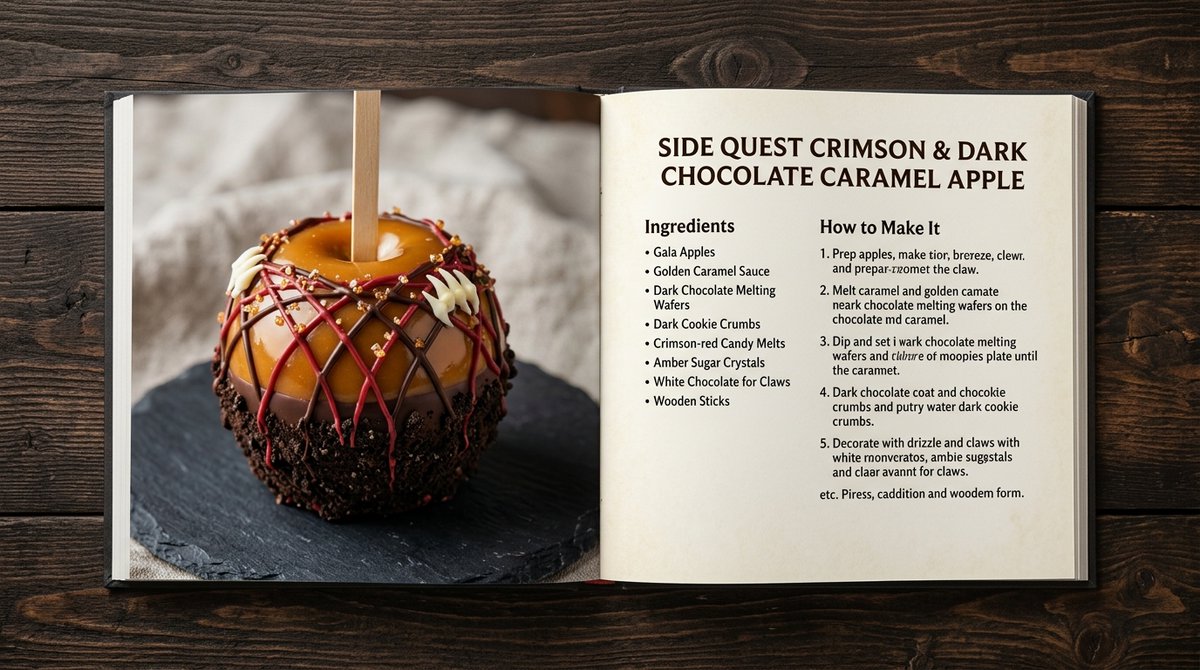
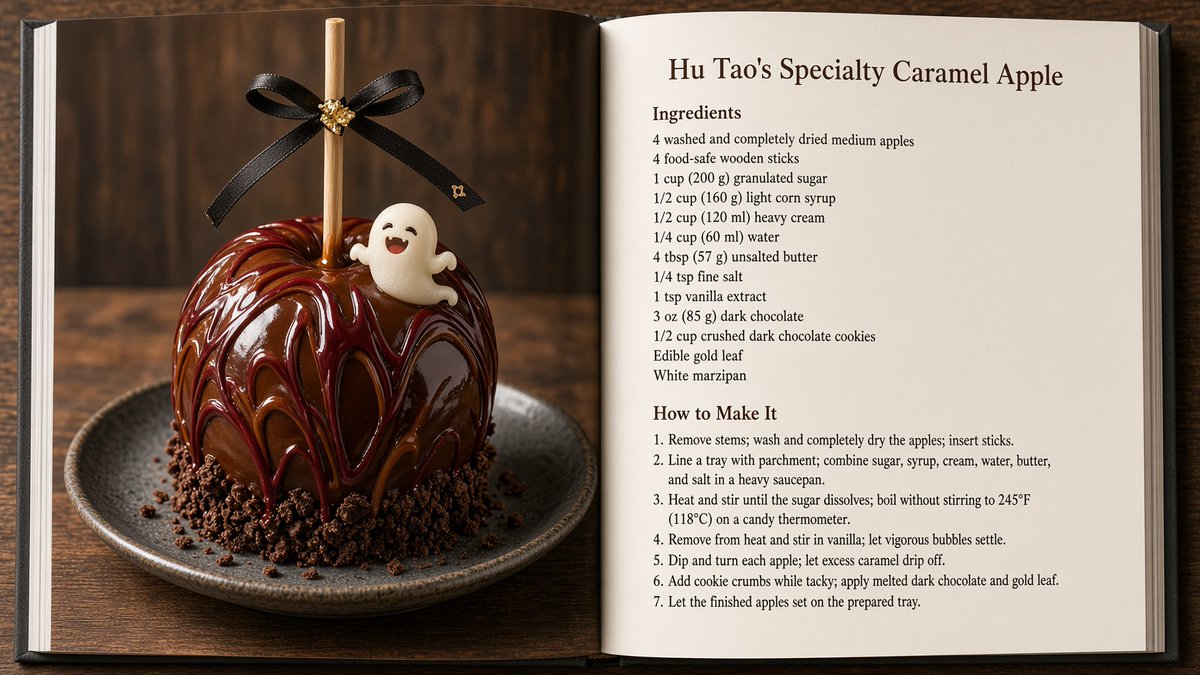
Gather close, my precious little troublemakers! Today’s prompt is fresh from the imagination oven! Please allow it to cool before touching. It’s JOLLY’S PROMPT OF THE DAY!
My all time FAVORITE treat is Caramel Apples. and there is some top shelf fancy once. So I thought I would push the limits and see what I could make. now Turn Yourself Into A Caramel Apple PLUS...The Actual Recipe To Make Said Apple!
Special Thanks To: @BlackwoodLegend, @Paingore, @tylenish, and Wardrake
Your OC's Caramel Apple by Jolly Joebean
PROMPT STARTS HERE
------------------------------
Attach ONE OC image or character reference sheet. Designate it @Image1. No written character name, flavor choice, color list, or other user input is required. Read visible names from the reference if legible; otherwise use a distinctive descriptive apple name based on visible traits without inventing a canonical name for the OC.
CREATE ONE finished, high-resolution LANDSCAPE cookbook spread: a mouthwatering photograph of a specialty caramel apple on the LEFT and its actual, usable recipe on the RIGHT. The entire apple, including its stick and all decorations, must be visible. The apple's design, its flavor, the recipe title, and the page styling must all belong to the specific OC in @Image1. The recipe is part of the finished image, printed beside the apple, not merely supplied in the surrounding chat.
This prompt works in an image generator or in an LLM with image-generation capability. An LLM should make the interpretation and recipe decisions below before generating the image, pass the chosen design AND exact recipe wording to its image generator, and also provide the same recipe as ordinary text after the image so it remains usable if small print is rendered imperfectly. A direct image generator should perform the same decisions internally and prioritize accurate recipe text on the page. Do not display private analysis or planning in the image.
REFERENCE AUTHORITY
@Image1 is the ONLY source for the OC's identity. Inspect the whole sheet, including multiple views, details, palette swatches, accessories, and legible labels when present. Identify the strongest two to four visual signatures: colors, patterns, markings, hairstyle or fur shapes, species features, clothing motifs, emblem, distinctive accessory, and emotional tone. Preserve the traits you choose accurately in their translated edible form. A dark gothic OC can produce an elegant dark confection; a colorful playful OC can produce a festive one; a futuristic OC can inspire precise geometric decoration. These are examples, not automatic formulas. Do not substitute another character, assume a species or gender, or import traits from earlier conversations or unrelated images.
Never claim knowledge of an OC's tastes, favorite foods, allergies, lore, powers, or name from appearance alone. Words printed legibly on @Image1 may be used. If no name is readable, create a product name describing the apple's visible design, such as a specific palette or motif, without asserting that this is the character's real name. Do not reproduce reference-sheet typography as part of the recipe unless it is an actual name needed for the title.
STEP 1 — DESIGN THE EDIBLE APPLE
Start with a real, fresh, firm apple on a food-safe stick and a generous, unmistakable caramel coating. Build a singular specialty caramel apple using a coherent combination of edible elements chosen for this OC. Possibilities include milk, dark, or white chocolate; cookie crumbs; crushed nuts; pretzels; toasted coconut; candy pieces; sprinkles; freeze-dried fruit; cinnamon sugar; colored cocoa-butter decoration; piped chocolate; and molded edible chocolate or fondant accents. These are examples, not a restricted list and not a requirement to include them all.
Make the caramel visibly present, even when chocolate or toppings are added. Choose complementary flavors that someone would want to eat together. Translate striking reference details through plausible confectionery techniques: stripes with drizzled chocolate, fur or hair tones with crumbs or colored chocolate, a symbol with a small chocolate medallion, a wing or horn silhouette with a stable edible accent, and wardrobe colors with restrained icing or confectionery coating. Use two to four strong identity cues rather than covering every inch with unrelated decorations. If a character feature would create an unwieldy or inedible sculpture, express it as a surface pattern, chocolate silhouette, or small edible garnish.
The apple must remain an apple, not a character's head, a living creature, a doll, an unrelated cake pop, or a painted plastic prop. No real fabric, plastic horns, metal ornaments, loose glitter, non-food dye, or other inedible decorations should touch the food. Any stick ribbon, if appropriate, is presentation-only and must not be listed as an ingredient or confused with an edible component. Any glitter or metallic finish on the apple itself must be specifically edible and food-grade. The visible topping colors and shapes must be achievable with the ingredients and methods on the right-hand page.
Select the apple variety, caramel flavor if any, coating, drizzle, inclusions, and final edible decorations as one coordinated recipe. The result should resemble a premium handmade confection, with real glossy caramel, believable thickness, gravity, crumbs, and a stable standing shape. Choose its mood and setting from the OC: cozy, whimsical, elegant, spooky, rustic, futuristic, or another visual direction clearly grounded in @Image1. Do not impose a universal Halloween, Christmas, pink, feminine, or clown theme.
STEP 2 — GIVE IT AN OC-THEMED PRODUCT NAME
Invent one short, appealing specialty-apple name that fits the OC and the actual ingredients. If the reference contains a clearly readable OC name, use that name naturally in the title; do not ask the user to enter it again. If it does not, use a distinctive visual descriptor rather than a fabricated character identity. The cookbook recipe title must name the exact apple pictured. Do not use the generic title of this prompt as the sole recipe title. Spell all visible words correctly.
STEP 3 — WRITE A REAL RECIPE FOR THE APPLE PICTURED
The recipe makes FOUR medium caramel apples; the photograph features ONE finished apple from that batch. Include an Ingredients list with exact amounts and a numbered How to Make It section with practical instructions. Every visible edible coating, drizzle, color, crumb, candy, filling, and garnish must appear in the ingredients and instructions. Every listed topping must have a visible role on the photographed apple. Do not name unavailable fictional ingredients, imply a decorative non-food item is edible, or write directions that would produce a different confection.
Use this dependable caramel foundation for four medium apples, listing all of it: 4 washed and completely dried medium apples; 4 food-safe wooden sticks; 1 cup (200 g) granulated sugar; 1/2 cup (160 g) light corn syrup; 1/2 cup (120 ml) heavy cream; 1/4 cup (60 ml) water; 4 tbsp (57 g) unsalted butter; 1/4 tsp fine salt; and 1 tsp vanilla extract. The sticks are equipment, clearly identified separately from edible ingredients. Add measured, attainable amounts for the OC-specific coatings and toppings. If the planned design calls for chocolate drizzle, specify its type and amount, approximately 3 oz (85 g) for four apples. Give quantities for crumbs, nuts, candy, colorings, and edible accent pieces actually used. If flavoring the caramel, name a compatible food-grade extract and measured amount; add it off heat with the vanilla. Do not add watery juice, paint, or an untested liquid that would break the caramel.
The method must explicitly cover: removing stems; washing and completely drying the apples; inserting sticks; lining a tray with parchment; combining the sugar, syrup, cream, water, butter, and salt in a heavy saucepan; heating and stirring until the sugar dissolves; then boiling without stirring to 245°F (118°C) on a candy thermometer; removing from heat and stirring in vanilla and any specified extract; letting vigorous bubbles settle; dipping and turning each apple; letting excess caramel drip off; adding toppings while their supporting coating is tacky; applying any separately melted chocolate or edible details at the appropriate stage; and letting the finished apples set on the prepared tray. Adjust the finishing sequence coherently: a topping that requires melted chocolate to adhere goes on the melted chocolate, not on already hardened caramel. Do not omit an ingredient from the method. Keep the written recipe concise enough to be readable on the page while retaining usable measurements and these essential steps.
STEP 4 — COOKBOOK SPREAD AND PHOTO
Follow the supplied cookbook-layout example for composition, not its avocado toast subject, title, or recipe. Make one horizontal, slightly overhead photograph of an open, premium printed cookbook or neatly stacked recipe pages lying on a subtly textured tabletop. The LEFT page is a large, richly detailed, professional food photograph of the finished OC caramel apple, standing upright on a small plate or suitable surface, with attractive, controlled lighting and the whole stick in frame. The RIGHT page is clean ivory or white paper with a generous, legible typeset recipe. The two sides belong to one unified physical spread, with natural paper edges, understated shadows, and a coherent OC-inspired accent color. The apple should be the visual hero; the recipe should still be large enough to read.
Use a landscape aspect ratio near 16:9 and high resolution, preferably at least 3200 × 1800 pixels when supported. Allocate roughly 45% of the useful page area to the food photograph and 55% to the recipe; adapt the exact ratio to fit the complete recipe without tiny text. On the recipe page, show the unique apple name at the top, then clear headings “Ingredients” and “How to Make It,” followed by the complete measured list and numbered directions. Typeset in a crisp, dark, high-contrast serif or similarly readable cookbook font. Avoid decorative lettering for body text. No text over the apple. Do not add unrelated paragraphs, fake brand logos, watermarks, calorie claims, or filler text.
TEXT RELIABILITY AND TWO-MODE DELIVERY
If run by an LLM with an image tool, finalize the recipe as plain text first, then place that EXACT recipe on the right page through the image prompt. After generating the image, provide the identical title, ingredients, and directions in normal text outside the image, preserving measurements and sequence. If available image editing or layout tools are needed to make the printed recipe genuinely legible, use them to complete the single final image. If run directly by an image generator, render the full recipe as accurately as possible, prioritizing correct ingredient quantities and readable steps over ornamental flourishes. Never silently replace the recipe with nonsense lettering or omit it because food photography is easier.
FINAL CONSISTENCY CHECK
Before finalizing, confirm that: (1) one recognizable caramel apple appears on the left; (2) its edible palette and motifs come from @Image1; (3) the title is OC-themed without inventing a canonical OC name; (4) the right page includes exact ingredients AND usable directions for the same apple; (5) the photograph shows only edible food decorations, with any non-food ribbon confined to the stick; (6) all pictured toppings are accounted for in the recipe; (7) the layout is a physical, landscape cookbook spread with a clear photo-left/recipe-right arrangement; and (8) no unrelated character, ingredients, title, or branding intrudes.
----
PROMPT ENDS HERE