Ir al contenido
ImágenesGratis

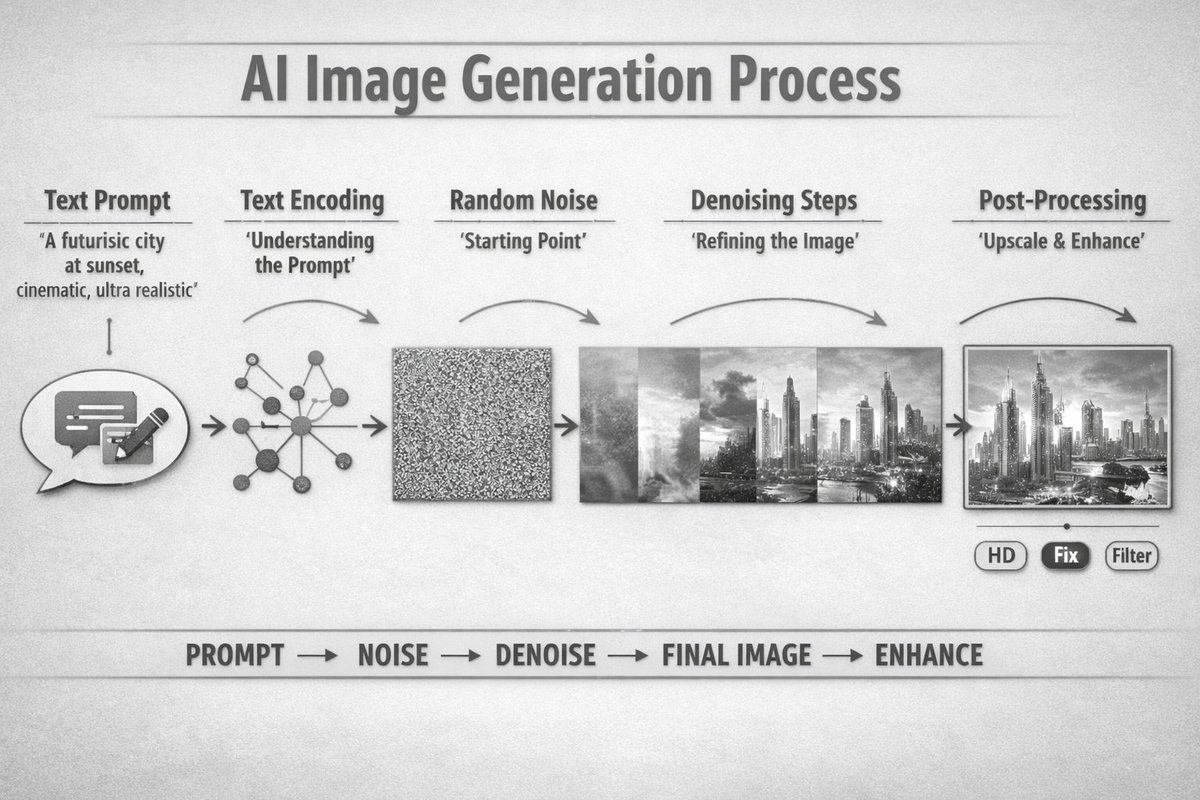
Ciclo de generación de imágenes con IA

Una explicación educativa describe cómo un prompt se convierte en una representación numérica y se depura gradualmente hasta formar una imagen.

Generación de imágenes

Ejemplos de la fuente

Estas imágenes provienen de la fuente original. DROPIDEA no ha probado estos ejemplos; los resultados dependen del modelo y los ajustes.

Listo para personalizar

Tu prompt

Texto original

Sustituye las variables en rojo por tus datos. Copia el texto completo y úsalo con tu agente preferido.

TXT MD Versión en inglés
The AI image generation cycle usually works like this: 1. You give it a prompt Example: a futuristic city at sunset, cinematic, ultra realistic The AI receives your text and tries to understand: the objects the style the mood the composition the visual details 2. The text is turned into a numerical representation The prompt is not read like a human reads it. It is converted into numerical vectors that capture the meaning of the words and the relationships between them. For example: city suggests buildings, streets, skyline sunset adds warm colors and low light cinematic influences the visual style 3. The model often starts from random noise In many modern systems, especially diffusion models, the image does not begin as a clean picture. It starts as something like random visual noise. 4. The AI gradually removes the noise This is the core of the process. At each step, the model asks: If this image is supposed to match the prompt, what should a slightly less noisy version look like? Then it repeats this process many times: full noise blurry shapes rough forms clearer objects fine details final image 5. The model guides the image toward the prompt During the denoising process, the AI keeps aligning the image with the meaning of the text. So it keeps adjusting: shape color lighting texture overall coherence That is why the prompt strongly affects the final result. 6. The latent image becomes a visible image In many systems, the model first works in a compressed space called latent space. Then a decoder turns that compressed version into a visible pixel image. 7. Extra steps can be added Depending on the system, there may also be: upscaling to increase resolution inpainting to modify a specific area face enhancement to improve faces color correction to refine the look safety filtering to block certain content Ultra simple version The cycle is: prompt → text understanding → random noise → gradual denoising → alignment with the prompt → final image One sentence summary An AI image generator takes a text prompt, converts it into mathematical meaning, often starts from random noise, and then transforms that noise step by step into an image that matches the prompt.
Ver resultados

Tu prompt

The AI image generation cycle usually works like this: 1. You give it a prompt Example: a futuristic city at sunset, cinematic, ultra realistic The AI receives your text and tries to understand: the objects the style the mood the composition the visual details 2. The text is turned into a numerical representation The prompt is not read like a human reads it. It is converted into numerical vectors that capture the meaning of the words and the relationships between them. For example: city suggests buildings, streets, skyline sunset adds warm colors and low light cinematic influences the visual style 3. The model often starts from random noise In many modern systems, especially diffusion models, the image does not begin as a clean picture. It starts as something like random visual noise. 4. The AI gradually removes the noise This is the core of the process. At each step, the model asks: If this image is supposed to match the prompt, what should a slightly less noisy version look like? Then it repeats this process many times: full noise blurry shapes rough forms clearer objects fine details final image 5. The model guides the image toward the prompt During the denoising process, the AI keeps aligning the image with the meaning of the text. So it keeps adjusting: shape color lighting texture overall coherence That is why the prompt strongly affects the final result. 6. The latent image becomes a visible image In many systems, the model first works in a compressed space called latent space. Then a decoder turns that compressed version into a visible pixel image. 7. Extra steps can be added Depending on the system, there may also be: upscaling to increase resolution inpainting to modify a specific area face enhancement to improve faces color correction to refine the look safety filtering to block certain content Ultra simple version The cycle is: prompt → text understanding → random noise → gradual denoising → alignment with the prompt → final image One sentence summary An AI image generator takes a text prompt, converts it into mathematical meaning, often starts from random noise, and then transforms that noise step by step into an image that matches the prompt.

Prompts relacionados