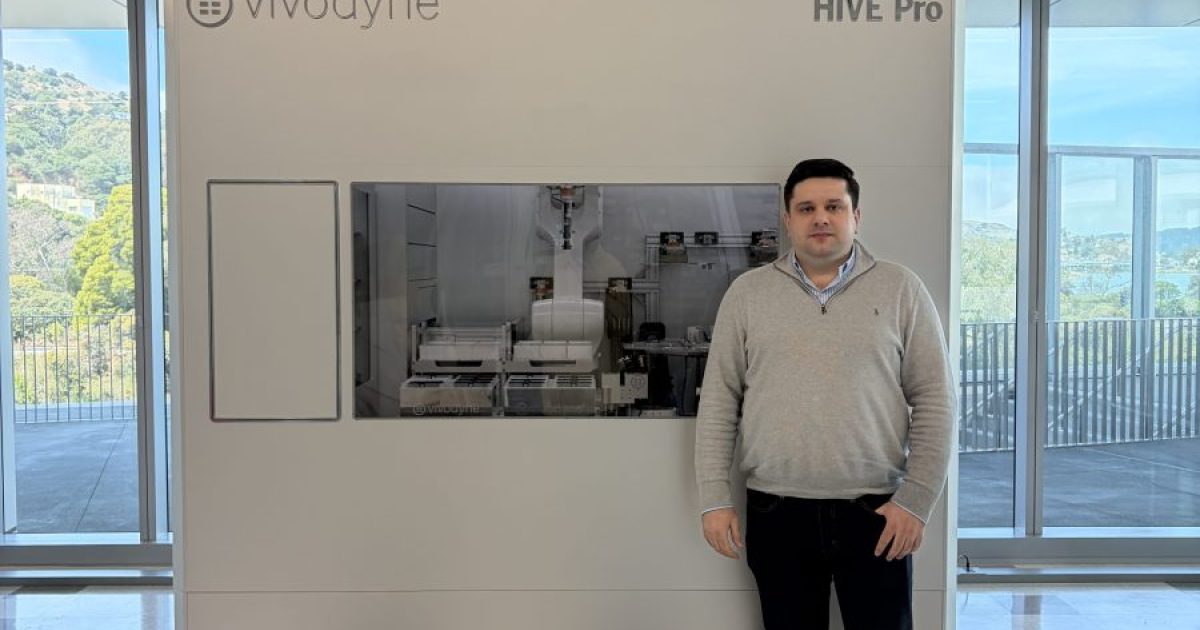
Talk in tech circles about AI's ability to "cure cancer" has become so frequent that this promise now feels closer to a marketing slogan than a genuine scientific achievement. But behind these glittering promises lies a fundamental obstacle that is rarely brought to light: the shortage of precise biological data that reflects how the human body actually behaves. This is precisely the problem that a startup called Vivodyne is seeking to address in an innovative way.
The Heart of the Problem: Data That Doesn't Reflect Humans
AI models used in drug discovery rely on data derived mostly from animal experiments or studies of individual cells and proteins, rather than living human tissue. This shortcoming makes the results far removed from clinical reality. Andrei Georgescu, the company's CEO and co-founder, sums it up with a biting remark, noting that in the absence of real human testing, these models "will cure cancer in mice" and nothing more.
Georgescu is not alone in sounding the alarm; even Dario Amodei, CEO of Anthropic, recently wrote that claims of AI curing cancer have become closer to a cliché than a credible statement, emphasizing that "the thing that's effective is actually curing cancer."
The Gap Between Promises and Results
Despite ambitious statements from major leaders such as Sam Altman, who made curing cancer a justification for the pursuit of artificial general intelligence, and Demis Hassabis of Google DeepMind, who predicted the cure of all diseases within a decade, real-world results remain modest. Only a handful of AI-designed drugs have entered human trials, with one reaching Phase III.
Even the Nobel Prize-winning AlphaFold model, which represented a leap in understanding the fundamental building blocks of life, has yet to produce an actual new drug. The pharmaceutical industry faces a difficult challenge, as 90% of drugs that prove effective in animal trials and enter the clinical phase fail to obtain regulatory approval for human use.
The Proposed Solution: A Human Tissue Factory
Vivodyne emerged from the University of Pennsylvania in 2021 and developed modular robotic machines it calls "HIVE," capable of growing twenty types of human tissue, then dosing and monitoring them autonomously to generate precise causal biological data. The company says its tissues mimic the behavior of real human organs with a high degree of accuracy:
- Liver cells with a predictive accuracy of 94% compared to human toxicity trials.
- Airway tissue matches the behavior of human tissue by 96%.
- Bone marrow achieved a full 100% concordance in testing twenty different chemical drugs.
The company has raised roughly $80 million across two funding rounds led by Khosla Ventures, and recently opened what it describes as the world's largest "human data center" near San Francisco, with a throughput exceeding twice all the animal trials conducted in the United States.
A Broader Vision: Causal Data for Training Models
Georgescu likens the idea to car crash tests; a car manufacturer is confident its vehicle will pass the standards before testing, whereas drug makers rarely have such confidence when entering clinical trials. But the greater ambition goes beyond accelerating drug discovery, as the founder sees his autonomous labs as key to generating causal data suitable for training a new generation of models that understand human biology.
He points out that current models are trained on "static snapshots" of cells without understanding how they reached their state; they learn "state A" and "state B" but do not grasp that the second state is a causal result of the first. The "HIVE" machines, however, track hundreds of thousands of ongoing experiments in which diseased tissue is exposed to specific stimuli, providing a foundation for reinforcement learning.
Georgescu believes that establishing causal relationships in human biology will be crucial for a future that requires combination therapies targeting multiple pathways, saying: "If we want combination therapies, the scope of research expands enormously and cannot remain an empirical approach; you must ask: I want this effect to happen, so what cause should be invoked?"
✦ بقلم فريق دروب أيديا
DROPIDEA
We hope this article has added real value to you. At DROPIDEA, we always strive to deliver high-quality content that helps you grow and evolve in the digital space. Follow us for more useful articles and guides.
Tags

Admin
DROPIDEA
Latest Articles

Amazon Makes Its AI Assistant Alexa+ Free on Fire TV Devices

TerraPower Bets on Nuclear Energy Storage to Power AI Data Centers
Etched Doubles Its Valuation to $21 Billion in a Single Month

OpenAI Tightens Security Measures After a Breach Incident During Model Training