WeatherNext 3: Google's New Model Redraws the Future of AI-Powered Weather Forecasting
 By Admin
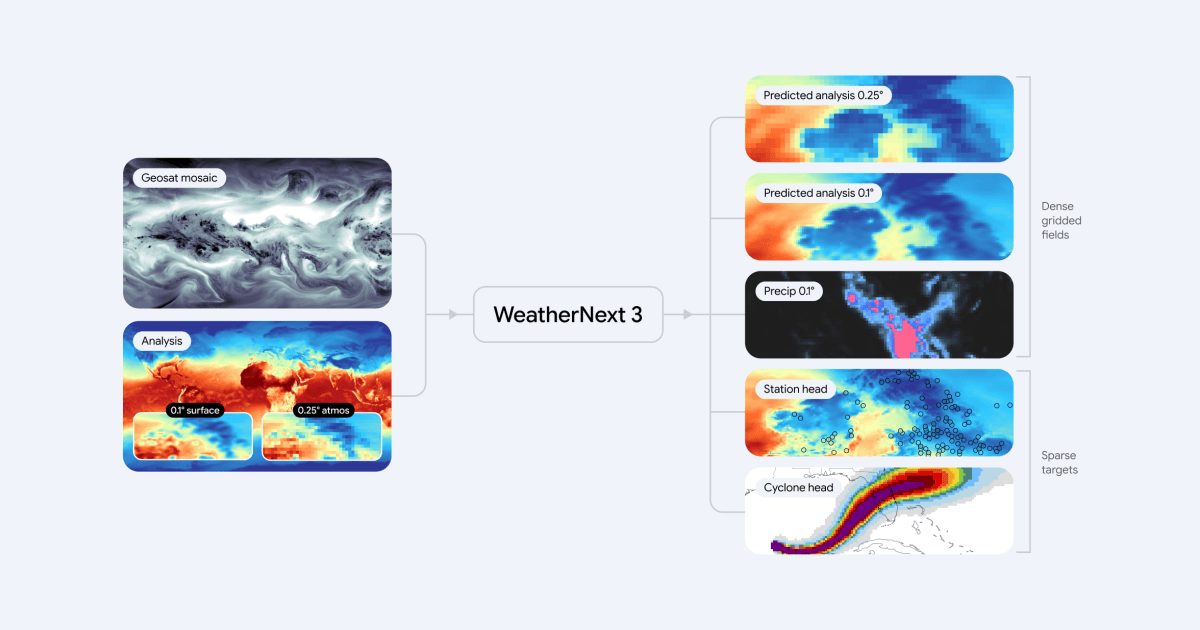
Weather forecasting is no longer the exclusive domain of slow and costly government supercomputers, as artificial intelligence drives a radical transformation in meteorology. In the latest step along this path, researchers from DeepMind and Google Research have unveiled a new model called WeatherNext 3, which promises a clearer view of the changing atmosphere and more accurate, more frequent forecasts than ever before.
A Model at the Heart of Google's Products
The role of this model is not limited to research labs. Google will begin using it to power the weather information users see in Search, Google Maps, and the Gemini assistant, in addition to making it available to researchers and developers through Google's cloud platforms. According to the company's principal engineer, Samir Merchant, this is the first time that certain core weather variables will feed and power a large number of Google products.
The model has already proven its superiority, scoring the highest accuracy among prominent competitors when tested on the Operational WeatherBench platform developed by the startup Brightband, which measures indicators such as temperature, wind speed, and humidity.
Outperforming Both Traditional and AI Competitors
WeatherNext 3 did not merely beat the competing deep learning models developed by companies such as Microsoft, Nvidia, and the European Centre for Medium-Range Weather Forecasts—it also surpassed the traditional forecasts issued by the U.S. National Weather Service and the European Centre itself.
The roots of this transformation go back to 2018, when the European Centre released weather data collected over more than half a century, opening the door to training deep learning models capable of producing far faster forecasts with accuracy rivaling government tools. Ferran Alet, a researcher at DeepMind, explains that weather is a chaotic system in which small differences cause enormous disturbances, and that machine learning tackles the core of the problem by learning patterns from a vast amount of data despite incomplete information and limited computing power.
Three Major Challenges Overcome by the Model
Previous AI models suffered from key weaknesses that WeatherNext 3 addressed all at once:
- Spatial accuracy: While older models forecast across broad areas ranging between 15 and 25 square kilometers, the new model is able to forecast with accuracy of up to 5 kilometers for core variables.
- Rainfall forecasts: Its performance in this area improved by 60% compared to the previous version, WeatherNext 2.
- Forecast frequency: It can now produce hourly forecasts instead of the usual forecasts every six hours.
These leaps came as a result of careful design choices, as the model is 2.4 times larger in terms of parameter count than its predecessor, and it was trained to direct its forecasts toward specific weather monitoring stations, providing more detailed forecasts and enabling its performance to be evaluated against real-world field data.
Relying on Raw Data
The ability to forecast more frequently stems from the model's assimilation of satellite data collected in real time every hour. Feeding models with raw experimental observations instead of ready-made analyses produced by supercomputers promises higher accuracy, despite being technically difficult.
Google describes its model as the "first" to integrate raw observations directly to produce a high-accuracy global forecast, though the startup WindBorne asserts that its WeatherMesh 6 model has integrated raw data from its fleet of balloons since late 2025. Nevertheless, all models still partly rely on national weather databases, meaning that full direct data integration still requires more work.
Impact Beyond Daily Forecasts
While large language models receive the lion's share of attention, the Transformer revolution in meteorology is no less important. Their speed and low cost promise a tangible economic impact in poor regions that have been deprived of accurate forecasts due to the high prices of sensors and supercomputers.
Bill Gates recently pointed out that AI-powered weather forecasting is a fundamental benefit of this technology, as it contributes to improving crop productivity in developing countries. Alet adds that high-accuracy forecasts for wind, rain, and cloud cover will make renewable energy projects more reliable. He concludes that the core of Google's mission is to provide useful information to the user, and much of what people search for is related to weather in one way or another.
✦ بقلم فريق دروب أيديا
DROPIDEA
We hope this article has added real value to you. At DROPIDEA, we always strive to deliver high-quality content that helps you grow and evolve in the digital space. Follow us for more useful articles and guides.
Tags
Admin
DROPIDEA
Latest Articles

Why Is Detecting AI-Generated Content Harder Than We Think?
NVIDIA Acquires Hugging Face for $12.9 Billion
OpenAI's New Reasoning Technique Alarms AI Safety Experts
A New Stage at Disrupt 2026 Bridges AI and the Physical World