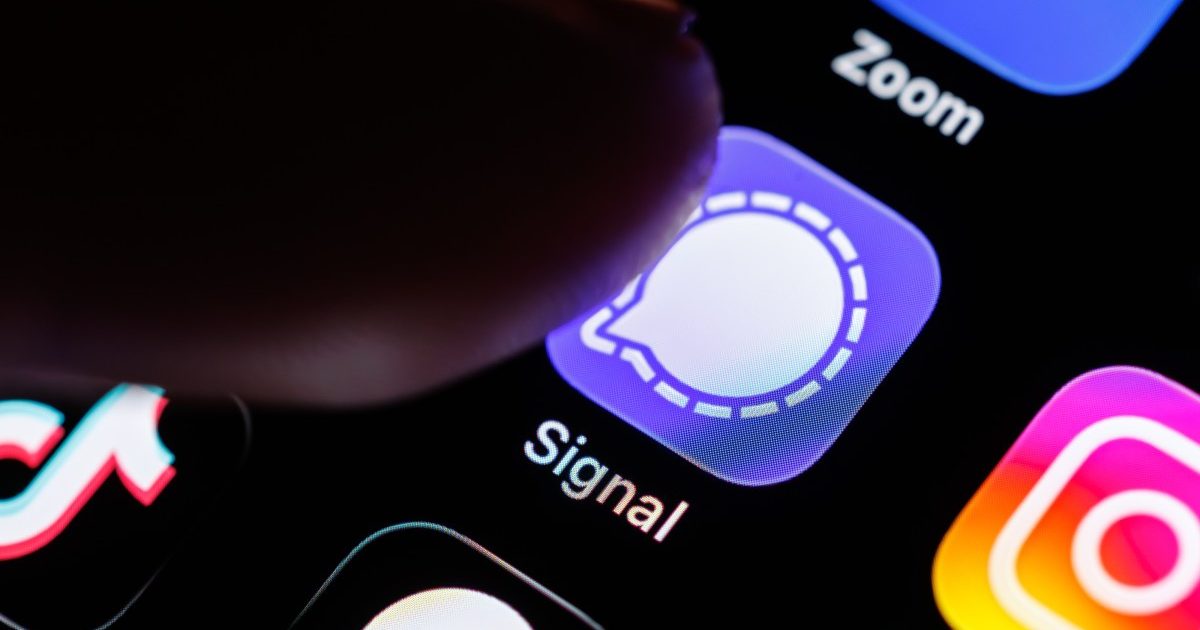
The encrypted messaging app Signal has taken a notable step that may at first seem inconvenient to some of its users, yet it reveals a deeper battle unfolding behind the scenes: restricting the ability to capture screenshots within the app on mobile operating systems. The stated reason has nothing to do with preventing conversations from leaking between individuals, but rather with confronting what the app's president, Meredith Whittaker, described as an "existential threat" arising from operating systems integrating AI agents capable of reading whatever appears on screen.
What has actually changed in the app?
Signal had previously enabled screenshot blocking by default in its Windows version. Now it has extended this measure to cover both the Android and iOS versions, so that capturing an image of conversations is automatically prohibited. That said, the company has left the door open for anyone who wishes to disable the option manually, accompanied by a clear warning that doing so means "breaking the privacy guarantees" on which the app is built.
The technical idea is straightforward: if the system is prevented from capturing the screen's contents within the app, then any tool that relies on "seeing" the screen in order to analyze it — including built-in AI assistants — loses its primary source of information.
The heart of the problem: agents reading your screen
The prevailing trend across Windows, Android, macOS, and iOS is to equip the user with a smart assistant capable of understanding the context in which it operates, which usually requires capturing and analyzing screen content. This capability, according to Whittaker, undermines Signal's ability to offer an independent privacy guarantee, because sensitive data is captured, stored, and becomes available to a local database or a remote server used by the AI agent at that moment.
The critical point here is that end-to-end encryption protects a message while it travels between sender and recipient, but it does not protect what happens after decryption, once the text is displayed on screen. It is precisely at that point that the matter slips entirely out of the app's hands.
Why the risk extends beyond a single user
Whittaker highlighted an important dimension: capturing the content of a conversation does not affect only the privacy of the device's owner, but the privacy of everyone who took part in that conversation. If one party is using a system that contains an AI agent scanning the screen, other people's messages — people who never consented to anything — may end up inside logs or servers they have no idea exist.
- An invisible third party: the system itself becomes a silent participant in the conversation.
- Incomplete consent: one person's decision affects the data of an entire group.
- Lack of transparency: it is difficult to know what is stored, for how long, and exactly where.
- A new attack surface: any aggregation of data means one more target for breaches.
A candid admission of the solution's limits
Notably, the company did not present its measure as a definitive fix. Whittaker described it as "incomplete," because it does not address the more covert routes AI agents might take to reach app data, such as accessibility services or various system interfaces. In other words, blocking screenshots shuts the widest door, but it does not guarantee that every window is closed.
This admission carries a message of its own: apps that sell privacy as a core promise now find themselves on the defensive against a layer beneath them in the technology stack — namely the operating system they run on.
What this means for organizations and users
For companies and entities handling sensitive information, this development raises a practical question about policies governing devices and permitted smart applications. There are some logical steps worth considering:
- Review the settings of AI assistants built into operating systems and disable whatever is not needed.
- Do not disable default protections in messaging apps except for a clear and limited reason.
- Include "screen reading" within risk assessments when reviewing the permissions granted to apps.
- Make teams aware that encryption alone is not enough if the device itself is analyzing the content being displayed.
Conclusion
Signal's decision is not merely a tweak to a minor setting; it is an indicator of a shift in the balance of power between apps and operating systems in the era of agentic AI. When the system becomes capable of seeing everything on the screen, protecting privacy turns from a question of encryption into a question of control over the layer that displays the data. The question now facing system developers is this: will users be given clear tools to determine what an AI agent is entitled to see?
✦ بقلم فريق دروب أيديا
DROPIDEA
We hope this article has added real value to you. At DROPIDEA, we always strive to deliver high-quality content that helps you grow and evolve in the digital space. Follow us for more useful articles and guides.
Tags
Admin
DROPIDEA
Latest Articles

Two Narratives About Nvidia: Record Profits and Pressure for Jensen Huang's Return

Anthropic's IPO: Its Founders Reap $2 Billion
Apple Aims to Build an AI Agent That Can Operate Your Computer on Its Own
Nadella Explains Why Microsoft Offered Voluntary Resignation to 60,000 Employees