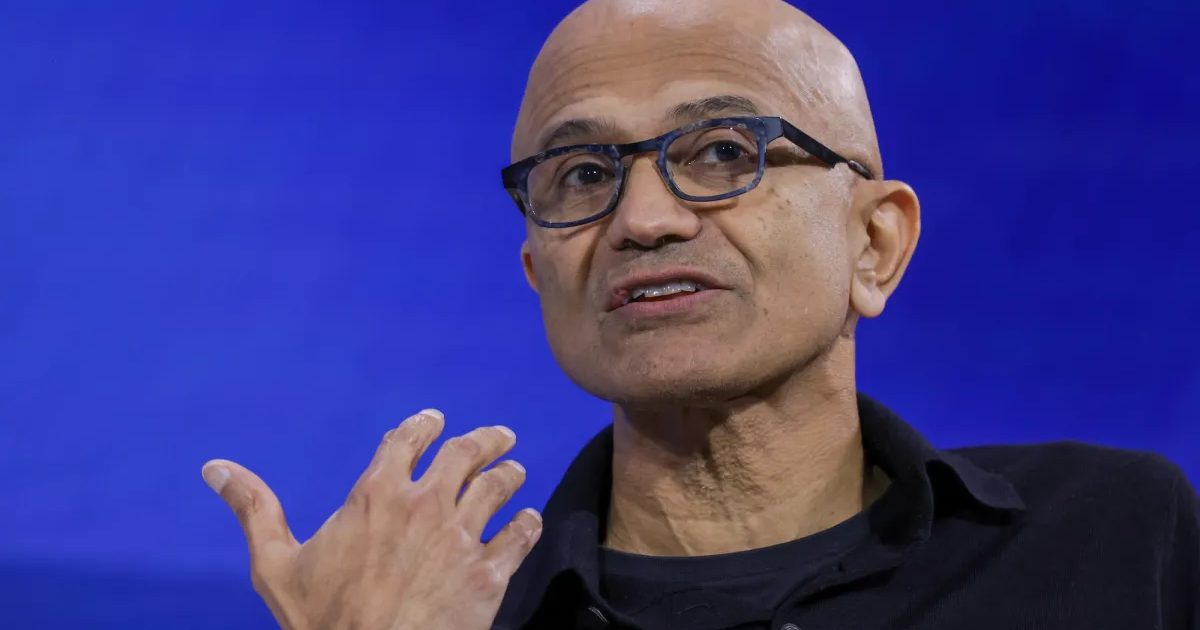
An unusual offer from Microsoft at the end of last October sparked wide debate across the tech sector: instead of announcing another round of mass layoffs, the company gave roughly 60,000 employees the option of resigning voluntarily in exchange for a severance package. After weeks of speculation, CEO Satya Nadella stepped forward to explain the logic behind the decision, rejecting the most common interpretation: that artificial intelligence had arrived to take human seats.
The Message: A Choice Rather Than a Surprise
Speaking at the DealBook economic summit, Nadella said the purpose of the voluntary resignation offer was to give employees a measure of control over their own professional fate, so that each individual would feel they had the ability to choose rather than wait for a decision imposed upon them. In other words, the company preferred to place the decision in its employees' hands rather than surprise them with termination notices.
In a separate conversation with a specialized engineering platform, he added that the way the "AI revolution" is publicly discussed has created enormous anxiety in the labor market, leaving many believing they have lost control over their future. He specifically criticized the overblown rhetoric around "technological singularity" — that hypothetical moment when artificial intelligence surpasses the capabilities of the human mind — and the predictions insisting that all jobs will disappear, arguing that this kind of talk raises tension even among those who are eager for change.
Software Engineering Isn't Dead… But It Has Changed
The most noteworthy part of Nadella's remarks is his stance on the future of the programming profession. He described the journey the sector has gone through in three rapid-fire stages:
- Denial: A prevailing belief that artificial intelligence would never write real software.
- Panic: A sudden flip to the question: if the model writes everything, what need is there for engineers?
- Rediscovery: The realization that software engineering is alive and will thrive, but with a completely different way of working and a new distribution of roles within the team.
Put differently, the job doesn't disappear — it shifts to a new "operating point": less effort spent writing lines of code, and far more effort spent on direction, review, systems design, and verifying outputs.
A Practical Example: A Team of 11 Developers
Nadella pointed to the team building Cowork, the AI agent embedded in Microsoft 365 applications. The team consists of just 11 developers who have mastered the use of artificial intelligence in their daily work. He described what they do in a striking phrase: "They are building a software factory that produces the product; they aren't the ones building the product directly."
This shift in level — from execution to building the system of execution — is what Nadella expects to spread to nearly every job, where the employee becomes a manager of a set of intelligent agents that carry out tasks under their direction, rather than being the first and last executor.
The Legacy Company Hurdle
Nadella admits the equation isn't easy. Microsoft is a company more than fifty years old, and it was not originally built on an "AI-first" foundation, which makes the real question: how quickly can an established player reshape the nature of work, its processes, and the form of the final product, while preserving the job structures and financial frameworks tied to all of that?
His answer is blunt: it will take longer than anyone imagines, and along the way some people will find that their professional options lie elsewhere. He acknowledged that reorganization is painful for many, "but it has to be done."
What Does This Mean for Tech Workers?
The implicit message of the offer can be read clearly: either move to a new working model that radically redefines daily tasks, or pursue a different career path outside the company. For those working in the tech sector, these remarks carry three practical implications:
- The most important skill is changing: Value is shifting from speed of execution to the quality of direction, verification, and engineering judgment.
- Team sizes are shrinking: Small, well-equipped teams may produce what once required many times their number.
- The shift is gradual, not immediate: Contrary to the pessimistic rhetoric, the transition period is long and leaves room for learning and reskilling.
The bottom line is that what Microsoft is undertaking is not the replacement of humans with algorithms, but the re-engineering of humanity's relationship with work itself. It is an organizational and cultural battle more than a technical one, and its outcome will shape what jobs in the sector look like in the years ahead.
✦ بقلم فريق دروب أيديا
DROPIDEA
We hope this article has added real value to you. At DROPIDEA, we always strive to deliver high-quality content that helps you grow and evolve in the digital space. Follow us for more useful articles and guides.
Tags
Admin
DROPIDEA
Latest Articles
Anthropic's IPO: Its Founders Reap $2 Billion

Apple Aims to Build an AI Agent That Can Operate Your Computer on Its Own

Nvidia Raises Its Guidance and Confirms Continued Record Revenue Growth

Nvidia's Investments Reach $65 Billion Amid Huang's Absence