For years, NVIDIA's dominance in the AI market has been tied to graphics processing units (GPUs) alone, as it was the sole source of the most powerful chips that ignited the AI boom. But as cloud giants like Amazon and Google entered the arena of manufacturing their own chips, many investors began to question how sustainable NVIDIA's edge really is. Yet the company's recent business results revealed a new narrative: its source of strength is no longer the processor itself, but the complete ecosystem surrounding it.
Beyond the Processor: The Battle for Data Orchestration
As the computing infrastructure of AI has expanded to reach gigawatt-scale limits, the matter of orchestrating and managing operations has turned into an extremely complex challenge. Running a hyperscale data center at peak efficiency is no simple matter; it grows more difficult as deployment sizes increase and their pace accelerates. And it is precisely here that NVIDIA has built much of the advanced hardware needed to manage this complexity, granting it a significant advantage in the systems surrounding the processor, even as competition over the processor itself intensifies.
Despite the abundant talk that computing power has become a commodity available to everyone, running a giant data center at optimal efficiency remains an extremely difficult task, and it grows more complex with every new expansion.
The Vera Rubin Architecture and an Integrated Ecosystem
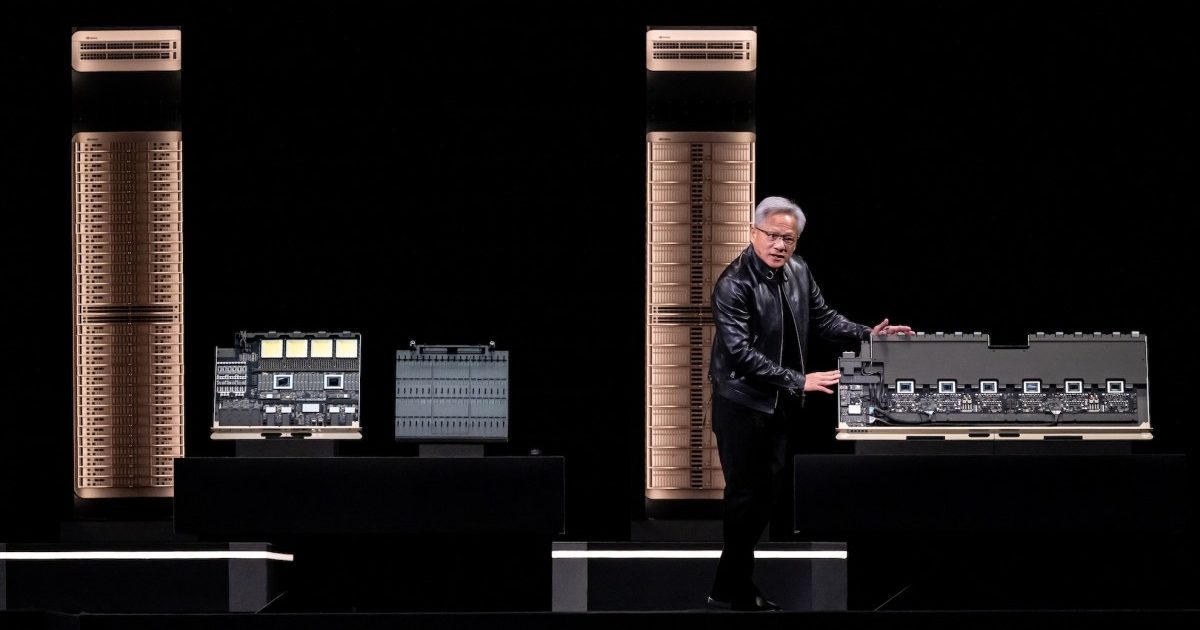
Part of this strategy becomes clear when looking at what NVIDIA actually sells. The company is currently rolling out its new "Vera Rubin" architecture, which combines the Rubin graphics processor with a set of other units, including the Vera central processor, inference accelerators, and units dedicated to storage and networking.
These systems, like the Rubin processor, are highly specialized, but instead of processing linguistic tokens, they ensure that everything outside the processor operates at the highest possible efficiency. If the processor is like a car's engine, then these units represent the rest of its parts.
The Vera Processor: The Brain of Data Organization
The Vera central processor focuses specifically on the problem of orchestrating data and transferring it at the right moment. Jason Hardy, Vice President of Storage Technologies at NVIDIA, says Vera's importance stems from the limited amount of memory that can be placed in a single server or a single computing platform.
As data centers have expanded in their computing capacities, memory capacities have expanded as well, which is what has enabled companies like Micron to reap enormous profits in the second wave of the infrastructure boom. However, delivering this data to the processor at the right moment is no easy matter, and its importance multiplies as companies seek to reduce power consumption per token processed.
Hardy affirms that the company has observed an improvement of up to threefold in these operations thanks to the acceleration provided by the Vera processor, which allows maximum utilization of fast storage units without performance bottlenecks.
Competing Approaches to the Same Challenge
NVIDIA is not alone in facing this dilemma. When OpenAI developed its own chip, one of its main goals was to avoid these challenges by reducing the amount of data that needs to be transferred in the first place. The company explained that it designed its chip to minimize data movement and communication latency, so that the entire workload stays within a single connected system, maintaining the speed and efficiency of requests from start to finish.
It is a different approach that relies on executing work within a single integrated chip, but it stems from the same logic: raising efficiency through smarter management of data movement rather than merely increasing processing cycles. This in turn opens up an entirely new layer of infrastructure in which companies compete.
A New Competitive Arena
This shift toward data orchestration does not mean a guaranteed win for NVIDIA; it will have to compete with chip makers and cloud giants just as it did in the processor market. But the competition has moved to a new level, where building a competing processor is no longer the most important criterion, but rather the ability to make the entire system operate with high efficiency.
- The shift of NVIDIA's advantage from the processor to the surrounding ecosystem.
- The rising importance of data orchestration and memory management.
- Performance improvements of up to threefold thanks to acceleration.
- A new competitive arena encompassing chip makers and cloud giants.
And at least in the early stages, NVIDIA appears to be leading this race by a clear margin.
✦ بقلم فريق دروب أيديا
DROPIDEA
We hope this article has added real value to you. At DROPIDEA, we always strive to deliver high-quality content that helps you grow and evolve in the digital space. Follow us for more useful articles and guides.
Tags

Admin
DROPIDEA
Latest Articles

OpenAI Launches Ads in ChatGPT in India

Plaud Launches Smart Earbuds with an eSIM-Enabled Case to Connect with AI Agents

Why Have Open-Weight Model Companies Become Acquisition Targets in Silicon Valley?

Anthropic Unveils an AI Model That Trains Itself