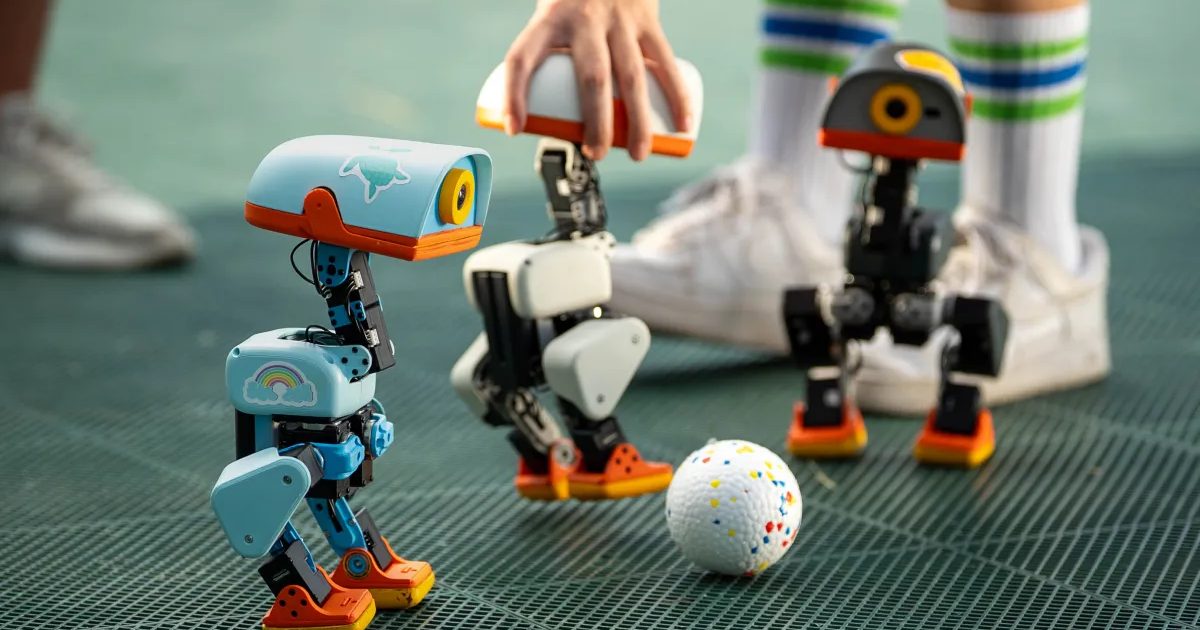
Sometimes a tech product doesn't need stunning specifications or extraordinary performance figures to make its mark on the market; it's enough for it to be charming enough that everyone wants one. That's exactly what happened with the Microduck robot, a small robotic duck that appeared on stage alongside Jensen Huang, CEO of NVIDIA, during his keynote at the GTC conference held in Berlin. Within hours, the demo went viral, and pre-orders for the robot surpassed 20,000 units, according to an announcement by Clément Delangue, co-founder of the Hugging Face platform.
What Made the Demo Spread So Quickly?
The demonstration was remarkably simple: a group of small robots waddling along, emitting electronic sounds reminiscent of the iconic R2-D2, and responding to direct voice commands. Huang asked one of them to do a backflip, and it complied; he asked another to "take a nap," and it dropped to the floor as though out of service. This blend of natural movement and instant responsiveness is what gave the demo its playful charm, while simultaneously serving as a practical showcase of machine learning capabilities in motion control.
The difference between a dry technical demo and one that becomes a phenomenon often lies in details like these: connecting technology to a direct human experience that anyone can understand without an engineering background.
Who's Behind Microduck?
The robot is manufactured by Pollen Robotics, a French company acquired by the Hugging Face platform in 2025. According to published reports, the platform itself later came under NVIDIA's ownership that same year, effectively making Microduck part of the graphics giant's ecosystem. This robot is the second release along these lines, following the earlier Reachy Mini.
More significant than the commercial angle is the fact that the device is open source, a choice consistent with the philosophy Hugging Face was originally built upon. This means the tech community can examine the design and software details and build upon them.
How Did the Robot Learn Its Movements?
Microduck's training relied on NVIDIA's suite of tools, where digital simulation models of the robot were trained on a series of core skills before being transferred to the physical device. These virtually embedded skills include:
- Walking and moving across a flat surface
- Sitting and standing
- Acrobatic movements such as backflips
- Responding to direct voice commands
This approach, known as Sim-to-Real transfer, has become a cornerstone of modern robotics development, as it dramatically reduces training time and costs compared to repeated physical experimentation.
The developer confirms that users can train their robots on new movements and skills, then share them with the rest of the community. This point is transformative: the device isn't sold as a closed toy, but as an expandable platform whose content improves over time through user interaction.
Holiday Toy or Educational Platform?
Reserved units are expected to ship before the holiday season, positioning Microduck as a potential contender for the title of best-selling robot of the year. Notably, however, the target audience doesn't appear limited to children; the promotional materials themselves show adults interacting with the device.
In practical terms, we're looking at a product that combines three functions at once:
- Home entertainment: A device that's simple to operate and suitable for family use.
- Technical learning: A hands-on gateway for students and enthusiasts to understand robotics and reinforcement learning.
- Open experimentation: An environment developers can build on and use to test their ideas.
A Broader Reading of the Landscape
This surge in popularity comes during a week in which the AI sector saw heated debates about the use of these technologies in cyberattacks, a reminder of technology's dual nature. From this perspective, Microduck represents the other side of the equation: the possibility of presenting artificial intelligence in an approachable, familiar, and safe form that helps build public trust rather than fuel anxiety.
At Droub Idea, we believe the most striking lesson here isn't in the robot itself, but in how it was presented: the most successful tech products are those that translate their engineering complexity into a simple, comprehensible experience. A few-minute demo on a single stage achieved what entire marketing campaigns might fail to accomplish, because the value was immediately visible without any need for explanation.
✦ بقلم فريق دروب أيديا
DROPIDEA
We hope this article has added real value to you. At DROPIDEA, we always strive to deliver high-quality content that helps you grow and evolve in the digital space. Follow us for more useful articles and guides.
Tags
Admin
DROPIDEA
Latest Articles
Short Seller Warned About Nvidia CEO's Ties Six Months Before the Scandal

Anthropic Pushes Ahead with IPO Plans Despite Market Turbulence

US Intelligence Memo: Alleged Recruitment Effort Targeting Nvidia's CEO

Independent Investigation at Nvidia into Its CEO's Relationship