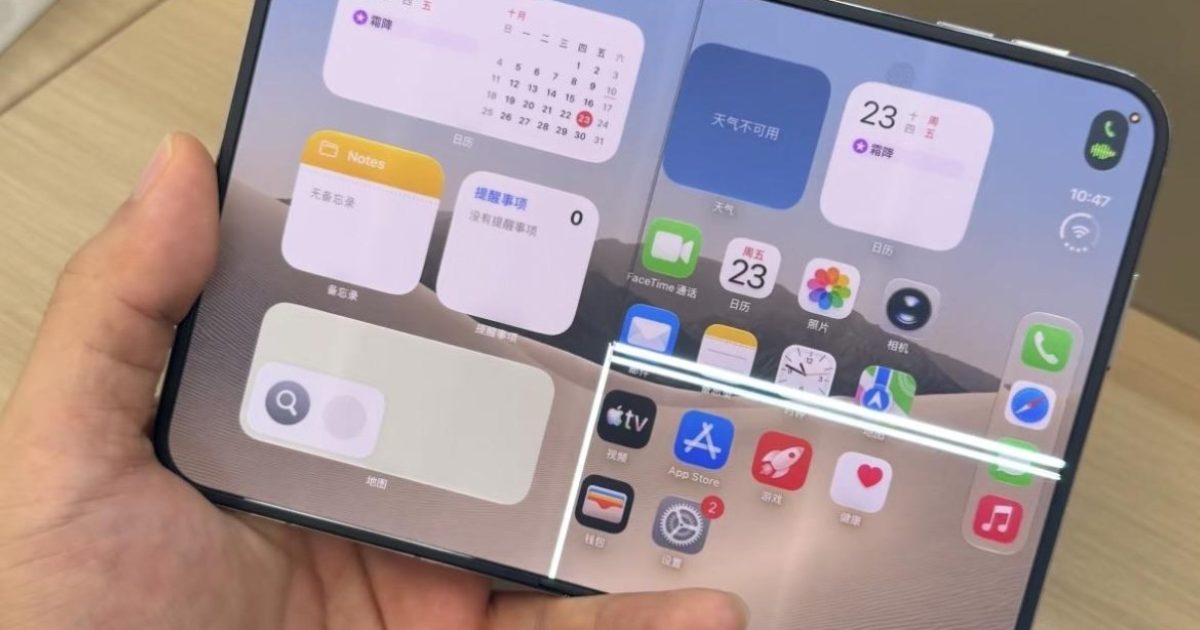
Ever since Apple's foldable phone, known as the iPhone Duo, reached users' hands, social media platforms and discussion forums have been filling up with complaints that are strikingly similar: a screen that cracks after just a few hours of use, preceded by a grinding or "clicking" sound coming from the hinge area. What has made these complaints even more concerning is that the cracks appear in roughly the same position on most affected devices, which points to a specific design or manufacturing flaw rather than isolated cases of user error.
From scattered complaints to hands-on testing
The well-known YouTube creator CuriousHagi set out to move the conversation from theory to practice, running a series of durability tests on the device until he successfully reproduced the very issue users have been reporting: a cracked screen in the area surrounding the fold axis. He then disassembled the phone piece by piece to reach the internal layers and try to pinpoint the component responsible for the failure.
This step highlights something important in the world of hardware: reproducing a defect under controlled conditions is far more telling than a pile of complaints alone, because it allows the point of failure to be identified precisely instead of leaving room for guesswork.
A complex hinge… and a weakest link
The teardown revealed that the phone's hinge is no simple part, but a complex mechanical system consisting of a central axis that operates through a gear-like mechanism, along with two different types of connecting links that distribute the folding motion and control the screen's curvature. With that level of complexity, the performance of the entire system becomes dependent on its weakest component.
According to what the video documented, the part that broke was one of the links located in the middle of the device, and it turned out to be thinner than the links above and below it. More importantly, the break occurred at a small hole or recess in the part — effectively its weakest point from an engineering standpoint, since mechanical stress concentrates there with every open-and-close cycle.
Friction marks that tell the story
The findings didn't stop at the break itself. The teardown also detected clear friction marks in the area where the hinge meets the internal support plate — signs suggesting that the link may have been "catching" on or colliding with a part it shouldn't touch during movement. This offers a logical explanation for the sequence of events users describe:
- Unintended friction between the link and the support plate during folding.
- A sudden buildup of stress at the thinnest point of the link.
- The part snapping with an audible sound.
- Pressure transferring to the flexible display layer above it, causing it to crack.
This also explains why the crack appears in the same spot across different devices: the weak point is fixed in the design rather than random.
What does this mean for users?
It's important to stress that this analysis remains an independent conclusion and does not represent an official diagnosis from the manufacturer. Determining the definitive root cause would require examining multiple production batches and establishing whether the problem is fundamentally a design issue or the result of manufacturing variation affecting a limited percentage of units. That said, the precision with which the break point was described makes this one of the most plausible explanations available so far.
In practical terms, anyone who owns a foldable device is advised to treat any unusual sound coming from the hinge as an early warning sign rather than something normal, and to visit an authorized service center before a small mechanical fault turns into a completely ruined screen. It's also wise to avoid forcing the fold or closing the device with any foreign object inside — even dust particles or fine sand.
A lesson in foldable device engineering
This incident highlights the real challenge in the foldable phone category: the problem isn't just the flexible display, but the mechanical system that supports it. The hinge endures tens of thousands of open-and-close cycles, and an error of a fraction of a millimeter in the thickness of a single link can turn into a widespread, recurring failure.
Ultimately, transparency remains the toughest test for companies in situations like this: promptly acknowledging the problem and offering a smooth replacement process protects user trust far more than attempting to downplay the scale of the complaints.
✦ بقلم فريق دروب أيديا
DROPIDEA
We hope this article has added real value to you. At DROPIDEA, we always strive to deliver high-quality content that helps you grow and evolve in the digital space. Follow us for more useful articles and guides.
Tags
Admin
DROPIDEA
Latest Articles

Short Seller Warned About Nvidia CEO's Ties Six Months Before the Scandal

Anthropic Pushes Ahead with IPO Plans Despite Market Turbulence

US Intelligence Memo: Alleged Recruitment Effort Targeting Nvidia's CEO

Independent Investigation at Nvidia into Its CEO's Relationship