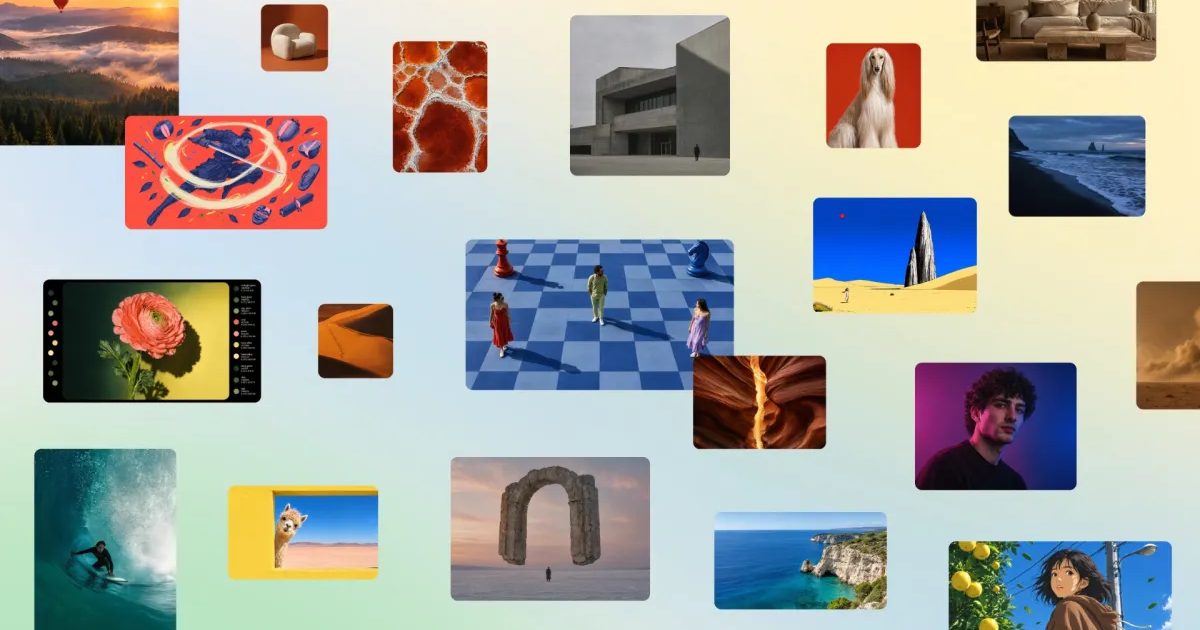
The popular design platform Canva has officially entered the AI image generation arena, announcing the first model developed by its internal research teams, named Canva Craft. The move places the company in direct competition with comparable models from Google, OpenAI, Meta and ByteDance — but with a different vision: a focus on functional design rather than general artistic imagery.
A Different Philosophy: Trained on Designs, Not Photographs
The most notable aspect of the new model isn't its size or speed, but the nature of the data it was trained on. According to the company, Canva Craft was not built on vast libraries of photographs, as is customary with generative models, but rather on templates actually created by humans from Canva's own library, including:
- Advertising and promotional posters
- Social media posts
- Presentations
- Infographics and illustrations
- Menus and designs rich in typography and text
This training choice explains the model's orientation: it isn't trying to produce a work of art, but design material ready for immediate commercial and marketing use — a meaningful practical difference for anyone working in digital marketing or visual identity management.
How Does the Model Work? Two Stages, Not One
Canva explained that the model operates through a workflow divided into two sequential stages:
Stage one — planning: The model analyzes the user's description (the prompt), then builds an internal "design plan" specifying details such as the spatial relationships between elements, the relative dimensions of each element, the visual hierarchy guiding the viewer's eye, along with the information needed to generate text within the design.
Stage two — execution: Based on that plan, the model produces an image at resolutions up to 2K, with a choice of around 30 different aspect ratios suited to a variety of publishing platforms, from vertical stories to website banners.
The company says this separation between planning and execution addresses two chronic problems in image generation models: distorted object details, and illegible generated text. It also allows users to make targeted edits to one part of a design without altering the remaining elements — a feature designers frequently request.
Integration with the Canva Ecosystem
The most practically significant advantage is that Canva Craft's outputs can be converted into layered, editable designs via the Magic Layers tool, which the company previously launched to turn images into structurally coherent designs. The image thus shifts from being a closed, final output to an open design project whose fonts, colors and elements can all be modified.
The model is currently available to all platform users through the Dream Lab tab, and will also be accessible via Canva's API. The company additionally plans to support image generation within external chatbots such as ChatGPT and Gemini through the MCP protocol, expanding the model's reach beyond the platform's walls.
Clear Economic Motives
Over the past period, Canva had relied on a range of third-party image generation models, which meant ongoing costs for using APIs belonging to other companies. Building an in-house model delivers tangible savings on those costs, alongside what the company described as better control over quality and speed.
Canva's 2024 acquisition of the generation platform Leonardo.ai appears to have been part of this plan, as the company confirmed that researchers from the Leonardo team contributed to developing the new model. It also noted that it is working on two lighter, lower-cost versions named Craft-fast and Craft-ultrafast, due for release soon to serve use cases requiring greater speed.
The Company's Financial Context
The announcement comes at a delicate moment for Canva. The company was on track to reach roughly $4 billion in revenue last year, but it lowered its growth forecasts for 2026 — a move that, according to outside analysts' estimates, drove its estimated market valuation down from $42 billion to around $35 billion.
In that context, Canva Craft can be read as a dual investment: improving cost margins on one hand, and strengthening competitive differentiation on the other. Rather than taking on general-purpose models on their own turf, Canva is choosing to specialize in what it knows better than anyone else: structured, editable design.
Conclusion
What Canva is offering isn't necessarily a more powerful model than its competitors', but one better suited to a specific use case. As pressure mounts on general-purpose generative models to prove their commercial viability, sector-specific specialization may be the most logical direction in the next phase of the generative AI market.
✦ بقلم فريق دروب أيديا
DROPIDEA
We hope this article has added real value to you. At DROPIDEA, we always strive to deliver high-quality content that helps you grow and evolve in the digital space. Follow us for more useful articles and guides.
Tags
Admin
DROPIDEA
Latest Articles
Short Seller Warned About Nvidia CEO's Ties Six Months Before the Scandal

Anthropic Pushes Ahead with IPO Plans Despite Market Turbulence

US Intelligence Memo: Alleged Recruitment Effort Targeting Nvidia's CEO

Independent Investigation at Nvidia into Its CEO's Relationship