Skip to content
ImagesFree

A Quiet Farewell Before a Great Journey

A cinematic vertical scene of a woman crossing her circular Shire doorway just before departure, faithful to the reference image with a low interior camera setup.

Image generation

Source previews

These example images come from the original source. DROPIDEA has not independently tested these examples; results depend on the model and settings.

Ready to personalize

Your prompt

English

Replace the red variables with your information. Copy the full prompt and use it with your preferred agent.

TXT MD English version
Use of the provided reference image is authorized exclusively to preserve maximum fidelity to the portrayed identity. Create a unique image, single frame, vertical 4:5, individual file, without grid, mosaic, collage, lettering or watermark, presenting a person with characteristics faithful to the reference image as the original protagonist of a cinematic narrative set in the Shire, without reinterpreting her identity, modifying face, body or natural proportions, and without reproducing actors, characters, figurines or official franchise framings. Portray the intimate instant immediately before the beginning of a great journey: the woman is crossing the large round door of a house built into a hill, with one foot still on the warm floor of the interior and the other already touching the damp path outside, as if she remained temporarily between two versions of her own life. Her body advances toward the road, but her face turns naturally over the shoulder to contemplate one last time the house she is leaving, without looking at the camera. The expression must simultaneously convey longing, courage, apprehension and a silent hope, without excessive dramatization; the eyes remain alive and emotionally present, while one of the hands begins to slowly release the brass doorknob and the other adjusts the strap of a worn leather travel bag. The body action must appear captured during a real event, with naturally distributed body weight, correct foot support, natural tension in the fingers, coherent articulations, clothing reacting to the movement and no appearance of planned pose. Fully preserve the human scale and proportions of the person, creating a wide circular door that is architecturally coherent with her height, without transforming her into a hobbit, dwarf or any existing character. Use the original traveler figurine from Middle-earth, maintaining aesthetic continuity with the first prompt: aged linen shirt with visible weave, wool vest, structured rustic pants, worn leather boots, artisan belt, small folded cloak attached to the luggage and discrete travel details, everything adapted naturally to the real body of the reference, without fantasy-store appearance, excess ornamentation or overly clean clothes. The fabrics must show weight, seams, folds, small signs of use and genuine reaction to the cold air that enters through the door. Build the interior of the house as a welcoming, lived-in and detailed environment: curved walls covered with plaster and artisan rendering, exposed beams, low furniture, shelves with old books, fireplace still lit, small candles, copper utensils, blankets, dried herbs, pottery and discrete signs of a recent farewell. On a partially visible table in the foreground, include an open parchment map, a mug with a steaming drink, an almost finished candle, a small key and crumbs from an interrupted meal — elements that suggest the decision to leave has just been made. Outside, reveal green hills covered in dew, irregular wooden fences, wildflowers, old trees, small round houses illuminated in the distance and a winding road that progressively disappears into the morning mist. The scenario must not function as mere decoration: the interior represents security and memory, while the exterior path represents uncertainty and transformation. Photograph the scene from inside the house, in an oblique and low position, approximately at table height, using a lens equivalent to 35 mm with natural perspective and controlled distortion. Avoid frontal or symmetrical framing of the door: position the circular opening off-center, with the woman occupying one of the vertical thirds and the road forming a visual curve that crosses the composition according to the golden ratio. The camera must be partially hidden by out-of-focus domestic elements, such as the edge of the table, the mug and the candle flame, creating the sensation that we are silently observing the departure.
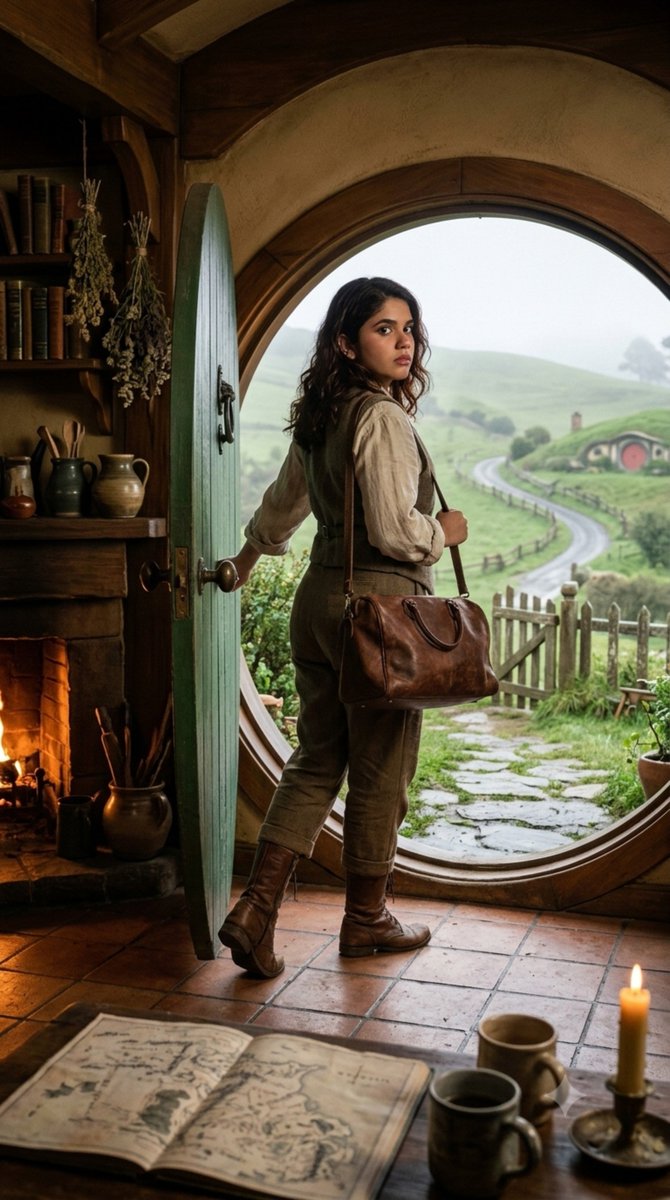
Preview results

Your prompt

Use of the provided reference image is authorized exclusively to preserve maximum fidelity to the portrayed identity. Create a unique image, single frame, vertical 4:5, individual file, without grid, mosaic, collage, lettering or watermark, presenting a person with characteristics faithful to the reference image as the original protagonist of a cinematic narrative set in the Shire, without reinterpreting her identity, modifying face, body or natural proportions, and without reproducing actors, characters, figurines or official franchise framings. Portray the intimate instant immediately before the beginning of a great journey: the woman is crossing the large round door of a house built into a hill, with one foot still on the warm floor of the interior and the other already touching the damp path outside, as if she remained temporarily between two versions of her own life. Her body advances toward the road, but her face turns naturally over the shoulder to contemplate one last time the house she is leaving, without looking at the camera. The expression must simultaneously convey longing, courage, apprehension and a silent hope, without excessive dramatization; the eyes remain alive and emotionally present, while one of the hands begins to slowly release the brass doorknob and the other adjusts the strap of a worn leather travel bag. The body action must appear captured during a real event, with naturally distributed body weight, correct foot support, natural tension in the fingers, coherent articulations, clothing reacting to the movement and no appearance of planned pose. Fully preserve the human scale and proportions of the person, creating a wide circular door that is architecturally coherent with her height, without transforming her into a hobbit, dwarf or any existing character. Use the original traveler figurine from Middle-earth, maintaining aesthetic continuity with the first prompt: aged linen shirt with visible weave, wool vest, structured rustic pants, worn leather boots, artisan belt, small folded cloak attached to the luggage and discrete travel details, everything adapted naturally to the real body of the reference, without fantasy-store appearance, excess ornamentation or overly clean clothes. The fabrics must show weight, seams, folds, small signs of use and genuine reaction to the cold air that enters through the door. Build the interior of the house as a welcoming, lived-in and detailed environment: curved walls covered with plaster and artisan rendering, exposed beams, low furniture, shelves with old books, fireplace still lit, small candles, copper utensils, blankets, dried herbs, pottery and discrete signs of a recent farewell. On a partially visible table in the foreground, include an open parchment map, a mug with a steaming drink, an almost finished candle, a small key and crumbs from an interrupted meal — elements that suggest the decision to leave has just been made. Outside, reveal green hills covered in dew, irregular wooden fences, wildflowers, old trees, small round houses illuminated in the distance and a winding road that progressively disappears into the morning mist. The scenario must not function as mere decoration: the interior represents security and memory, while the exterior path represents uncertainty and transformation. Photograph the scene from inside the house, in an oblique and low position, approximately at table height, using a lens equivalent to 35 mm with natural perspective and controlled distortion. Avoid frontal or symmetrical framing of the door: position the circular opening off-center, with the woman occupying one of the vertical thirds and the road forming a visual curve that crosses the composition according to the golden ratio. The camera must be partially hidden by out-of-focus domestic elements, such as the edge of the table, the mug and the candle flame, creating the sensation that we are silently observing the departure.

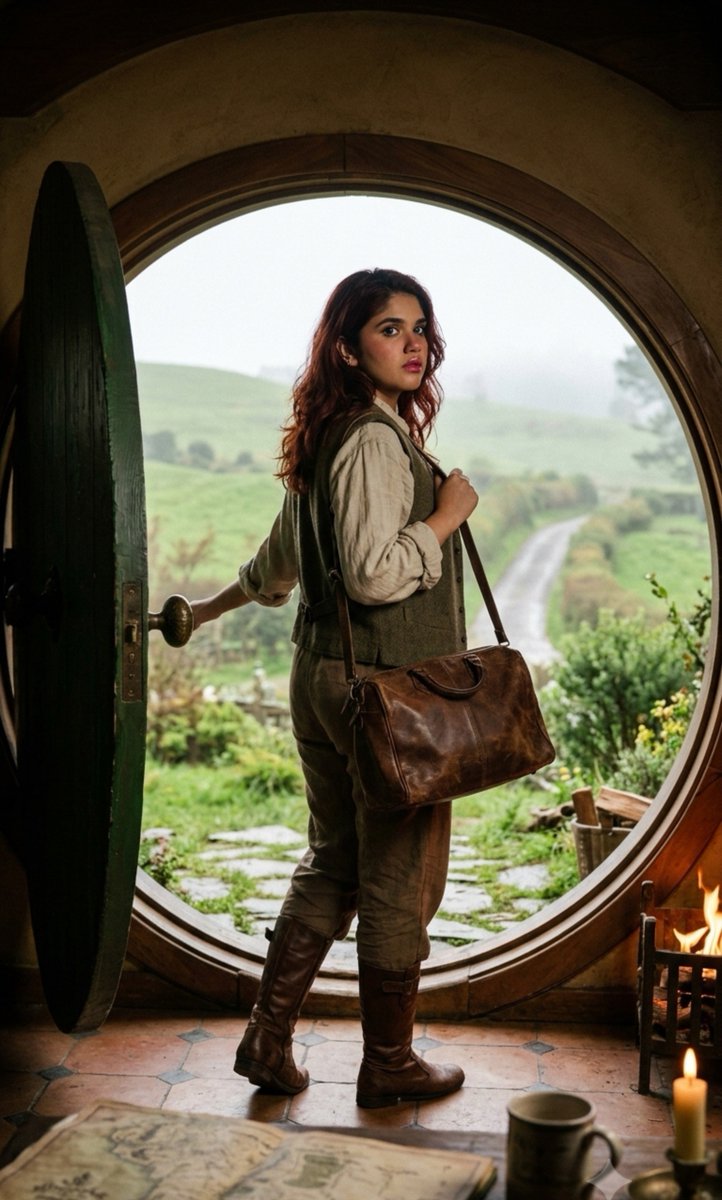
Variable guide

the Shire

The narrative setting of the scene.

"a cinematic narrative set in the Shire".

Example value

an old English countryside

35 mm

The equivalent focal length.

"a lens equivalent to 35 mm".

Example value

50 mm

the woman

The human subject description.

occurrences of "the woman" in the template.

Example value

a male traveler

What you get

  • A single cinematic vertical 4:5 frame with no text or watermarks.
  • A low oblique interior shot with a 35 mm equivalent lens and foreground domestic elements out of focus.
  • Rich fabric, furnishing and outdoor details expressing safety and transformation.

Use cases

  • Story covers or fantasy books with a consistent human character.
  • Storyboard panels for farewell scenes.
  • Cinematic visuals for travel or personal transformation campaigns.

How to use

  • Upload a clear reference image of the person; it is required to preserve identity fidelity.
  • Replace editable values such as "the Shire" if desired while keeping technical constraints intact.
  • Paste the template into a reference-image-capable generator and choose a vertical 4:5 ratio.
  • Review the output to confirm no grid, text, watermark or identity drift.
  • Regenerate as needed using the same reference image for character continuity.

Related prompts