Skip to content
ImagesFree

Embroidered Travel Patch Editorial Posters From Photos

Turns each travel photo you upload into a standalone 3:4 vertical editorial poster pairing the original photo, lightly color-graded, on top with a hand-embroidered cloth patch of one extracted subject below, complete with embroidered title text, a patch number field, and a short English observation sentence. Fabric color and thread colors adapt to each photo.

OpenAI

Source previews

These example images come from the original source. DROPIDEA has not independently tested these examples; results depend on the model and settings.

Ready to personalize

Your prompt

English

Replace the red variables with your information. Copy the full prompt and use it with your preferred agent.

TXT MD English version
Please turn each of the travel photos I upload into an independent, high-end editorial poster of an "embroidered travel cloth patch," without tiling multiple images together — output each photo separately. Use an overall 3:4 vertical original-photo comparison composition. The upper half must clearly keep the original photo with substantial area; the lower half presents a single embroidered travel subject extracted from the same photo. Each half usually occupies about 50%, and may be adjusted slightly according to the photo's proportions, but the original-photo comparison must not be removed. In the upper half, preserve the subject's identity, quantity, pose, structure, viewing angle, environmental relationships, real materials, natural light and shadow, and original colors in high fidelity. Only apply subtle travel-magazine and art-publication color grading. The upper half must remain a real photographic work — do not illustrate it, replace the scene, add or remove subjects, or alter the structure of buildings or vehicles. When the original photo's proportions do not fit the horizontal area, center it while preserving its own aspect ratio, and fill the remaining space with solid-color side panels using the lower half's fabric base color. Do not stretch, mirror, or fill the sides with a blurred photo. In the lower half, do not embroider the entire photo. Select only one core subject with the strongest recognizability and clearest silhouette from the photo, for example a tram, a boat, a bicycle, a hot-air balloon, an animal, a figure with a clear action, or a travel object. Preserve the outer silhouette, orientation, pose, key structures, and signature color blocks that define the subject's identity, and remove building groups, streets, sky, water, mountains, trees, and other complex backgrounds. The subject should use a reduced and refined or single-object display composition, occupying about 28%–52% of the width and 30%–50% of the height of the lower area, usually placed in the center or lower-center. Reserve about 45%–65% of the surrounding space as continuous, complete fabric negative space without fragmentary decorations. You may add 2–5 short stitches to suggest tracks, water ripples, wind direction, ground, or the direction of motion, but they must not develop into a complete background, and no second visual subject may appear. The lower background is a single, visibly real piece of twill, old canvas, coarse cotton, or linen. The fabric base color must be extracted from the original photo and adapt to each photo — for example grey-blue, terracotta pink, blue-green, smoky blue-grey, warm beige, or other low-saturation colors. Do not fix the same off-white fabric for all photos. Use real satin stitch, split stitch, chain stitch, backstitch, and a small amount of loose thread to construct the subject. The stitch direction must change according to the subject's volumes, structure, and motion: metal, wood, clothing, animal fur, wheels, hull, balloon, or plants need to be rendered with different stitch directions, lengths, and thread pile heights. Locally allow thread buildup, slightly uneven stitches, misaligned edges, exposed ground fabric, loose threads, thread ends, and wrinkled cloth surface, so it looks like hand embroidery actually sewn onto cloth rather than a printed illustration or digital filter. For each piece, extract 4–8 thread colors from the original photo, preserve the subject's most recognizable color relationships, then appropriately summarize and soften them. Do not use fixed rainbow threads, neon gradients, or high-saturation clashing colors unrelated to the photo. Text is concentrated below the embroidered subject, using lower-pile chain stitches, small woven labels, or cloth embroidery. By default include a title of 1–3 English words, a field in the style of "PATCH NO. 01", and a short observation sentence of 5–10 English words. The text content must be distilled from the truly visible subject, action, or state in the photo, and must be clearly legible…
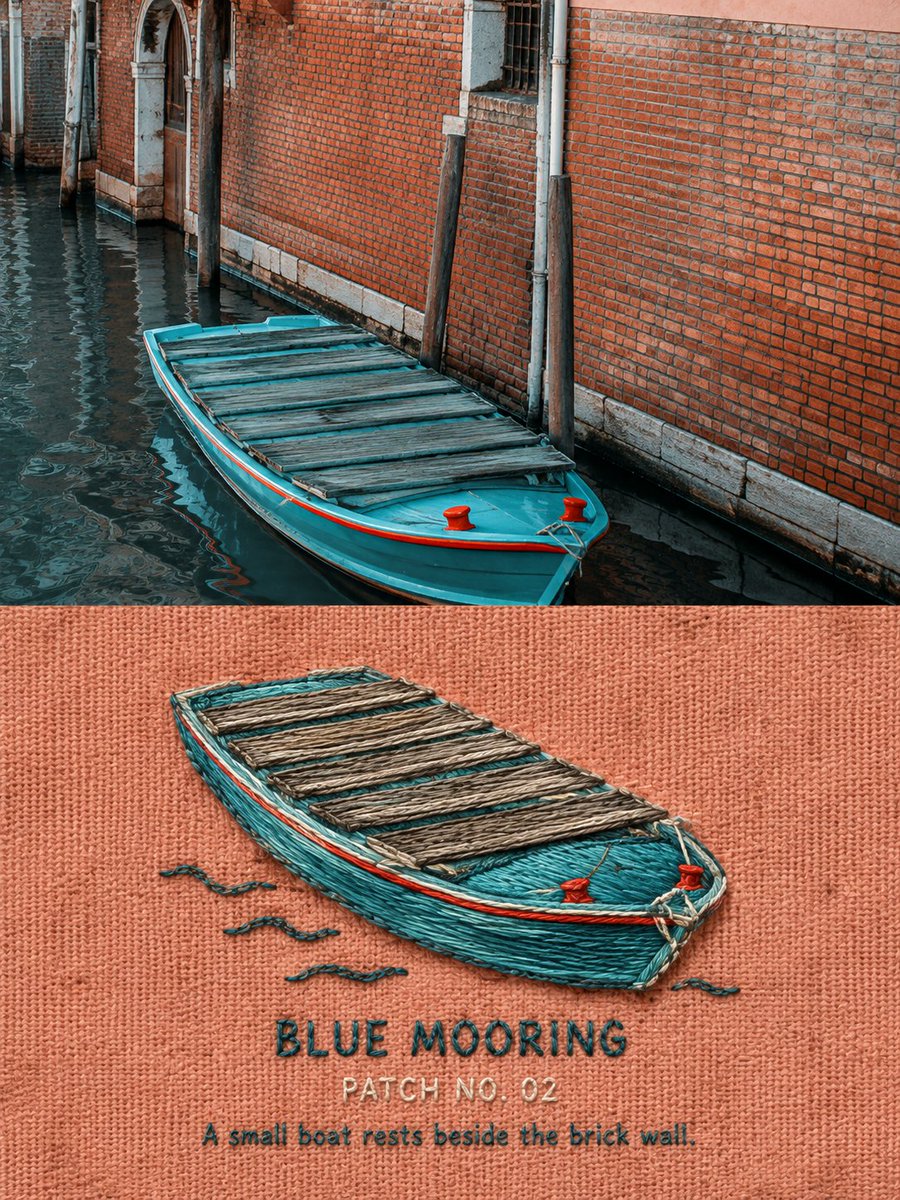
Preview results

Your prompt

Please turn each of the travel photos I upload into an independent, high-end editorial poster of an "embroidered travel cloth patch," without tiling multiple images together — output each photo separately. Use an overall 3:4 vertical original-photo comparison composition. The upper half must clearly keep the original photo with substantial area; the lower half presents a single embroidered travel subject extracted from the same photo. Each half usually occupies about 50%, and may be adjusted slightly according to the photo's proportions, but the original-photo comparison must not be removed. In the upper half, preserve the subject's identity, quantity, pose, structure, viewing angle, environmental relationships, real materials, natural light and shadow, and original colors in high fidelity. Only apply subtle travel-magazine and art-publication color grading. The upper half must remain a real photographic work — do not illustrate it, replace the scene, add or remove subjects, or alter the structure of buildings or vehicles. When the original photo's proportions do not fit the horizontal area, center it while preserving its own aspect ratio, and fill the remaining space with solid-color side panels using the lower half's fabric base color. Do not stretch, mirror, or fill the sides with a blurred photo. In the lower half, do not embroider the entire photo. Select only one core subject with the strongest recognizability and clearest silhouette from the photo, for example a tram, a boat, a bicycle, a hot-air balloon, an animal, a figure with a clear action, or a travel object. Preserve the outer silhouette, orientation, pose, key structures, and signature color blocks that define the subject's identity, and remove building groups, streets, sky, water, mountains, trees, and other complex backgrounds. The subject should use a reduced and refined or single-object display composition, occupying about 28%–52% of the width and 30%–50% of the height of the lower area, usually placed in the center or lower-center. Reserve about 45%–65% of the surrounding space as continuous, complete fabric negative space without fragmentary decorations. You may add 2–5 short stitches to suggest tracks, water ripples, wind direction, ground, or the direction of motion, but they must not develop into a complete background, and no second visual subject may appear. The lower background is a single, visibly real piece of twill, old canvas, coarse cotton, or linen. The fabric base color must be extracted from the original photo and adapt to each photo — for example grey-blue, terracotta pink, blue-green, smoky blue-grey, warm beige, or other low-saturation colors. Do not fix the same off-white fabric for all photos. Use real satin stitch, split stitch, chain stitch, backstitch, and a small amount of loose thread to construct the subject. The stitch direction must change according to the subject's volumes, structure, and motion: metal, wood, clothing, animal fur, wheels, hull, balloon, or plants need to be rendered with different stitch directions, lengths, and thread pile heights. Locally allow thread buildup, slightly uneven stitches, misaligned edges, exposed ground fabric, loose threads, thread ends, and wrinkled cloth surface, so it looks like hand embroidery actually sewn onto cloth rather than a printed illustration or digital filter. For each piece, extract 4–8 thread colors from the original photo, preserve the subject's most recognizable color relationships, then appropriately summarize and soften them. Do not use fixed rainbow threads, neon gradients, or high-saturation clashing colors unrelated to the photo. Text is concentrated below the embroidered subject, using lower-pile chain stitches, small woven labels, or cloth embroidery. By default include a title of 1–3 English words, a field in the style of "PATCH NO. 01", and a short observation sentence of 5–10 English words. The text content must be distilled from the truly visible subject, action, or state in the photo, and must be clearly legible…

Variable guide

PATCH NO. 01

The patch number in the "PATCH NO. 01" field; change 01 for each photo to number the series, keeping the field format unchanged.

In the text paragraph near the end of the English template, in the phrase: a field in the style of "PATCH NO. 01" (Arabic template: حقلًا بنمط «PATCH NO. 01»)

Example value

PATCH NO. 02

What you get

  • A 3:4 vertical poster per photo, split into two mirrored halves of about 50% each.
  • An upper half preserving the original photo with subtle travel-magazine color grading.
  • A lower half showing a single hand-embroidered subject on real fabric whose base color is extracted from the photo.
  • Embroidered text with a 1–3 English-word title, a "PATCH NO. 01" field, and a 5–10 English-word observation sentence.

Use cases

  • A commemorative poster series for a trip or travel blog.
  • Framed prints and editorial-style cards.
  • Social media content for travel brands and craft products.
  • Visual identity or packaging for a travel-gear shop.

How to use

  • Upload one or more travel photos (the photos are required as uploads, since they are the source of both the top half and the embroidered subject).
  • If you want numbered patches, edit the number in "PATCH NO. 01" in the text paragraph to the desired value for each photo.
  • Submit the request; one independent poster will be produced per photo, without merging photos together.
  • Review the result and repeat for the remaining photos to build a cohesive poster series.

Related prompts