Skip to content
ImagesFree

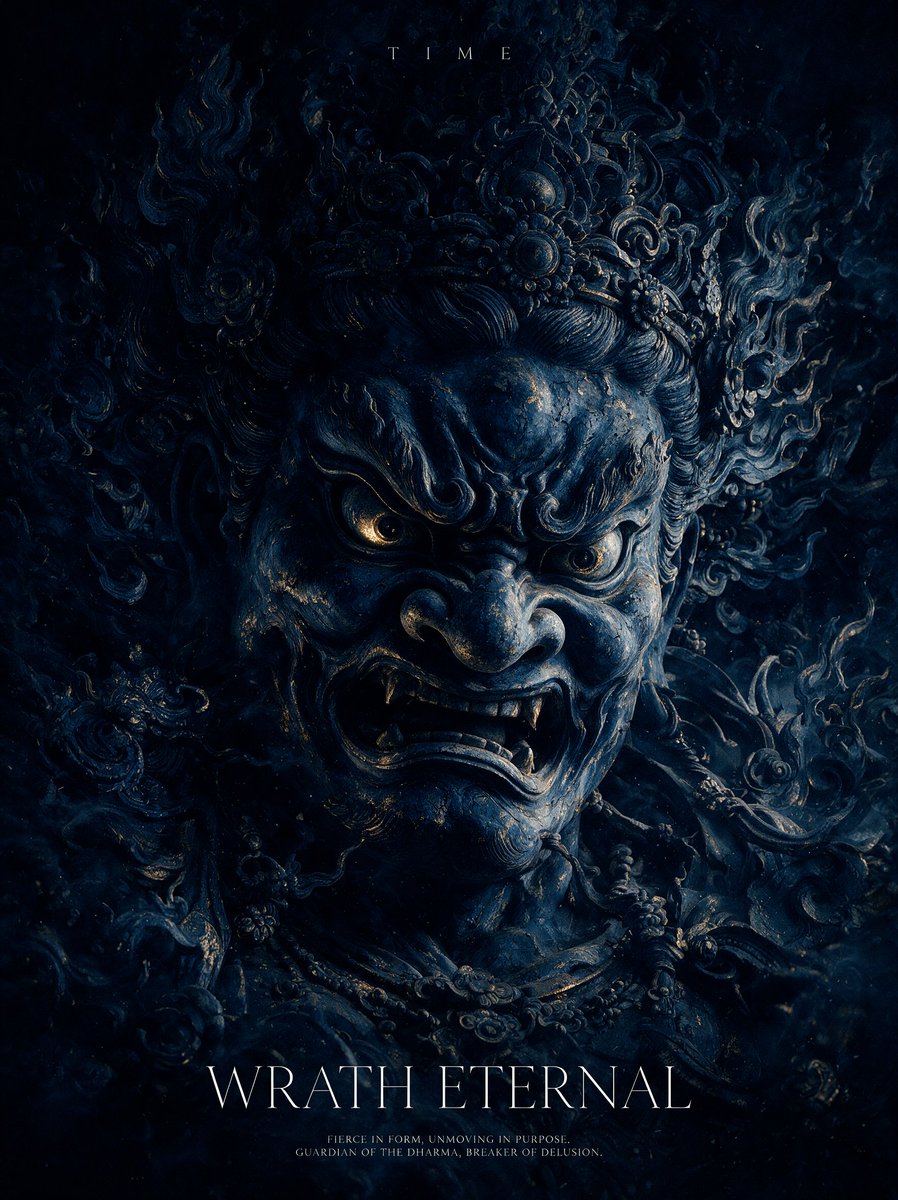
Wrath Eternal: Nara Vajra Guardian Dark Poster

Fully Arabic-localized prompt that generates a dark vertical art poster: an extreme close-up of a wrathful Kongō Rikishi (Vajra Guardian) inspired by ancient Nara temple sculpture, blending hand-carved woodblock textures, chiaroscuro lighting, navy-black tones, restrained antique-gold accents, and minimal English typography.

Image generation

Source previews

These example images come from the original source. DROPIDEA has not independently tested these examples; results depend on the model and settings.

Ready to personalize

Your prompt

English

Replace the red variables with your information. Copy the full prompt and use it with your preferred agent.

TXT MD English version
WRATH ETERNAL Prompt Share 172: vertical dark artistic poster dominated by deep navy blue and indigo-black, with pure white and antique gold used only as subtle accents. Avant-garde and experimental visual language, gradient mapping, aged grain, weathered stone, cracked wood carving, peeling gold leaf, and rough textures eroded by centuries of time. The central subject is an extreme close-up portrait of a wrathful Kongō Rikishi (Vajra Guardian), drawing from the visual language of ancient Buddhist sculptures, wooden carvings, and relief sculptures found in the old temples of Nara, Japan. The enormous face of the guardian fills almost the entire composition, viewed from slightly below in a dramatic low-angle perspective, creating an overwhelming sense of pressure, monumentality, and sacred authority. The Kongō Rikishi stares fiercely with wide-open, powerful eyes. The brow ridge is strongly pronounced, with eyebrows curling outward like flames. The nostrils flare, facial muscles are intensely contracted, and clenched teeth reveal subtle fangs. The corners of the mouth and cheekbones carry extreme dynamic tension. The expression is ferocious and wrathful, yet never evil—it represents the solemn wrath of a divine guardian protecting the Dharma and suppressing malevolent forces. The facial structure should possess the distinctive sculptural quality of ancient Nara Buddhist statuary, emphasizing massive volume, archaic proportions, and visible traces of hand carving. The surface should not resemble realistic human skin. Instead, it should feel like an ancient hybrid of carved wood, lacquer, and aged metal that has survived for a thousand years. The surface is covered with delicate cracks, chisel marks, abrasion, oxidation, smoke stains, and remnants of antique gold leaf. Beneath layers of deep navy and blue-black lacquer, traces of dark aged gold subtly emerge, giving the sculpture an extraordinarily rich sense of history and material depth. Surrounding the head are intricate and turbulent flame motifs, swirling cloud patterns, sacred floral ornaments, jeweled Buddhist garlands, vajras, and elaborate Buddhist decorative motifs. Dense Nara-style relief carvings emerge faintly from the darkness. The ornamentation is extraordinarily elaborate and maximalist, yet the composition maintains a clear visual center, creating the impression of a masterpiece of maximalist sacred art. Use an extreme close-up composition. Parts of the crown, shoulders, flames, and ornaments extend beyond the edges of the frame, making the guardian appear far too monumental to be contained within the poster itself. The background disappears into an almost-black navy abyss, leaving only faint traces of ancient temple carvings, drifting smoke, suspended dust, and indistinct Buddhist patterns. The figure seems to emerge directly from the darkness. Lighting should feature intense chiaroscuro. A single, extremely subtle warm golden sidelight grazes across the guardian’s eyes, brow ridge, nose bridge, fangs, and carved surface textures, while the opposite side gradually disappears into deep navy shadow. The eyes may contain an extremely subtle reflection of aged gold, but avoid modern fantasy-style glowing eyes or supernatural neon effects. The overall aesthetic should feel like a fusion of: Ancient Nara Buddhist temple sculpture × traditional hand-carved woodblock print × ancient Buddhist painting × contemporary avant-garde graphic design. Emphasize hand-drawn qualities, printmaking textures, engraved lines, carving marks, and aged printing grain. Avoid polished, glossy, or overly smooth CGI aesthetics. The atmosphere is mysterious, silent, solemn, dangerous, and sacred, expressing the Eastern Buddhist aesthetic of “the Vajra Guardian glares in wrath, while the Bodhisattva lowers the gaze in compassion.” The image should feel overwhelmingly powerful and intimidating while remaining restrained, sophisticated, dignified, and meditative. High contrast, deep black shadows, navy gradients, restrained antique-gold accents, rough grain, intricate carving, ultra-high-density details, a stable and strongly focused visual center, museum-grade East Asian sacred art aesthetics, premium commercial art poster design, luxurious yet restrained, avant-garde high-art editorial poster aesthetics. At the top center, place extremely small, ultra-thin, widely tracked sans-serif English typography: TIME At the bottom center, place the main English title in an elegant, ultra-thin, high-contrast serif typeface: WRATH ETERNAL Below it, in extremely small English typography: FIERCE IN FORM, UNMOVING IN PURPOSE. GUARDIAN OF THE DHARMA, BREAKER OF DELUSION. The typography must never compete with the main subject. Keep the graphic layout extremely minimal and restrained, creating a strong visual contrast between the minimalist typography and the extraordinarily intricate, maximalist sculpture above. Image:Seedream 5 Pro on @capcutapp_jp
Preview results

Your prompt

WRATH ETERNAL Prompt Share 172: vertical dark artistic poster dominated by deep navy blue and indigo-black, with pure white and antique gold used only as subtle accents. Avant-garde and experimental visual language, gradient mapping, aged grain, weathered stone, cracked wood carving, peeling gold leaf, and rough textures eroded by centuries of time. The central subject is an extreme close-up portrait of a wrathful Kongō Rikishi (Vajra Guardian), drawing from the visual language of ancient Buddhist sculptures, wooden carvings, and relief sculptures found in the old temples of Nara, Japan. The enormous face of the guardian fills almost the entire composition, viewed from slightly below in a dramatic low-angle perspective, creating an overwhelming sense of pressure, monumentality, and sacred authority. The Kongō Rikishi stares fiercely with wide-open, powerful eyes. The brow ridge is strongly pronounced, with eyebrows curling outward like flames. The nostrils flare, facial muscles are intensely contracted, and clenched teeth reveal subtle fangs. The corners of the mouth and cheekbones carry extreme dynamic tension. The expression is ferocious and wrathful, yet never evil—it represents the solemn wrath of a divine guardian protecting the Dharma and suppressing malevolent forces. The facial structure should possess the distinctive sculptural quality of ancient Nara Buddhist statuary, emphasizing massive volume, archaic proportions, and visible traces of hand carving. The surface should not resemble realistic human skin. Instead, it should feel like an ancient hybrid of carved wood, lacquer, and aged metal that has survived for a thousand years. The surface is covered with delicate cracks, chisel marks, abrasion, oxidation, smoke stains, and remnants of antique gold leaf. Beneath layers of deep navy and blue-black lacquer, traces of dark aged gold subtly emerge, giving the sculpture an extraordinarily rich sense of history and material depth. Surrounding the head are intricate and turbulent flame motifs, swirling cloud patterns, sacred floral ornaments, jeweled Buddhist garlands, vajras, and elaborate Buddhist decorative motifs. Dense Nara-style relief carvings emerge faintly from the darkness. The ornamentation is extraordinarily elaborate and maximalist, yet the composition maintains a clear visual center, creating the impression of a masterpiece of maximalist sacred art. Use an extreme close-up composition. Parts of the crown, shoulders, flames, and ornaments extend beyond the edges of the frame, making the guardian appear far too monumental to be contained within the poster itself. The background disappears into an almost-black navy abyss, leaving only faint traces of ancient temple carvings, drifting smoke, suspended dust, and indistinct Buddhist patterns. The figure seems to emerge directly from the darkness. Lighting should feature intense chiaroscuro. A single, extremely subtle warm golden sidelight grazes across the guardian’s eyes, brow ridge, nose bridge, fangs, and carved surface textures, while the opposite side gradually disappears into deep navy shadow. The eyes may contain an extremely subtle reflection of aged gold, but avoid modern fantasy-style glowing eyes or supernatural neon effects. The overall aesthetic should feel like a fusion of: Ancient Nara Buddhist temple sculpture × traditional hand-carved woodblock print × ancient Buddhist painting × contemporary avant-garde graphic design. Emphasize hand-drawn qualities, printmaking textures, engraved lines, carving marks, and aged printing grain. Avoid polished, glossy, or overly smooth CGI aesthetics. The atmosphere is mysterious, silent, solemn, dangerous, and sacred, expressing the Eastern Buddhist aesthetic of “the Vajra Guardian glares in wrath, while the Bodhisattva lowers the gaze in compassion.” The image should feel overwhelmingly powerful and intimidating while remaining restrained, sophisticated, dignified, and meditative. High contrast, deep black shadows, navy gradients, restrained antique-gold accents, rough grain, intricate carving, ultra-high-density details, a stable and strongly focused visual center, museum-grade East Asian sacred art aesthetics, premium commercial art poster design, luxurious yet restrained, avant-garde high-art editorial poster aesthetics. At the top center, place extremely small, ultra-thin, widely tracked sans-serif English typography: TIME At the bottom center, place the main English title in an elegant, ultra-thin, high-contrast serif typeface: WRATH ETERNAL Below it, in extremely small English typography: FIERCE IN FORM, UNMOVING IN PURPOSE. GUARDIAN OF THE DHARMA, BREAKER OF DELUSION. The typography must never compete with the main subject. Keep the graphic layout extremely minimal and restrained, creating a strong visual contrast between the minimalist typography and the extraordinarily intricate, maximalist sculpture above. Image:Seedream 5 Pro on @capcutapp_jp

Variable guide

WRATH ETERNAL

The main English poster title; appears twice: first line of the template and the bottom-center title line.

Replace both occurrences: the template's first line and the "WRATH ETERNAL" line after the bottom-center title paragraph.

Example value

SILENT WRATH

TIME

The tiny English word at top center; keep it one short uppercase word.

The "TIME" line after the "At the top center..." (Arabic: في أعلى المنتصف...) paragraph.

Example value

VOID

FIERCE IN FORM, UNMOVING IN PURPOSE. GUARDIAN OF THE DHARMA, BREAKER OF DELUSION.

The two-line English closing tagline; the replacement must be two short uppercase lines, each ending with a period.

The two consecutive lines after the Arabic sentence meaning "Below it, in extremely small English typography:".

Example value

FIERCE IN SPIRIT, IMMOVABLE IN SOUL. WARDEN OF THE FLAME, KEEPER OF THE LAW.

Seedream 5 Pro on @capcutapp_jp

The generation credit line (model and tool).

The final line: "الصورة:Seedream 5 Pro on @capcutapp_jp".

Example value

Seedream 5 Pro on @capcutapp_jp

What you get

  • A dark vertical poster dominated by deep navy and indigo-black with restrained antique-gold accents.
  • A monumental extreme close-up of a wrathful Kongō Rikishi in low-angle perspective, textured like cracked carved wood, lacquer, and aged metal.
  • Dense Nara-style flame, cloud, garland, and vajra reliefs emerging from a near-black abyss.
  • Chiaroscuro lighting with a subtle warm golden sidelight, rough grain, ultra-high-density museum-grade details.
  • Minimal English typography: TIME at top center and WRATH ETERNAL with a two-line tagline at bottom center.

Use cases

  • Artistic wall posters and premium printed décor.
  • Visual identity for art exhibitions, meditation or yoga studios, and Asian cultural events.
  • Social media artwork and digital covers with a refined avant-garde character.
  • Editorial and luxury commercial print material inspired by East Asian sacred art.

How to use

  • Copy the full Arabic prompt and paste it into the image tool named in the credit line (Seedream 5 Pro via @capcutapp_jp) or any similar generator.
  • Edit the creative variables before generating: the main title WRATH ETERNAL, the top word TIME, and the two-line closing tagline, keeping all of them in English and uppercase.
  • The prompt requires no reference images or uploads; text input alone is sufficient.
  • Request a vertical (poster) aspect ratio and generate; retry as needed since generative results vary.
  • If glowing or modern neon eyes appear, regenerate while stressing the negative instruction in the lighting paragraph.

Related prompts