Skip to content
ImagesFree

Cinematic Realistic Vehicle Design Board Prompt

A comprehensive English prompt for creating a cinematic realistic design board of the VANTA prototype racer: hero shot, five-view turnaround, aero study, beauty shot, component breakdown, material swatches, annotation callouts, and production notes. Requires an attached reference image for exact vehicle match.

OpenAI

Source previews

These example images come from the original source. DROPIDEA has not independently tested these examples; results depend on the model and settings.

Ready to personalize

Your prompt

English

Replace the red variables with your information. Copy the full prompt and use it with your preferred agent.

TXT MD English version
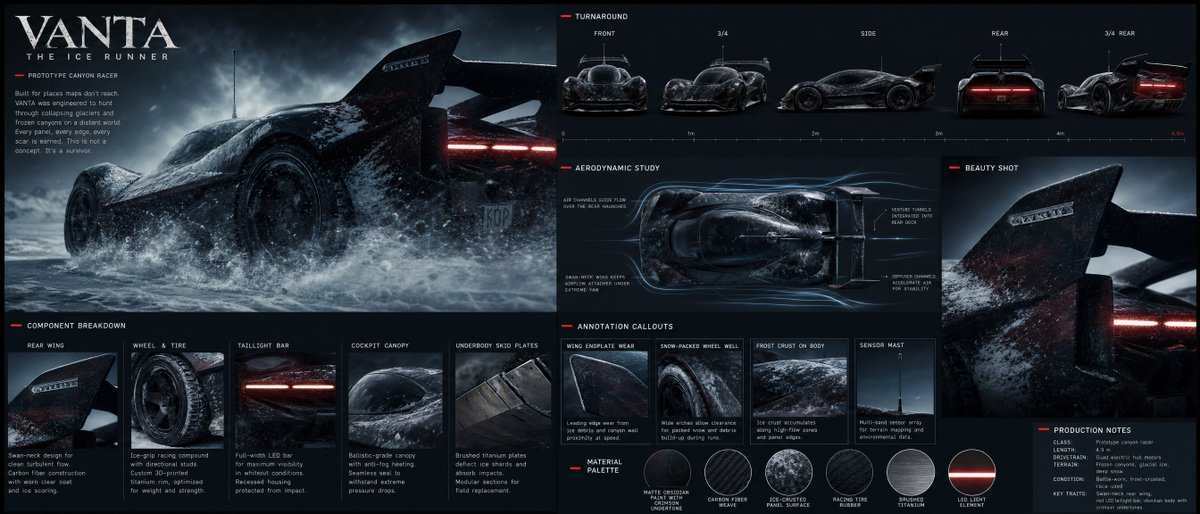
Car character sheet prompt by ChatGPT Image 2 : Create a cinematic realistic vehicle design board for a high-budget film production. Avoid generic grids, perfect symmetry, or template-style layouts. The composition should feel art-directed, slightly asymmetrical, and visually intentional like a premium movie pitch presentation. Design a futuristic prototype racing machine with grounded engineering logic, believable aerodynamic construction, weathered surfaces, and real-world material behavior. VEHICLE: VANTA — THE ICE RUNNER A prototype canyon racer built for frozen alien terrain. Low-slung monocoque hull in matte obsidian black with deep crimson undertones surfacing through the paint. Every panel carries frost crust, snow spray residue, and micro-scratches from ice debris. Built to survive collapsing glaciers, not showrooms. Visual description: Low aggressive silhouette with sculpted rear haunches and wide muscular fenders. Oversized swan-neck rear wing with sharp angular endplates, carbon fiber construction with worn edges. Slim horizontal LED taillight bar glowing warm red. Wide low-profile racing tires with ice-grip tread, snow packed into the wheel wells. Sensor mast antenna on the roofline. Enclosed cockpit canopy in dark tinted glass. Underbody skid plates in brushed titanium with scrape marks. Bodywork partially crusted in ice and blown snow. Include: * Large hero shot on the left (rear three-quarter, low angle, snow spray kicking off the rear tires) with the vehicle name as stylized typography header and the backstory blurb in small caption type beside it * Full vehicle turnaround — five views labeled FRONT, 3/4, SIDE, REAR, 3/4 REAR — with a length reference scale ruler in meters * Aerodynamic study panel — top-down view with airflow annotation lines over the wing and hull * Cinematic beauty shot — medium close-up on the rear wing and taillight bar, shallow depth of field, frost detail * Component breakdown — close-up details of the rear wing, wheel and tire, taillight bar, cockpit canopy, and underbody skid plates with caption notes * Material texture realism — six circular material swatches showing matte black paint with crimson undertone, carbon fiber weave, ice-crusted panel surface, racing tire rubber, brushed titanium, and LED light element * Annotation callouts — close-ups of key features (wing endplate wear, snow-packed wheel well, frost crust on body panel, sensor mast) * Production notes block Production notes: - Class: Prototype canyon racer - Length: 4.9 m - Drivetrain: Quad electric hub motors - Terrain: Frozen canyons, glacial ice, deep snow - Condition: Battle-worn, frost-crusted, race-used - Key traits: Swan-neck rear wing, red LED taillight bar, obsidian body with crimson undertones The vehicle should feel like a real machine captured mid-campaign, not a clean showroom render. Surfaces carry history — frost, scrapes, snow residue. Style: Photorealistic cinematic vehicle design, film-production quality, cold overcast arctic lighting with steel-blue grade and deep blacks, realistic materials, shallow depth of field on detail shots, premium studio presentation aesthetic. Background: dark moody environment with subtle frozen atmospheric haze, deep blacks, faint cold rim light. Typography: clean editorial sans-serif for labels and section headers, larger stylized display or serif treatment for the vehicle name. Important: Maintain strict consistency in silhouette, wing shape, body color, taillight design, wheel design, and weathering details across every angle and section. Maintain exact vehicle match to the attached reference image — same silhouette, rear wing geometry, body color with crimson undertones, taillight signature, snow weathering, and cold steel-blue color grade. Use the attached image as canonical vehicle DNA across all turnaround views, detail panels, and the beauty shot. Do not invent alternate body variants or drift from the reference.
Preview results

Your prompt

Car character sheet prompt by ChatGPT Image 2 : Create a cinematic realistic vehicle design board for a high-budget film production. Avoid generic grids, perfect symmetry, or template-style layouts. The composition should feel art-directed, slightly asymmetrical, and visually intentional like a premium movie pitch presentation. Design a futuristic prototype racing machine with grounded engineering logic, believable aerodynamic construction, weathered surfaces, and real-world material behavior. VEHICLE: VANTA — THE ICE RUNNER A prototype canyon racer built for frozen alien terrain. Low-slung monocoque hull in matte obsidian black with deep crimson undertones surfacing through the paint. Every panel carries frost crust, snow spray residue, and micro-scratches from ice debris. Built to survive collapsing glaciers, not showrooms. Visual description: Low aggressive silhouette with sculpted rear haunches and wide muscular fenders. Oversized swan-neck rear wing with sharp angular endplates, carbon fiber construction with worn edges. Slim horizontal LED taillight bar glowing warm red. Wide low-profile racing tires with ice-grip tread, snow packed into the wheel wells. Sensor mast antenna on the roofline. Enclosed cockpit canopy in dark tinted glass. Underbody skid plates in brushed titanium with scrape marks. Bodywork partially crusted in ice and blown snow. Include: * Large hero shot on the left (rear three-quarter, low angle, snow spray kicking off the rear tires) with the vehicle name as stylized typography header and the backstory blurb in small caption type beside it * Full vehicle turnaround — five views labeled FRONT, 3/4, SIDE, REAR, 3/4 REAR — with a length reference scale ruler in meters * Aerodynamic study panel — top-down view with airflow annotation lines over the wing and hull * Cinematic beauty shot — medium close-up on the rear wing and taillight bar, shallow depth of field, frost detail * Component breakdown — close-up details of the rear wing, wheel and tire, taillight bar, cockpit canopy, and underbody skid plates with caption notes * Material texture realism — six circular material swatches showing matte black paint with crimson undertone, carbon fiber weave, ice-crusted panel surface, racing tire rubber, brushed titanium, and LED light element * Annotation callouts — close-ups of key features (wing endplate wear, snow-packed wheel well, frost crust on body panel, sensor mast) * Production notes block Production notes: - Class: Prototype canyon racer - Length: 4.9 m - Drivetrain: Quad electric hub motors - Terrain: Frozen canyons, glacial ice, deep snow - Condition: Battle-worn, frost-crusted, race-used - Key traits: Swan-neck rear wing, red LED taillight bar, obsidian body with crimson undertones The vehicle should feel like a real machine captured mid-campaign, not a clean showroom render. Surfaces carry history — frost, scrapes, snow residue. Style: Photorealistic cinematic vehicle design, film-production quality, cold overcast arctic lighting with steel-blue grade and deep blacks, realistic materials, shallow depth of field on detail shots, premium studio presentation aesthetic. Background: dark moody environment with subtle frozen atmospheric haze, deep blacks, faint cold rim light. Typography: clean editorial sans-serif for labels and section headers, larger stylized display or serif treatment for the vehicle name. Important: Maintain strict consistency in silhouette, wing shape, body color, taillight design, wheel design, and weathering details across every angle and section. Maintain exact vehicle match to the attached reference image — same silhouette, rear wing geometry, body color with crimson undertones, taillight signature, snow weathering, and cold steel-blue color grade. Use the attached image as canonical vehicle DNA across all turnaround views, detail panels, and the beauty shot. Do not invent alternate body variants or drift from the reference.

Variable guide

VANTA — THE ICE RUNNER

The vehicle name shown in the stylized typography header

The line starting with «المركبة:» and the hero shot typography header in the Arabic template

Example value

ONYX — THE DUNE STRIDER

Built to survive collapsing glaciers, not showrooms.

The backstory blurb appearing beside the hero shot in small caption type

End of the vehicle description paragraph, before «الوصف البصري:» in the Arabic template

Example value

Built to endure eternal sandstorms, not city streets.

Prototype canyon racer

The vehicle class listed in the production notes

The «- الفئة:» line under «ملاحظات الإنتاج:» in the Arabic template

Example value

Prototype desert exploration truck

What you get

  • A photorealistic cinematic vehicle design board styled like a premium film pitch
  • A large rear three-quarter hero shot at low angle with stylized typography header and backstory caption
  • A five-view turnaround labeled FRONT, 3/4, SIDE, REAR, 3/4 REAR with a length scale ruler in meters
  • An aerodynamic top-down study with airflow annotation lines and a cinematic beauty shot with shallow depth of field
  • Component breakdown, six circular material swatches, annotation callouts, and a production notes block
  • Weathered surfaces with frost, scrapes, and snow residue under cold arctic lighting with a steel-blue grade

Use cases

  • Vehicle design boards for high-budget film productions and cinematic pitch decks
  • Character sheets for vehicles in video games, comics, and science fiction worlds
  • Concept presentation boards for vehicle design studios and 3D modeling workflows
  • Industrial design documentation for prototype vehicles in a professional style

How to use

  • Upload a reference image of your intended vehicle; the prompt requires it as canonical DNA for silhouette, wing, color, and weathering consistency
  • Replace VEHICLE_NAME with your vehicle's name keeping the em dash, and edit the VEHICLE_BACKSTORY sentence to match its story
  • Adjust VEHICLE_CLASS in the production notes if designing a different vehicle type, keeping technical values such as the 4.9 m length unless your specs change
  • Paste the full prompt together with the reference image into your image generator and run it
  • Review the output for strict consistency of silhouette, wing shape, body color, taillight design, and wheel design across every angle and section

Related prompts