Skip to content
ImagesFree

Scientific Poster Plate of Personal Sound Artifacts

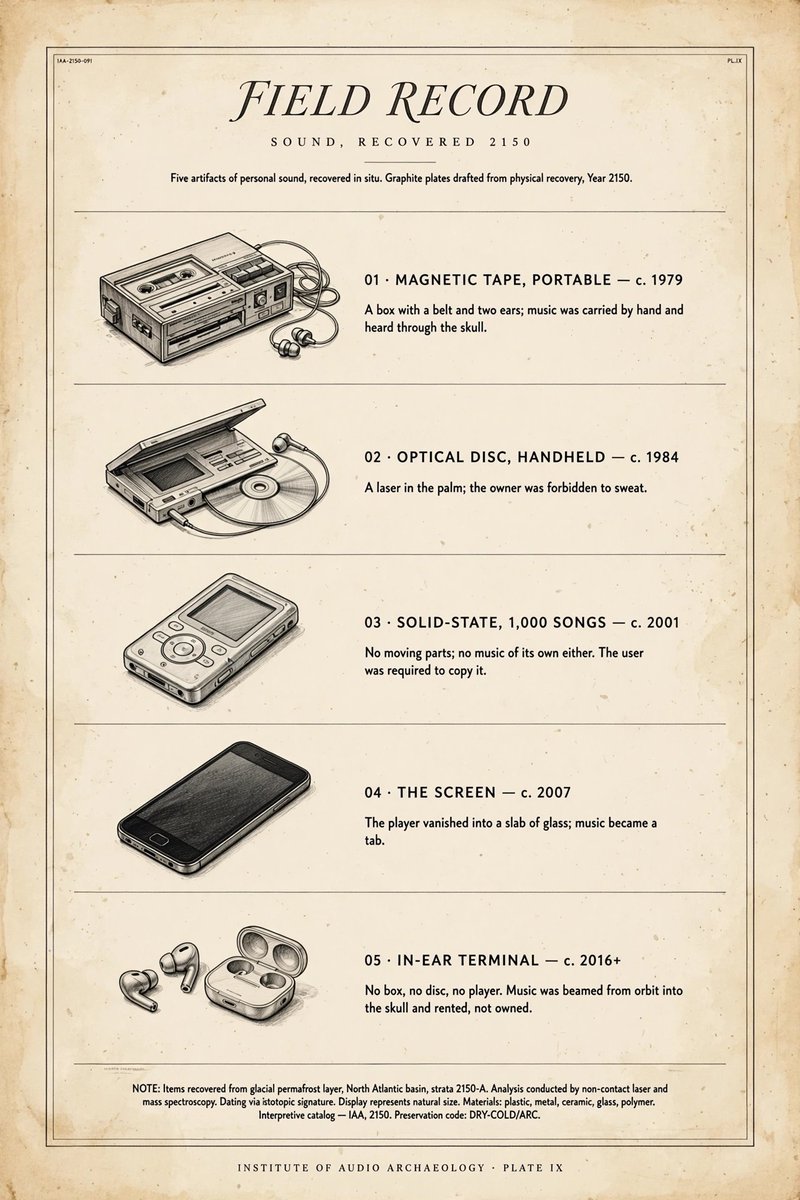
Full Arabic template for a photorealistic printed poster: a scientific plate from the year 2150 cataloguing five personal-sound artifacts (cassette, CD, MP3 player, smartphone, wireless earbuds) as graphite drawings with English catalog captions, ochre wash, 2:3 aspect ratio.

OpenAI

Source previews

These example images come from the original source. DROPIDEA has not independently tested these examples; results depend on the model and settings.
Ready to personalize

Your prompt

English

Replace the red variables with your information. Copy the full prompt and use it with your preferred agent.

TXT MD English version
A photorealistic printed poster filling the entire frame edge to edge, photographed flat and square-on, no room, no wall, no pins. A scientific plate on heavy cream paper: five artifacts of personal sound, recovered in the year 2150, arranged in five horizontal rows, each row a fine graphite drawing of the object at left with a catalog entry in small ruled type at right — row one: a portable cassette player with thin earbuds coiled beside it, "01 · MAGNETIC TAPE, PORTABLE — c. 1979. A box with a belt and two ears; music was carried by hand and heard through the skull." — row two: a handheld compact-disc player with a disc, "02 · OPTICAL DISC, HANDHELD — c. 1984. A laser in the palm; the owner was forbidden to sweat." — row three: a small silver MP3 player, "03 · SOLID-STATE, 1,000 SONGS — c. 2001. No moving parts; no music of its own either. The user was required to copy it." — row four: a black glass smartphone, "04 · THE SCREEN — c. 2007. The player vanished into a slab of glass; music became a tab." — row five: a pair of small wireless earbuds, "05 · IN-EAR TERMINAL — c. 2016+. No box, no disc, no player. Music was beamed from orbit into the skull and rented, not owned." Thin ruled lines divide the rows, a thin ruled border, small catalog numbers in the corners, a short paragraph of fine print at the foot. Title in italic serif: "FIELD RECORD". Beneath: "SOUND, RECOVERED 2150". Bottom: "INSTITUTE OF AUDIO ARCHAEOLOGY · PLATE IX". Cream, graphite, a wash of ochre, flat even light. 2:3 aspect ratio. 🔵 GPT Image 2: [img. 1] 🟣 Muse Image: [img. 2] RT + reply who you pick 👇 #AIart #GPTImage2 #MuseImage
Preview results

Your prompt

A photorealistic printed poster filling the entire frame edge to edge, photographed flat and square-on, no room, no wall, no pins. A scientific plate on heavy cream paper: five artifacts of personal sound, recovered in the year 2150, arranged in five horizontal rows, each row a fine graphite drawing of the object at left with a catalog entry in small ruled type at right — row one: a portable cassette player with thin earbuds coiled beside it, "01 · MAGNETIC TAPE, PORTABLE — c. 1979. A box with a belt and two ears; music was carried by hand and heard through the skull." — row two: a handheld compact-disc player with a disc, "02 · OPTICAL DISC, HANDHELD — c. 1984. A laser in the palm; the owner was forbidden to sweat." — row three: a small silver MP3 player, "03 · SOLID-STATE, 1,000 SONGS — c. 2001. No moving parts; no music of its own either. The user was required to copy it." — row four: a black glass smartphone, "04 · THE SCREEN — c. 2007. The player vanished into a slab of glass; music became a tab." — row five: a pair of small wireless earbuds, "05 · IN-EAR TERMINAL — c. 2016+. No box, no disc, no player. Music was beamed from orbit into the skull and rented, not owned." Thin ruled lines divide the rows, a thin ruled border, small catalog numbers in the corners, a short paragraph of fine print at the foot. Title in italic serif: "FIELD RECORD". Beneath: "SOUND, RECOVERED 2150". Bottom: "INSTITUTE OF AUDIO ARCHAEOLOGY · PLATE IX". Cream, graphite, a wash of ochre, flat even light. 2:3 aspect ratio. 🔵 GPT Image 2: [img. 1] 🟣 Muse Image: [img. 2] RT + reply who you pick 👇 #AIart #GPTImage2 #MuseImage

Variable guide

[img. 1]

First image insertion token; replace with the image generated by GPT Image 2.

The line starting with 🔵 at the end of the template.

Example value

[img. 1]

[img. 2]

Second image insertion token; replace with the image generated by Muse Image.

The line starting with 🟣 at the end of the template.

Example value

[img. 2]

What you get

  • A photorealistic edge-to-edge printed poster in 2:3 aspect ratio.
  • A scientific plate on heavy cream paper with five horizontal rows separated by thin ruled lines.
  • Fine graphite drawings of five sound devices with dated English catalog captions (1979 to 2016+).
  • Italic serif title "FIELD RECORD", subtitle "SOUND, RECOVERED 2150", and footer "INSTITUTE OF AUDIO ARCHAEOLOGY · PLATE IX".
  • Cream and graphite palette with a wash of ochre under flat even light.

Use cases

  • Social media AI-art posts comparing two image models.
  • Museum-style wall posters or printed décor.
  • Covers for articles or newsletters on the history of personal listening tech.
  • Visual educational material about audio devices from tape to streaming.

How to use

  • Copy the full Arabic template into a text-to-image tool such as GPT Image 2 or Muse Image.
  • Attach or reference the required images if your tool needs them; [img. 1] and [img. 2] mark the two result images for the social post.
  • Keep the quoted English captions (e.g. "FIELD RECORD", "SOUND, RECOVERED 2150") unchanged, as they must appear verbatim in the poster.
  • Optionally tweak only creative literals like the title or year, while keeping all digits, technical settings, and the 2:3 ratio intact.
  • Generate and review the five rows, catalog numbers, and ruled borders before finalizing.
  • Publish the result with the included hashtags and let the audience pick their favorite model.

Related prompts