Skip to content
ImagesFree

City Pass Diorama Posters From Travel Photos

A 3:4 vertical comparison format preserving the original photo on top while re-rendering the scene below as an old paper handheld city pass card with a rising landmark, graphite study lines, and printed text like PASS STUDY 01. One poster per uploaded photo, no collage.

OpenAI

Source previews

These example images come from the original source. DROPIDEA has not independently tested these examples; results depend on the model and settings.

Ready to personalize

Your prompt

English

Replace the red variables with your information. Copy the full prompt and use it with your preferred agent.

TXT MD English version
Create a separate high-end travel illustration poster for each of the travel photos I upload, with each photo output individually and no multi-image collage. Style Name: HANDHELD CITY PASS DIORAMA|Handheld City Pass Card Miniature Overall composition uses a 3:4 vertical format, forming a clear top-and-bottom original-image comparison structure. The upper portion occupies approximately 48% of the frame and completely preserves the original travel photo; the lower portion occupies approximately 52% and transforms the same scene into a miniature model of an old-paper city pass card held between fingers. The upper half faithfully preserves the original photography, maintaining subject identity, architectural structure, number of people, viewing angle, real materials, natural lighting, and original color atmosphere, with only subtle high-end photographic color grading. To fit the frame, the sky, ground, or environmental background may be extended naturally, but the subject must not be stretched, distorted, or replaced, and no famous buildings or cultural symbols not present in the original image may be added. The lower half uses warm ivory old paper as the background, retaining at least 30% continuous paper-surface negative space. Only one vertical old-style city pass card is placed in the center of the frame, with the card occupying approximately 42%–60% of the lower region's width, featuring real paper thickness, worn edges, slight creases, faded ink, perforations or cut notches, and subtle misregistration. Extract the most recognizable core landmark from the original photo and compress it inside the card. The landmark must not merely be a flat photo printed on the card, but must rise realistically outward from the card surface, forming a paper architectural sand-table, miniature model, or shallow relief combined with three-dimensional model effect. Accurately preserve the landmark's proportions, silhouette, facade structure, and key identifying features. If surrounding buildings, trees, plazas, roads, or people exist in the original image, a small number of real elements may be selected and converted into lower-level miniature blocks to establish scale relationships; pyramids, churches, mosques, towers, or other landmarks not present in the photo must not be added. Only one hand is allowed to enter the frame from one corner below the card, gently pinching the card with the thumb and fingers. The hand proportions must be natural and the area restrained, used only to establish the "actually held in hand" sense of scale, and must not obscure the subject or become the visual center. Up to four sparse graphite architectural observation line drawings may be added around the card, such as the main subject's side silhouette, partial structure, columns, trees, or simple block analysis. The line drawings must be light, faint, and loose, blending with the negative space, and must not develop into a crowded travel scrapbook collage. The color palette is extracted from the original photo, using warm old paper color as the base, preserving sky blue, stone gray, sand color, plant green, or the most representative colors from the original, and selecting one low-saturation old-printing accent color. The overall presentation is faded, restrained, and carries a vintage travel print quality. Text is printed directly on the card surface rather than floating on the background. Generate a brief, accurate English title based on the location or subject in the photo, paired with: PASS STUDY 01 One line of brief English on-site observation sentence The main title uses bold narrow old lead type, and small text fields use typewriter font. Text must be clear, with sufficient font size to remain readable in chat previews, and consistent with the card's worn ink texture. No author name, brand name, or watermark may appear. The overall mood references old-style city passes, architectural survey cards, paper miniature sand-tables, travel commemorative specimens, and independent publication design. Presenting a real,...
Preview results

Your prompt

Create a separate high-end travel illustration poster for each of the travel photos I upload, with each photo output individually and no multi-image collage. Style Name: HANDHELD CITY PASS DIORAMA|Handheld City Pass Card Miniature Overall composition uses a 3:4 vertical format, forming a clear top-and-bottom original-image comparison structure. The upper portion occupies approximately 48% of the frame and completely preserves the original travel photo; the lower portion occupies approximately 52% and transforms the same scene into a miniature model of an old-paper city pass card held between fingers. The upper half faithfully preserves the original photography, maintaining subject identity, architectural structure, number of people, viewing angle, real materials, natural lighting, and original color atmosphere, with only subtle high-end photographic color grading. To fit the frame, the sky, ground, or environmental background may be extended naturally, but the subject must not be stretched, distorted, or replaced, and no famous buildings or cultural symbols not present in the original image may be added. The lower half uses warm ivory old paper as the background, retaining at least 30% continuous paper-surface negative space. Only one vertical old-style city pass card is placed in the center of the frame, with the card occupying approximately 42%–60% of the lower region's width, featuring real paper thickness, worn edges, slight creases, faded ink, perforations or cut notches, and subtle misregistration. Extract the most recognizable core landmark from the original photo and compress it inside the card. The landmark must not merely be a flat photo printed on the card, but must rise realistically outward from the card surface, forming a paper architectural sand-table, miniature model, or shallow relief combined with three-dimensional model effect. Accurately preserve the landmark's proportions, silhouette, facade structure, and key identifying features. If surrounding buildings, trees, plazas, roads, or people exist in the original image, a small number of real elements may be selected and converted into lower-level miniature blocks to establish scale relationships; pyramids, churches, mosques, towers, or other landmarks not present in the photo must not be added. Only one hand is allowed to enter the frame from one corner below the card, gently pinching the card with the thumb and fingers. The hand proportions must be natural and the area restrained, used only to establish the "actually held in hand" sense of scale, and must not obscure the subject or become the visual center. Up to four sparse graphite architectural observation line drawings may be added around the card, such as the main subject's side silhouette, partial structure, columns, trees, or simple block analysis. The line drawings must be light, faint, and loose, blending with the negative space, and must not develop into a crowded travel scrapbook collage. The color palette is extracted from the original photo, using warm old paper color as the base, preserving sky blue, stone gray, sand color, plant green, or the most representative colors from the original, and selecting one low-saturation old-printing accent color. The overall presentation is faded, restrained, and carries a vintage travel print quality. Text is printed directly on the card surface rather than floating on the background. Generate a brief, accurate English title based on the location or subject in the photo, paired with: PASS STUDY 01 One line of brief English on-site observation sentence The main title uses bold narrow old lead type, and small text fields use typewriter font. Text must be clear, with sufficient font size to remain readable in chat previews, and consistent with the card's worn ink texture. No author name, brand name, or watermark may appear. The overall mood references old-style city passes, architectural survey cards, paper miniature sand-tables, travel commemorative specimens, and independent publication design. Presenting a real,...

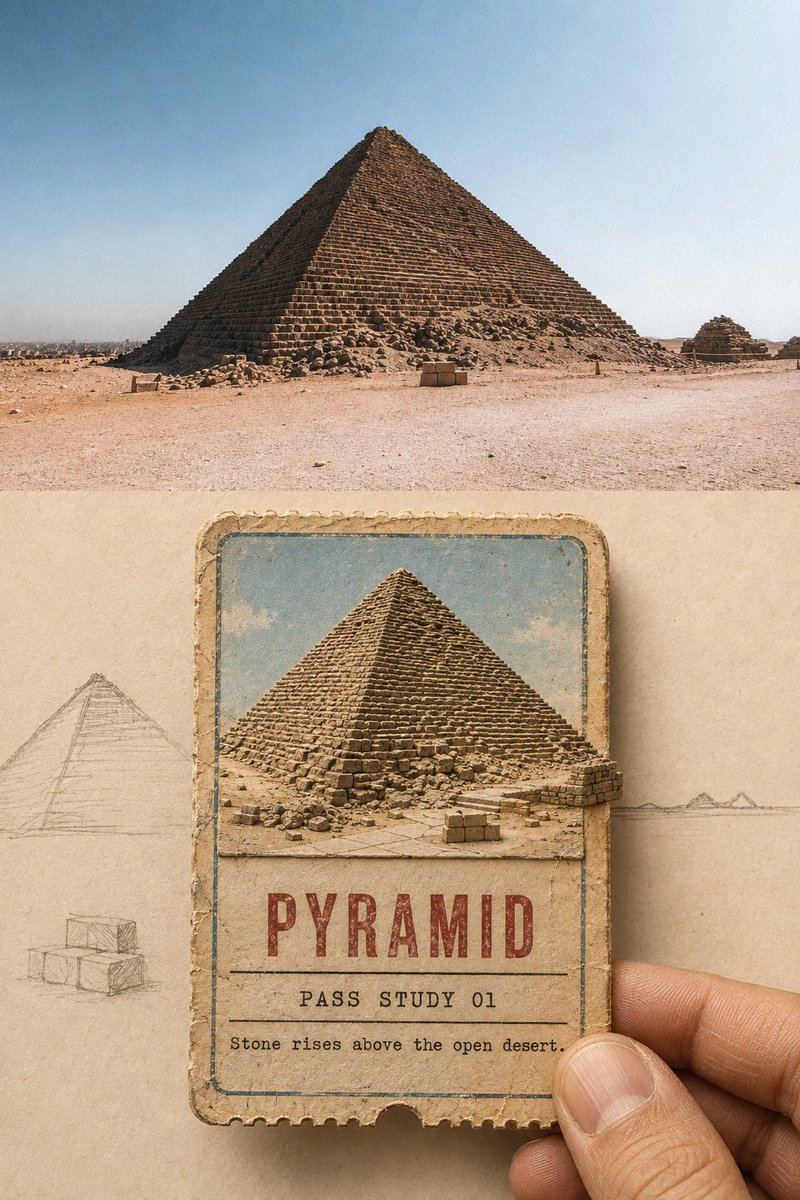
What you get

  • One 3:4 vertical poster per uploaded photo, with no multi-image collage.
  • A top half faithfully preserving the original photo with subtle high-end color grading.
  • A lower half re-imagined as an old paper city pass card at 42%–60% of the region's width with at least 30% paper negative space.
  • A landmark rising realistically from the card surface with supporting miniature blocks and a single hand holding the card from one lower corner.
  • Up to four light graphite observation drawings and text printed on the card, including a short English title and the PASS STUDY 01 line.

Use cases

  • Premium commemorative posters for personal travel photos.
  • Social media posts in a before/after comparison style.
  • Printed designs or independent publications inspired by architectural survey cards.
  • Miniature visual keepsakes of city landmarks for friends or clients.

How to use

  • Upload one or several travel photos; each will become its own separate poster, never merged with others.
  • Make sure the photo contains a recognizable landmark so it can be extracted and compressed inside the paper card in the lower half.
  • Review the fixed ratios (3:4 frame, 48% original photo, 52% transformation) before generating.
  • Optionally steer the generated short English title and observation line by mentioning the location or subject of the photo.
  • Use the result as a premium commemorative poster or a vintage-print style independent publication design.

Related prompts