Skip to content
ImagesFree

visualize this data. It produced a standard chart. Correct data, readable axes, nothing wrong. But a legend box instead of direct

visualize this data. It produced a standard chart. Correct data, readable axes, nothing wrong. But a legend box instead of direct

Image generation

Source previews

These example images come from the original source. DROPIDEA has not independently tested these examples; results depend on the model and settings.
Ready to personalize

Your prompt

Source text

Replace the red variables with your information. Copy the full prompt and use it with your preferred agent.

TXT MD English version
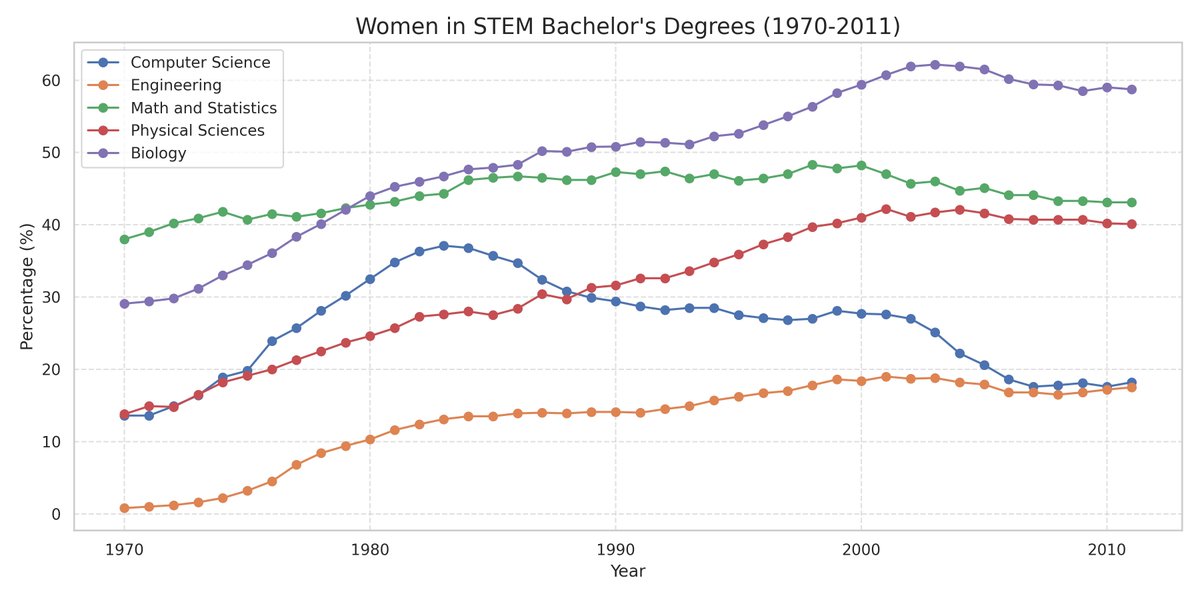
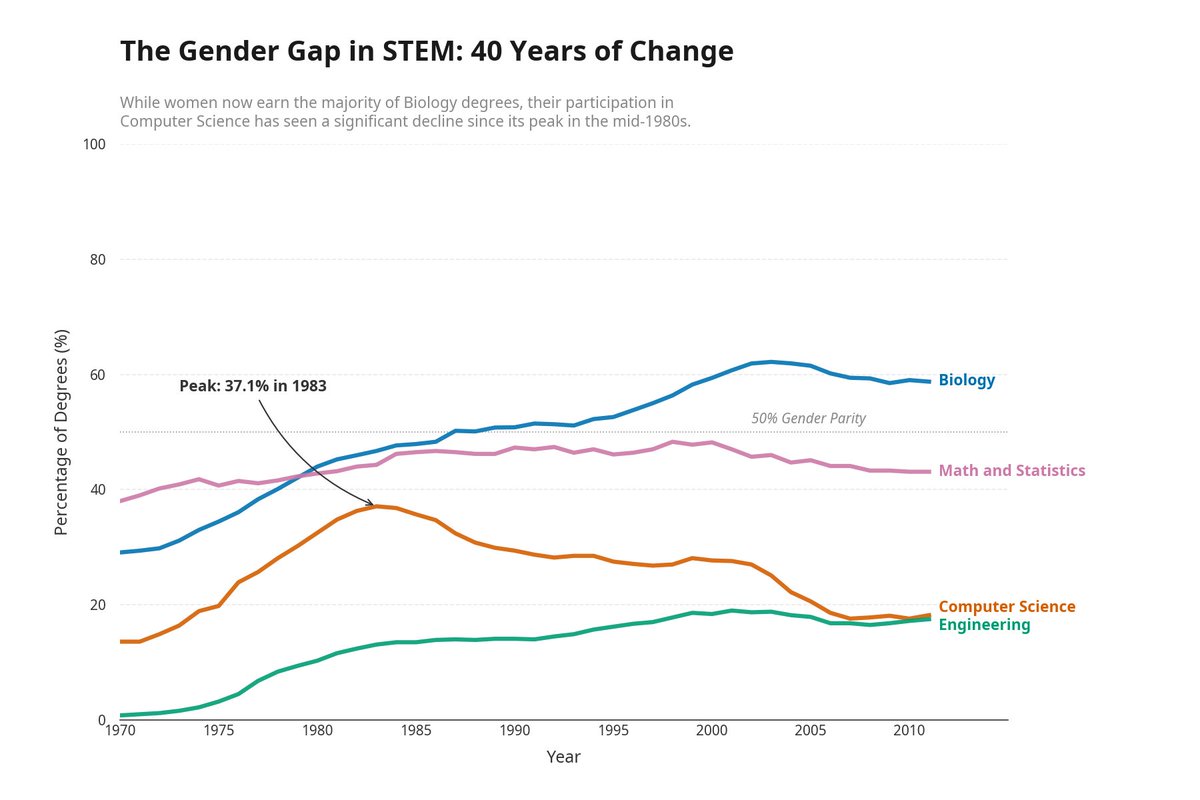
visualize this data. It produced a standard chart. Correct data, readable axes, nothing wrong. But a legend box instead of direct labels. No annotations calling out the rise and fall of women in Computer Science. Default colors. This is what every AI agent produces right now. So I pointed it at the Tufte Test, a quality standard I built in Truesight that checks charts against seven of Tufte's core principles. The API came back: fail on direct labeling and integrated annotations. Five other criteria passed. A quality standard gives an agent something a vague prompt never can: a precise list of exactly what to fix. Manus revised on its own. Legend box became direct endpoint labels. A subtitle surfaced the key insight. An annotation marked the Computer Science peak at 37.1% in 1983. Two prompts total from me. Everything else was autonomous. Any AI agent that can call an API could do this. What matters is the pattern: encode expert judgment once, deploy it as an API, and every AI agent in your stack builds against it. Your taste becomes infrastructure at scale instead of manual review. The Tufte Test is available as a template in Truesight if you want to try it on your own charts. Full writeup + demo video: https://t.co/Xkc9AK87xG
Preview results

Your prompt

visualize this data. It produced a standard chart. Correct data, readable axes, nothing wrong. But a legend box instead of direct labels. No annotations calling out the rise and fall of women in Computer Science. Default colors. This is what every AI agent produces right now. So I pointed it at the Tufte Test, a quality standard I built in Truesight that checks charts against seven of Tufte's core principles. The API came back: fail on direct labeling and integrated annotations. Five other criteria passed. A quality standard gives an agent something a vague prompt never can: a precise list of exactly what to fix. Manus revised on its own. Legend box became direct endpoint labels. A subtitle surfaced the key insight. An annotation marked the Computer Science peak at 37.1% in 1983. Two prompts total from me. Everything else was autonomous. Any AI agent that can call an API could do this. What matters is the pattern: encode expert judgment once, deploy it as an API, and every AI agent in your stack builds against it. Your taste becomes infrastructure at scale instead of manual review. The Tufte Test is available as a template in Truesight if you want to try it on your own charts. Full writeup + demo video: https://t.co/Xkc9AK87xG

Related prompts