Skip to content
ImagesFree

Contemporary Swiss Editorial Poster for Moscow Letter M

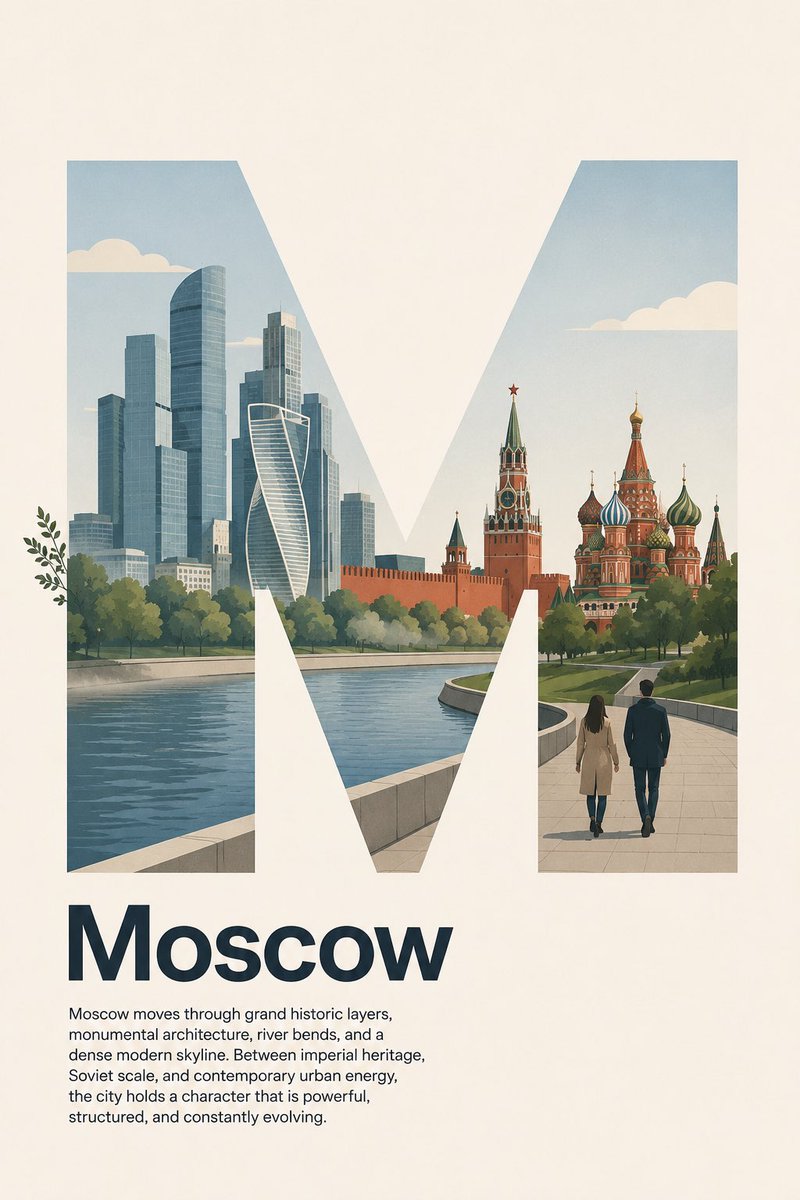
A minimalist Swiss-style poster featuring a bold capital M framing a flat illustration of Moscow: Moscow City skyscrapers, the river, Kremlin silhouettes, Saint Basil's domes, a green park, and two pedestrians, with headline, body copy, and a precise left-aligned grid.

OpenAI

Source previews

These example images come from the original source. DROPIDEA has not independently tested these examples; results depend on the model and settings.

Ready to personalize

Your prompt

English

Replace the red variables with your information. Copy the full prompt and use it with your preferred agent.

TXT MD English version
Design a contemporary Swiss Style editorial poster for Moscow, Russia. Use a large bold sans-serif capital letter “M” as the main typographic structure. The “M” must be very clear, clean, geometric, solid, and dominant, with no stroke outline, no border, no shadow outline, and no decorative treatment. The silhouette of the letter “M” must remain easy to read at first glance. Do not let the illustration obscure or distort the shape of the letter. The poster should follow a precise left-aligned Swiss grid system with generous negative space. Inside the “M”, create a simple, logical, and restrained flat illustration of Moscow’s city landscape character. Use only a few essential visual elements: simplified modern skyscrapers inspired by Moscow City business district, the calm curve of the Moscow River, a subtle silhouette of the Kremlin walls and towers, onion domes of Saint Basil’s Cathedral in a simplified geometric form, a soft green park landscape inspired by Gorky Park or Zaryadye Park, and two pedestrians on a clean riverside walkway. Keep the composition minimal, spacious, and easy to understand. Do not add too many landmarks, people, signs, vehicles, monuments, statues, fountains, trains, buses, or small decorative objects. The illustration should suggest Moscow’s identity as a capital city where imperial history, Soviet monumental scale, modern glass skyscrapers, riverfront public spaces, and vast urban rhythm coexist in a clean contemporary way. Use flat vector shapes, clean silhouettes, minimal linework, simplified architecture, and believable scale relationships. Keep the scene lightly lively but not busy. The illustration should support the letter “M”, not compete with it. Allow only extremely subtle overlap outside the “M” frame using simple organic or atmospheric elements only: a few leaves from riverside trees or soft atmospheric mist over the river may slightly extend beyond the letter edge. Keep 97% of the illustration inside the “M”. Do not let people, buildings, domes, towers, vehicles, faces, paths, signage, or complex objects overlap outside the letter. The “M” must remain clearly readable and visually dominant. Place the headline “Moscow” below the letter in bold sans-serif type, title case, not all caps, left aligned to the same grid. Under the headline, add this short body paragraph in small regular sans-serif text, also left aligned, with clean spacing and refined editorial hierarchy: “Moscow moves through grand historic layers, monumental architecture, river bends, and a dense modern skyline. Between imperial heritage, Soviet scale, and contemporary urban energy, the city holds a character that is powerful, structured, and constantly evolving.” No icons, no badges, no decorative symbols. The overall design should feel Swiss minimalist: strong grid, precise alignment, asymmetrical balance, clean typography, generous negative space, restrained composition, and modern cultural city poster aesthetics. Color palette: warm ivory background, deep navy or charcoal typography, concrete gray, glass blue, pine green, Kremlin red accents, river blue-gray, pale beige, and soft black accents. Matte paper finish, subtle paper grain, crisp edges, flat contemporary illustration, modern Moscow metropolitan mood, calm but strong, sophisticated, balanced, and print-ready. Negative prompt: photorealistic, 3D render, glossy, maximalist, overcrowded city, complex illustration, too many details, too many landmarks
Preview results

Your prompt

Design a contemporary Swiss Style editorial poster for Moscow, Russia. Use a large bold sans-serif capital letter “M” as the main typographic structure. The “M” must be very clear, clean, geometric, solid, and dominant, with no stroke outline, no border, no shadow outline, and no decorative treatment. The silhouette of the letter “M” must remain easy to read at first glance. Do not let the illustration obscure or distort the shape of the letter. The poster should follow a precise left-aligned Swiss grid system with generous negative space. Inside the “M”, create a simple, logical, and restrained flat illustration of Moscow’s city landscape character. Use only a few essential visual elements: simplified modern skyscrapers inspired by Moscow City business district, the calm curve of the Moscow River, a subtle silhouette of the Kremlin walls and towers, onion domes of Saint Basil’s Cathedral in a simplified geometric form, a soft green park landscape inspired by Gorky Park or Zaryadye Park, and two pedestrians on a clean riverside walkway. Keep the composition minimal, spacious, and easy to understand. Do not add too many landmarks, people, signs, vehicles, monuments, statues, fountains, trains, buses, or small decorative objects. The illustration should suggest Moscow’s identity as a capital city where imperial history, Soviet monumental scale, modern glass skyscrapers, riverfront public spaces, and vast urban rhythm coexist in a clean contemporary way. Use flat vector shapes, clean silhouettes, minimal linework, simplified architecture, and believable scale relationships. Keep the scene lightly lively but not busy. The illustration should support the letter “M”, not compete with it. Allow only extremely subtle overlap outside the “M” frame using simple organic or atmospheric elements only: a few leaves from riverside trees or soft atmospheric mist over the river may slightly extend beyond the letter edge. Keep 97% of the illustration inside the “M”. Do not let people, buildings, domes, towers, vehicles, faces, paths, signage, or complex objects overlap outside the letter. The “M” must remain clearly readable and visually dominant. Place the headline “Moscow” below the letter in bold sans-serif type, title case, not all caps, left aligned to the same grid. Under the headline, add this short body paragraph in small regular sans-serif text, also left aligned, with clean spacing and refined editorial hierarchy: “Moscow moves through grand historic layers, monumental architecture, river bends, and a dense modern skyline. Between imperial heritage, Soviet scale, and contemporary urban energy, the city holds a character that is powerful, structured, and constantly evolving.” No icons, no badges, no decorative symbols. The overall design should feel Swiss minimalist: strong grid, precise alignment, asymmetrical balance, clean typography, generous negative space, restrained composition, and modern cultural city poster aesthetics. Color palette: warm ivory background, deep navy or charcoal typography, concrete gray, glass blue, pine green, Kremlin red accents, river blue-gray, pale beige, and soft black accents. Matte paper finish, subtle paper grain, crisp edges, flat contemporary illustration, modern Moscow metropolitan mood, calm but strong, sophisticated, balanced, and print-ready. Negative prompt: photorealistic, 3D render, glossy, maximalist, overcrowded city, complex illustration, too many details, too many landmarks

What you get

  • A minimalist Swiss-style editorial poster with a left-aligned precise grid.
  • A bold, dominant letter “M” framing a simplified flat illustration of Moscow.
  • The headline “Moscow” and a short body paragraph with clean editorial hierarchy.
  • A matte, print-ready color palette including warm ivory, deep navy, concrete gray, and Kremlin red accents.

Use cases

  • Urban or cultural decor posters for homes and offices.
  • Travel and tourism marketing materials about Moscow.
  • Editorial designs for articles about cities and architecture.
  • Visual identity for exhibitions or cultural events.

How to use

  • Copy the full Arabic template and use it as an image generation prompt in your preferred tool.
  • Keep the letter “M”, the headline “Moscow”, and the quoted body paragraph in English, as they are required output text on the poster.
  • Review the negative prompt at the end and include it with your command to avoid photorealistic or overcrowded results.
  • Use a vertical aspect ratio suitable for editorial posters when generating.
  • For higher fidelity, regenerate while keeping all constraints unchanged, without altering percentages or numbers.

Related prompts