Skip to content
ImagesFree

Professional Animation Storyboard Sheet: The Shadow Who

A single high-detail 16:9 professional animation storyboard sheet for an original family-friendly 2D short, "The Shadow Who Wanted a Face," featuring 12 panels in 3 rows of 4, character design and prop reference sections, and emotion, camera, and color note boxes in a hand-drawn graphite studio style.

OpenAI

Source previews

These example images come from the original source. DROPIDEA has not independently tested these examples; results depend on the model and settings.

Ready to personalize

Your prompt

English

Replace the red variables with your information. Copy the full prompt and use it with your preferred agent.

TXT MD English version
Create a single high-detail professional animation storyboard sheet in a clean 16:9 widescreen landscape format for an original 2D cartoon story titled: “The Shadow Who Wanted a Face.” Make the concept fully original, family-friendly, copyright-safe, and violence-free, with no copyrighted characters, no franchise designs, no logos, no gore, no horror, and no realistic weapons. Present it as a polished studio pre-production board on a clean off-white paper background with a hand-drawn graphite and pencil storyboard look, light shading, red framing boxes around each storyboard panel, blue arrows indicating camera movement and action flow, circled shot numbers, handwritten production notes, and a clean animation-studio development layout that is visually dense yet organized. Use subtle color only in selected reference boxes, the character color portraits, the prop reference area, and a few key emotional or magical moments. All text must be highly readable and feel like a professional storyboard presentation. At the top place a large bold title: “THE SHADOW WHO WANTED A FACE,” under it a smaller subtitle: “Sequence concept board for an original emotional fantasy short about identity, friendship, and belonging.” Add a small boxed label reading “SEQUENCE 01.” In the top-right corner include a small legend with a red box icon labeled “CAMERA / FRAMING,” a blue arrow icon labeled “ACTION / MOVE / ENERGY,” a small handwritten date, a small handwritten artist credit, and a small “PAGE 1 OF 1” label. The main storyboard grid must contain exactly 12 panels arranged in 3 rows of 4, reading left to right, top to bottom. The story world is a cozy old town at dusk with warm windows, narrow alleys, lamp-lit walls, and a hidden monochrome shadow realm beneath doorways and street corners. The main character is an original young boy named Niko, around 10 years old, slim, curious, kind, wearing a simple oversized sweater, rolled shorts, and sneakers, with expressive hair and big eyes. The second major character is his living shadow, an elastic ink-like silhouette that has no face at first and communicates through shape, gesture, and drawn expressions. The symbolic key prop is a small sketchbook and charcoal pencil used to draw faces, plus a paper cut-out theater mask motif that appears in design notes. The tone should be magical, heartfelt, slightly mysterious, hopeful, and visually poetic, with soft emotional progression and expressive body language. Panel 1, Shot 01: Establishing wide shot of a quiet sunset street and Niko’s small apartment building, long evening shadows stretching across the pavement, camera wide and slightly high angle, mood calm and wistful, caption note: “Introduce gentle world of dusk and possibility.” Panel 2, Shot 02: Medium character intro of Niko sitting by a window drawing silly cartoon faces in his sketchbook while his shadow stretches along the wall beside him, camera medium side angle, mood lonely but imaginative, production note: “Niko is creative, a little isolated, searching for connection.” Panel 3, Shot 03: Story trigger, Niko notices his shadow is no longer copying him and instead reaches toward the sketchbook, camera push-in with blue arrow toward the shadow hand, mood surprise and wonder, caption note: “First impossible behavior—shadow wants something.” Panel 4, Shot 04: Early emotional beat, the shadow draws crude face shapes on the wall using Niko’s charcoal, trying eyes, smiles, and frowns that smear and disappear, camera close-up with small inserts of failed faces, mood tender and sad, note: “The shadow wants an identity but cannot hold one.” Panel 5, Shot 05: Escalation, the frustrated shadow slips under the bedroom door and races into the alley, Niko grabs the sketchbook and chases after it, camera dynamic low tracking shot with blue arrows showing movement, mood urgent but playful and safe, note: “Chase begins—no danger, only emotional urgency.” Panel 6, Shot 06: Development, Niko follows the shadow through twisting alleys where walls become abstract and darker, and enters a hidden monochrome shadow corridor under a street lamp, camera wide perspective tunnel shot, mood mysterious and cinematic, caption: “Threshold into the shadow world.” Panel 7, Shot 07: Deeper turn, inside the shadow world Niko sees dozens of faceless shadows mimicking emotions without features, and his own shadow stands apart, ashamed and hiding behind a giant mask-shaped doorway, camera medium-wide with dramatic negative space, mood melancholy and revealing, note: “He is not rebelling—he is hurting.” Panel 8, Shot 08: Midpoint reveal and strategy, Niko kneels and gently sketches many different simple faces into the air and on floating paper scraps—happy, brave, shy, curious—showing the shadow that it can choose who it wants to be, camera over-the-shoulder with insert sketches and soft magical glow, mood hopeful, caption: “Identity is not found by copying; it is created.” Panel 9, Shot 09: Climax setup, a gust of swirling shadow wind scatters the drawn faces and the shadow begins to dissolve into the dark floor, afraid it will never become real, camera dramatic diagonal composition with blue spiral arrows, mood emotional tension, note: “Fear of disappearing.” Panel 10, Shot 10: Main climax, Niko steps into a beam of light and presses his hand to the shadow, then draws one simple glowing face directly onto it—a face made from kindness, not perfection—camera close dramatic hero angle, mood uplifting and cathartic, note: “Connection stabilizes the shadow.” Panel 11, Shot 11: Resolution, the shadow now holds a soft, simple expressive face of its own and stands beside Niko as an equal, both walking back through the alley into the warm color world, camera medium back three-quarter shot, mood peaceful and relieved, caption: “The shadow returns home, transformed.” Panel 12, Shot 12: Final emotional payoff hero shot, Niko and the shadow are shown in a warm sunrise reflection on the wall, the shadow making its own joyful expression while Niko smiles proudly, camera wide hero composition with gentle upward tilt, mood triumphant, healing, and heartwarming, note: “Belonging through self-acceptance.” On the right side create a “CHARACTER DESIGN / CASTING” section. Include for Niko: front turnaround sketch, side turnaround sketch, a seated pose study with sketchbook, a surprised expression study, and a small soft-color reference portrait with handwritten notes: “creative,” “gentle,” “observant,” “quietly brave,” plus silhouette note: “round sweater shape, tousled hair, sketchbook always nearby.” Include for the Shadow: front silhouette study, side silhouette study, expression study showing how a face appears within the dark form, playful stretch pose, and a small color-accent reference portrait using charcoal black with a faint blue-violet edge glow; handwritten notes: “curious,” “sensitive,” “mimic learning to become self,” silhouette note: “liquid, flexible, tapering limbs, expressive posture before facial features.” Add 2–3 mini support sketches labeled “supporting shadow figures” showing other faceless background shadows in the shadow realm. Include an optional “KEY PROP / ENVIRONMENT DESIGN” section with small design drawings of Niko’s sketchbook, charcoal pencil, paper mask motif, lamp-lit alley corner, and the shadow doorway shaped like a theater mask. Add tiny handwritten notes such as “mask symbol = desire for identity,” “alley threshold becomes portal at dusk,” and “monochrome realm contrasts warm town palette.” Along the bottom place 3 neat note boxes. Box 1 heading: “EMOTIONAL JOURNEY” with short bullet points: “loneliness to connection,” “imitation to selfhood,” “curiosity -> fear -> empathy -> acceptance,” “ending feeling: gentle joy.” Box 2 heading: “CAMERA / STORY NOTES” with bullets: “start grounded and intimate,” “increase motion in chase,” “shadow realm uses longer shapes and stronger perspective,” “climax uses close-up hand-to-shadow contact,” “final shot opens wide for emotional release.” Box 3 heading: “COLOR / MOOD / LIGHTING” with bullets: “real world = warm amber dusk, soft peach windows, muted teal shadows,” “shadow realm = graphite gray, cool indigo, pale silver highlights,” “key emotional magic moments use selective soft blue glow,” “final sunrise adds warm gold for hope.” In the lower right include a small color palette strip with swatches labeled warm amber, dusk peach, muted teal, charcoal black, cool indigo, pale silver, and sunrise gold. Ensure the whole sheet feels like a premium professional 2D animation development board: hand-drawn, cinematic, expressive, readable, story-rich, emotionally clear, original, safe, and suitable for a high-quality short film storyboard presentation.
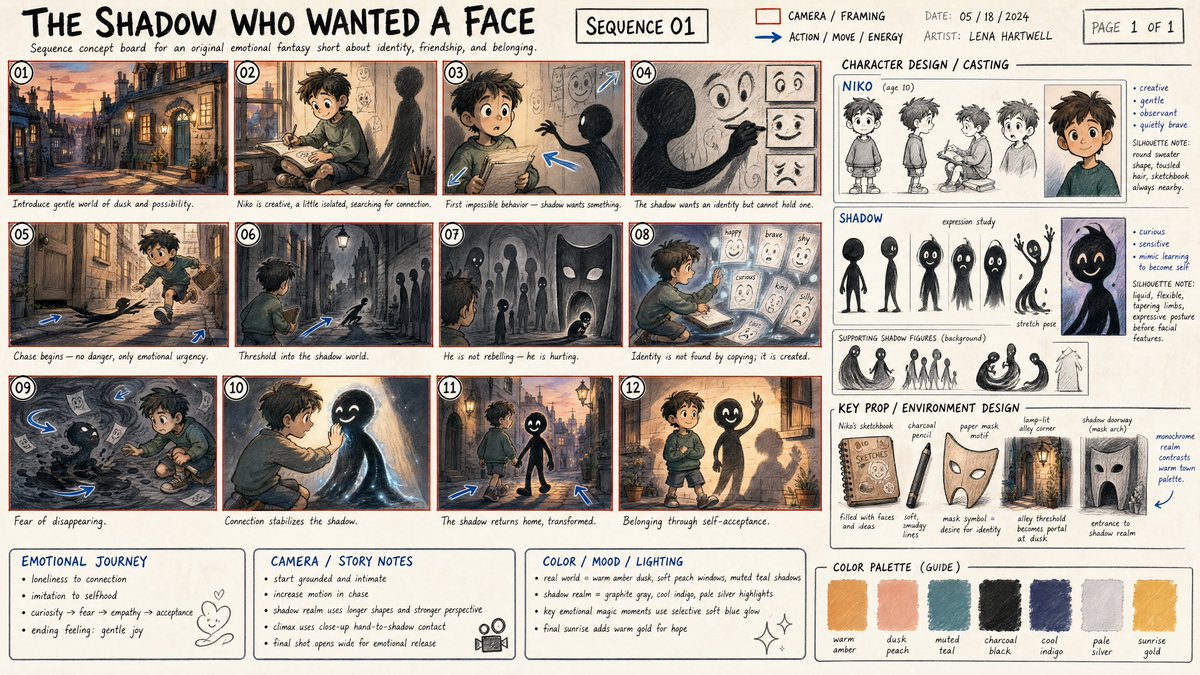
Preview results

Your prompt

Create a single high-detail professional animation storyboard sheet in a clean 16:9 widescreen landscape format for an original 2D cartoon story titled: “The Shadow Who Wanted a Face.” Make the concept fully original, family-friendly, copyright-safe, and violence-free, with no copyrighted characters, no franchise designs, no logos, no gore, no horror, and no realistic weapons. Present it as a polished studio pre-production board on a clean off-white paper background with a hand-drawn graphite and pencil storyboard look, light shading, red framing boxes around each storyboard panel, blue arrows indicating camera movement and action flow, circled shot numbers, handwritten production notes, and a clean animation-studio development layout that is visually dense yet organized. Use subtle color only in selected reference boxes, the character color portraits, the prop reference area, and a few key emotional or magical moments. All text must be highly readable and feel like a professional storyboard presentation. At the top place a large bold title: “THE SHADOW WHO WANTED A FACE,” under it a smaller subtitle: “Sequence concept board for an original emotional fantasy short about identity, friendship, and belonging.” Add a small boxed label reading “SEQUENCE 01.” In the top-right corner include a small legend with a red box icon labeled “CAMERA / FRAMING,” a blue arrow icon labeled “ACTION / MOVE / ENERGY,” a small handwritten date, a small handwritten artist credit, and a small “PAGE 1 OF 1” label. The main storyboard grid must contain exactly 12 panels arranged in 3 rows of 4, reading left to right, top to bottom. The story world is a cozy old town at dusk with warm windows, narrow alleys, lamp-lit walls, and a hidden monochrome shadow realm beneath doorways and street corners. The main character is an original young boy named Niko, around 10 years old, slim, curious, kind, wearing a simple oversized sweater, rolled shorts, and sneakers, with expressive hair and big eyes. The second major character is his living shadow, an elastic ink-like silhouette that has no face at first and communicates through shape, gesture, and drawn expressions. The symbolic key prop is a small sketchbook and charcoal pencil used to draw faces, plus a paper cut-out theater mask motif that appears in design notes. The tone should be magical, heartfelt, slightly mysterious, hopeful, and visually poetic, with soft emotional progression and expressive body language. Panel 1, Shot 01: Establishing wide shot of a quiet sunset street and Niko’s small apartment building, long evening shadows stretching across the pavement, camera wide and slightly high angle, mood calm and wistful, caption note: “Introduce gentle world of dusk and possibility.” Panel 2, Shot 02: Medium character intro of Niko sitting by a window drawing silly cartoon faces in his sketchbook while his shadow stretches along the wall beside him, camera medium side angle, mood lonely but imaginative, production note: “Niko is creative, a little isolated, searching for connection.” Panel 3, Shot 03: Story trigger, Niko notices his shadow is no longer copying him and instead reaches toward the sketchbook, camera push-in with blue arrow toward the shadow hand, mood surprise and wonder, caption note: “First impossible behavior—shadow wants something.” Panel 4, Shot 04: Early emotional beat, the shadow draws crude face shapes on the wall using Niko’s charcoal, trying eyes, smiles, and frowns that smear and disappear, camera close-up with small inserts of failed faces, mood tender and sad, note: “The shadow wants an identity but cannot hold one.” Panel 5, Shot 05: Escalation, the frustrated shadow slips under the bedroom door and races into the alley, Niko grabs the sketchbook and chases after it, camera dynamic low tracking shot with blue arrows showing movement, mood urgent but playful and safe, note: “Chase begins—no danger, only emotional urgency.” Panel 6, Shot 06: Development, Niko follows the shadow through twisting alleys where walls become abstract and darker, and enters a hidden monochrome shadow corridor under a street lamp, camera wide perspective tunnel shot, mood mysterious and cinematic, caption: “Threshold into the shadow world.” Panel 7, Shot 07: Deeper turn, inside the shadow world Niko sees dozens of faceless shadows mimicking emotions without features, and his own shadow stands apart, ashamed and hiding behind a giant mask-shaped doorway, camera medium-wide with dramatic negative space, mood melancholy and revealing, note: “He is not rebelling—he is hurting.” Panel 8, Shot 08: Midpoint reveal and strategy, Niko kneels and gently sketches many different simple faces into the air and on floating paper scraps—happy, brave, shy, curious—showing the shadow that it can choose who it wants to be, camera over-the-shoulder with insert sketches and soft magical glow, mood hopeful, caption: “Identity is not found by copying; it is created.” Panel 9, Shot 09: Climax setup, a gust of swirling shadow wind scatters the drawn faces and the shadow begins to dissolve into the dark floor, afraid it will never become real, camera dramatic diagonal composition with blue spiral arrows, mood emotional tension, note: “Fear of disappearing.” Panel 10, Shot 10: Main climax, Niko steps into a beam of light and presses his hand to the shadow, then draws one simple glowing face directly onto it—a face made from kindness, not perfection—camera close dramatic hero angle, mood uplifting and cathartic, note: “Connection stabilizes the shadow.” Panel 11, Shot 11: Resolution, the shadow now holds a soft, simple expressive face of its own and stands beside Niko as an equal, both walking back through the alley into the warm color world, camera medium back three-quarter shot, mood peaceful and relieved, caption: “The shadow returns home, transformed.” Panel 12, Shot 12: Final emotional payoff hero shot, Niko and the shadow are shown in a warm sunrise reflection on the wall, the shadow making its own joyful expression while Niko smiles proudly, camera wide hero composition with gentle upward tilt, mood triumphant, healing, and heartwarming, note: “Belonging through self-acceptance.” On the right side create a “CHARACTER DESIGN / CASTING” section. Include for Niko: front turnaround sketch, side turnaround sketch, a seated pose study with sketchbook, a surprised expression study, and a small soft-color reference portrait with handwritten notes: “creative,” “gentle,” “observant,” “quietly brave,” plus silhouette note: “round sweater shape, tousled hair, sketchbook always nearby.” Include for the Shadow: front silhouette study, side silhouette study, expression study showing how a face appears within the dark form, playful stretch pose, and a small color-accent reference portrait using charcoal black with a faint blue-violet edge glow; handwritten notes: “curious,” “sensitive,” “mimic learning to become self,” silhouette note: “liquid, flexible, tapering limbs, expressive posture before facial features.” Add 2–3 mini support sketches labeled “supporting shadow figures” showing other faceless background shadows in the shadow realm. Include an optional “KEY PROP / ENVIRONMENT DESIGN” section with small design drawings of Niko’s sketchbook, charcoal pencil, paper mask motif, lamp-lit alley corner, and the shadow doorway shaped like a theater mask. Add tiny handwritten notes such as “mask symbol = desire for identity,” “alley threshold becomes portal at dusk,” and “monochrome realm contrasts warm town palette.” Along the bottom place 3 neat note boxes. Box 1 heading: “EMOTIONAL JOURNEY” with short bullet points: “loneliness to connection,” “imitation to selfhood,” “curiosity -> fear -> empathy -> acceptance,” “ending feeling: gentle joy.” Box 2 heading: “CAMERA / STORY NOTES” with bullets: “start grounded and intimate,” “increase motion in chase,” “shadow realm uses longer shapes and stronger perspective,” “climax uses close-up hand-to-shadow contact,” “final shot opens wide for emotional release.” Box 3 heading: “COLOR / MOOD / LIGHTING” with bullets: “real world = warm amber dusk, soft peach windows, muted teal shadows,” “shadow realm = graphite gray, cool indigo, pale silver highlights,” “key emotional magic moments use selective soft blue glow,” “final sunrise adds warm gold for hope.” In the lower right include a small color palette strip with swatches labeled warm amber, dusk peach, muted teal, charcoal black, cool indigo, pale silver, and sunrise gold. Ensure the whole sheet feels like a premium professional 2D animation development board: hand-drawn, cinematic, expressive, readable, story-rich, emotionally clear, original, safe, and suitable for a high-quality short film storyboard presentation.

Variable guide

THE SHADOW WHO WANTED A FACE

The original story title appearing in the prompt's opening and the large top-of-sheet title.

First line inside the quoted text after "titled:", and the large quoted title at the top of the sheet.

Example value

The Lantern Who Forgot Its Light

Sequence concept board for an original emotional fantasy short about identity, friendship, and belonging.

The small descriptive subtitle under the main title.

The quoted string after the instruction to add a smaller subtitle.

Example value

Concept board for a gentle fantasy short about courage and memory.

Niko

The hero's name; replace every occurrence, including notes and side sections.

Every occurrence of Niko in the character description, panel notes, and both design sections.

Example value

Omar

What you get

  • One studio-style 16:9 landscape storyboard sheet with a hand-drawn graphite look on off-white paper.
  • 12 red-framed story panels in 3 rows of 4 telling Niko and his shadow's complete arc.
  • A CHARACTER DESIGN / CASTING section with turnarounds, expression studies, and color reference portraits.
  • An optional KEY PROP / ENVIRONMENT DESIGN section with symbolic handwritten notes.
  • Three note boxes (emotional journey, camera/story, color/mood/lighting) plus a 7-swatch color palette strip.

Use cases

  • Developing and pitching an original 2D animated short to a production team or investors.
  • A portfolio piece for storyboard artists or directors showcasing emotional visual storytelling.
  • Teaching material for storyboard structure, shot planning, and emotional progression.
  • A springboard for a picture script or children's book based on the same story.

How to use

  • Copy the full template and paste it into your image generation tool without altering numbers or technical tokens.
  • Optionally replace the story title, subtitle, and hero name Niko with your own story values for a customized version.
  • Keep all quoted English strings untouched, since they must appear verbatim on the generated sheet.
  • Submit the prompt and expect a single 16:9 storyboard sheet, then review the 12 panels and layout accuracy.
  • Re-run generation for alternate takes of the same board; stochastic results will vary in detail, not be identical.

Related prompts