Skip to content
ImagesFree

Storyboard Sheet: Theo & Nara — Repair Begins

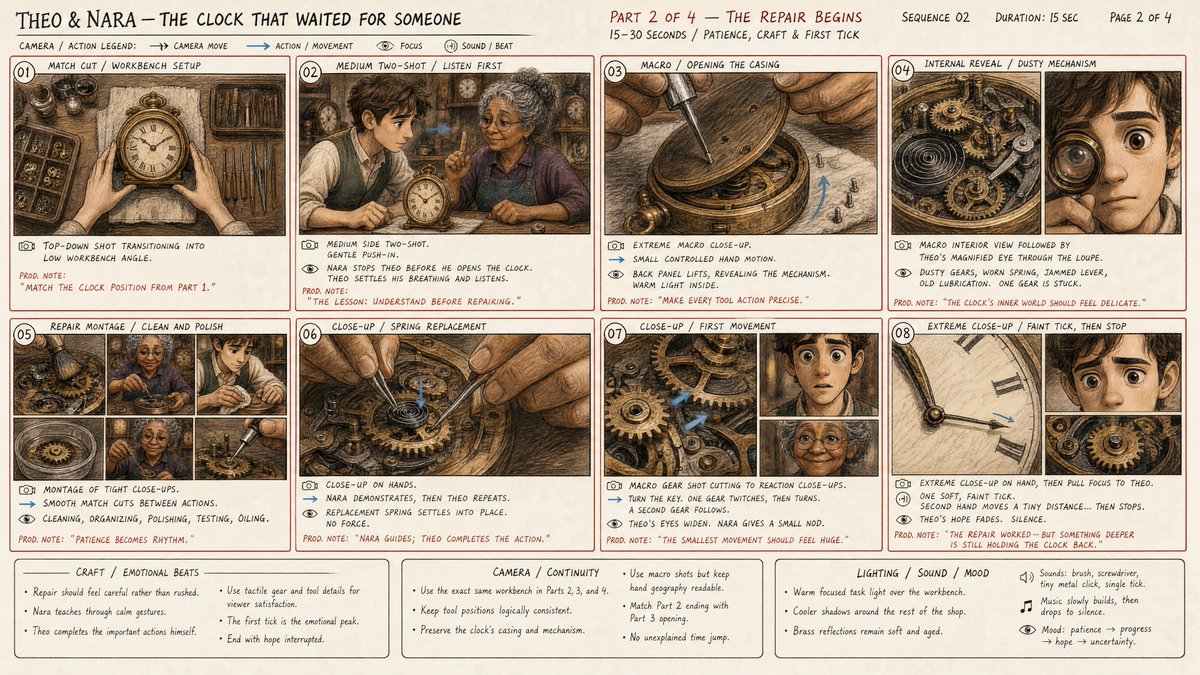
A professional 16:9 storyboard sheet template for Part 2 of 4 of "THEO & NARA — THE CLOCK THAT WAITED FOR SOMEONE", covering seconds 15–30: the repair begins under Nara's guidance, with eight cinematic panels plus craft, continuity, lighting and sound notes, ending on a hopeful first tick and sudden stop.

OpenAI

Source previews

These example images come from the original source. DROPIDEA has not independently tested these examples; results depend on the model and settings.

Ready to personalize

Your prompt

English

Replace the red variables with your information. Copy the full prompt and use it with your preferred agent.

TXT MD English version
Create one complete high-detail professional animation storyboard sheet in an exact 16:9 widescreen landscape format for: “THEO & NARA — THE CLOCK THAT WAITED FOR SOMEONE” Storyboard section: “PART 2 OF 4 — THE REPAIR BEGINS” Sequence subtitle: “15–30 SECONDS / PATIENCE, CRAFT & FIRST TICK” REFERENCE CONTROL: Use <<<image_1>>> as the exact Theo identity reference. Use <<<image_2>>> as the exact Nara identity reference. Use <<<image_4>>> as the definitive shared scale and character-consistency reference. Use @Image5 as the same clock-shop and workbench environment established in Part 1. Use @Image6 as the exact silent-clock prop reference. Continue directly from the ending of Part 1. Preserve all character faces, hairstyles, outfits, proportions, accessories, colors, silhouettes, shop architecture, tools, and clock design exactly. Do not include character turnarounds or casting information. This storyboard sheet must show story panels and production notes only. STORYBOARD SHEET STYLE: - professional studio storyboard page - exact 16:9 sheet - warm off-white paper - graphite and pencil sketches - thin red panel frames - blue movement arrows - circled shot numbers - handwritten production annotations - selective warm color on brass gears, wood, clock casing, and key emotional moments - detailed but readable - eight horizontal cinematic panels in two rows of four HEADER: - Main title - “PART 2 OF 4” - “SEQUENCE 02” - “DURATION: 15 SEC” - “PAGE 2 OF 4” - camera/action legend STORY GOAL: Show Theo beginning the repair under Nara’s guidance. The process should feel tactile, satisfying, and emotionally meaningful. End with one faint tick that creates hope—then immediate disappointment when the clock stops again. PANEL 01 — MATCH CUT / WORKBENCH SETUP Begin with the silent clock from Part 1 being placed gently onto a soft work cloth. Theo arranges miniature screwdrivers, tweezers, brushes, oil, gear trays, and a clockmaker’s loupe. Nara stands beside him, observing calmly. Camera: Top-down shot transitioning into a low workbench angle. Mood: Focused beginning. Production note: “MATCH THE CLOCK POSITION FROM PART 1.” PANEL 02 — MEDIUM TWO-SHOT / LISTEN FIRST Nara stops Theo before he opens the clock. She places one finger near the casing, encouraging him to listen and observe first. Theo settles his breathing and becomes less hurried. Camera: Medium side two-shot. Movement: Gentle push-in. Emotion: Mentorship, patience, trust. Production note: “THE LESSON: UNDERSTAND BEFORE REPAIRING.” PANEL 03 — MACRO / OPENING THE CASING Theo uses a miniature screwdriver to carefully remove the back panel. Show screws placed in an orderly line, the casing lifting, and warm light revealing the internal mechanism. Camera: Extreme macro close-up. Movement: Small controlled hand motion. Mood: Discovery and craftsmanship. Production note: “MAKE EVERY TOOL ACTION PRECISE.” PANEL 04 — INTERNAL REVEAL / DUSTY MECHANISM Reveal the inside: - dusty brass gears - worn coiled spring - jammed lever - old lubrication residue - one gear unable to turn Theo examines the mechanism through his loupe. Camera: Macro interior view followed by Theo’s magnified eye through the loupe. Mood: Mechanical mystery. Production note: “THE CLOCK’S INNER WORLD SHOULD FEEL DELICATE.” PANEL 05 — REPAIR MONTAGE / CLEAN AND POLISH Create a rhythmic montage panel with small inserts: - Theo brushing dust from gears - Nara placing each part in a tray - Theo polishing the clock casing - one gear soaking in cleaning solution - Nara testing a spring - Theo applying one tiny drop of oil Camera: Macro inserts with smooth match cuts. Mood: Satisfying progress. Production note: “PATIENCE BECOMES RHYTHM.” PANEL 06 — CLOSE-UP / SPRING REPLACEMENT Nara demonstrates how to position a tiny replacement spring. Theo carefully repeats the movement. The spring settles into place without force. Camera: Close-up on their hands. Movement: Blue guide arrow showing placement. Emotion: Concentration becoming confidence. Production note: “NARA GUIDES; THEO COMPLETES THE ACTION.” PANEL 07 — CLOSE-UP / FIRST MOVEMENT Theo gently turns the key. One tiny gear twitches, then slowly rotates. A second gear follows. Theo’s eyes widen with hopeful surprise. Nara gives a restrained approving smile. Camera: Macro gear shot cutting to reaction close-ups. Mood: Small triumph. Production note: “THE SMALLEST MOVEMENT SHOULD FEEL HUGE.” PANEL 08 — EXTREME CLOSE-UP / FAINT TICK, THEN STOP The clock produces one soft, faint tick. Theo and Nara freeze and listen. The second hand moves a tiny distance—then stops again. Theo’s hopeful smile fades into disappointment. Camera: Extreme close-up on the hand, then slow pull focus to Theo. Sound note: One isolated tick followed by silence. End-frame requirement: Hold on Theo’s disappointed expression and the unmoving gear. Cliffhanger feeling: “The repair worked—but something deeper is still holding the clock back.” BOTTOM BOX 1 — CRAFT / EMOTIONAL BEATS Include notes: - Repair should feel careful rather than rushed. - Nara teaches through calm gestures. - Theo completes the important actions himself. - Use tactile gear and tool details for viewer satisfaction. - The first tick is the emotional peak. - End with hope interrupted. BOTTOM BOX 2 — CAMERA / CONTINUITY Include notes: - Use the exact same workbench in Parts 2, 3, and 4. - Keep tool positions logically consistent. - Preserve the clock’s casing and mechanism. - Use macro shots but keep hand geography readable. - Match Part 2 ending with Part 3 opening. - No unexplained time jump. BOTTOM BOX 3 — LIGHTING / SOUND / MOOD Include notes: - Warm focused task light over the workbench. - Cooler shadows around the rest of the shop. - Brass reflections remain soft and aged. - Sounds: brush, screwdriver, tiny metal click, single tick. - Music slowly builds, then drops to silence. - Mood: patience → progress → hope → uncertainty. CONTINUITY CONSTRAINTS: - Use Theo and Nara exactly as referenced. - Keep both outfits unchanged. - Maintain the clock’s exact size and visual design. - Keep every gear and prop visually consistent. - Do not introduce Elias yet. - No alternate clock design. - No character sheets inside the finished storyboard. - No logos, watermarks, brands, or copyrighted visual elements.
Preview results

Your prompt

Create one complete high-detail professional animation storyboard sheet in an exact 16:9 widescreen landscape format for: “THEO & NARA — THE CLOCK THAT WAITED FOR SOMEONE” Storyboard section: “PART 2 OF 4 — THE REPAIR BEGINS” Sequence subtitle: “15–30 SECONDS / PATIENCE, CRAFT & FIRST TICK” REFERENCE CONTROL: Use <<<image_1>>> as the exact Theo identity reference. Use <<<image_2>>> as the exact Nara identity reference. Use <<<image_4>>> as the definitive shared scale and character-consistency reference. Use @Image5 as the same clock-shop and workbench environment established in Part 1. Use @Image6 as the exact silent-clock prop reference. Continue directly from the ending of Part 1. Preserve all character faces, hairstyles, outfits, proportions, accessories, colors, silhouettes, shop architecture, tools, and clock design exactly. Do not include character turnarounds or casting information. This storyboard sheet must show story panels and production notes only. STORYBOARD SHEET STYLE: - professional studio storyboard page - exact 16:9 sheet - warm off-white paper - graphite and pencil sketches - thin red panel frames - blue movement arrows - circled shot numbers - handwritten production annotations - selective warm color on brass gears, wood, clock casing, and key emotional moments - detailed but readable - eight horizontal cinematic panels in two rows of four HEADER: - Main title - “PART 2 OF 4” - “SEQUENCE 02” - “DURATION: 15 SEC” - “PAGE 2 OF 4” - camera/action legend STORY GOAL: Show Theo beginning the repair under Nara’s guidance. The process should feel tactile, satisfying, and emotionally meaningful. End with one faint tick that creates hope—then immediate disappointment when the clock stops again. PANEL 01 — MATCH CUT / WORKBENCH SETUP Begin with the silent clock from Part 1 being placed gently onto a soft work cloth. Theo arranges miniature screwdrivers, tweezers, brushes, oil, gear trays, and a clockmaker’s loupe. Nara stands beside him, observing calmly. Camera: Top-down shot transitioning into a low workbench angle. Mood: Focused beginning. Production note: “MATCH THE CLOCK POSITION FROM PART 1.” PANEL 02 — MEDIUM TWO-SHOT / LISTEN FIRST Nara stops Theo before he opens the clock. She places one finger near the casing, encouraging him to listen and observe first. Theo settles his breathing and becomes less hurried. Camera: Medium side two-shot. Movement: Gentle push-in. Emotion: Mentorship, patience, trust. Production note: “THE LESSON: UNDERSTAND BEFORE REPAIRING.” PANEL 03 — MACRO / OPENING THE CASING Theo uses a miniature screwdriver to carefully remove the back panel. Show screws placed in an orderly line, the casing lifting, and warm light revealing the internal mechanism. Camera: Extreme macro close-up. Movement: Small controlled hand motion. Mood: Discovery and craftsmanship. Production note: “MAKE EVERY TOOL ACTION PRECISE.” PANEL 04 — INTERNAL REVEAL / DUSTY MECHANISM Reveal the inside: - dusty brass gears - worn coiled spring - jammed lever - old lubrication residue - one gear unable to turn Theo examines the mechanism through his loupe. Camera: Macro interior view followed by Theo’s magnified eye through the loupe. Mood: Mechanical mystery. Production note: “THE CLOCK’S INNER WORLD SHOULD FEEL DELICATE.” PANEL 05 — REPAIR MONTAGE / CLEAN AND POLISH Create a rhythmic montage panel with small inserts: - Theo brushing dust from gears - Nara placing each part in a tray - Theo polishing the clock casing - one gear soaking in cleaning solution - Nara testing a spring - Theo applying one tiny drop of oil Camera: Macro inserts with smooth match cuts. Mood: Satisfying progress. Production note: “PATIENCE BECOMES RHYTHM.” PANEL 06 — CLOSE-UP / SPRING REPLACEMENT Nara demonstrates how to position a tiny replacement spring. Theo carefully repeats the movement. The spring settles into place without force. Camera: Close-up on their hands. Movement: Blue guide arrow showing placement. Emotion: Concentration becoming confidence. Production note: “NARA GUIDES; THEO COMPLETES THE ACTION.” PANEL 07 — CLOSE-UP / FIRST MOVEMENT Theo gently turns the key. One tiny gear twitches, then slowly rotates. A second gear follows. Theo’s eyes widen with hopeful surprise. Nara gives a restrained approving smile. Camera: Macro gear shot cutting to reaction close-ups. Mood: Small triumph. Production note: “THE SMALLEST MOVEMENT SHOULD FEEL HUGE.” PANEL 08 — EXTREME CLOSE-UP / FAINT TICK, THEN STOP The clock produces one soft, faint tick. Theo and Nara freeze and listen. The second hand moves a tiny distance—then stops again. Theo’s hopeful smile fades into disappointment. Camera: Extreme close-up on the hand, then slow pull focus to Theo. Sound note: One isolated tick followed by silence. End-frame requirement: Hold on Theo’s disappointed expression and the unmoving gear. Cliffhanger feeling: “The repair worked—but something deeper is still holding the clock back.” BOTTOM BOX 1 — CRAFT / EMOTIONAL BEATS Include notes: - Repair should feel careful rather than rushed. - Nara teaches through calm gestures. - Theo completes the important actions himself. - Use tactile gear and tool details for viewer satisfaction. - The first tick is the emotional peak. - End with hope interrupted. BOTTOM BOX 2 — CAMERA / CONTINUITY Include notes: - Use the exact same workbench in Parts 2, 3, and 4. - Keep tool positions logically consistent. - Preserve the clock’s casing and mechanism. - Use macro shots but keep hand geography readable. - Match Part 2 ending with Part 3 opening. - No unexplained time jump. BOTTOM BOX 3 — LIGHTING / SOUND / MOOD Include notes: - Warm focused task light over the workbench. - Cooler shadows around the rest of the shop. - Brass reflections remain soft and aged. - Sounds: brush, screwdriver, tiny metal click, single tick. - Music slowly builds, then drops to silence. - Mood: patience → progress → hope → uncertainty. CONTINUITY CONSTRAINTS: - Use Theo and Nara exactly as referenced. - Keep both outfits unchanged. - Maintain the clock’s exact size and visual design. - Keep every gear and prop visually consistent. - Do not introduce Elias yet. - No alternate clock design. - No character sheets inside the finished storyboard. - No logos, watermarks, brands, or copyrighted visual elements.

Variable guide

<<<image_1>>>

Reference image of Theo's exact identity.

"Use <<<image_1>>> as the exact Theo identity reference."

Example value

Approved Theo image

<<<image_2>>>

Reference image of Nara's exact identity.

"Use <<<image_2>>> as the exact Nara identity reference."

Example value

Approved Nara image

<<<image_4>>>

Shared scale and character-consistency reference.

"Use <<<image_4>>> as the definitive shared scale reference."

Example value

Shared scale sheet

@Image5

Shop and workbench environment image.

"Use @Image5 as the same clock-shop environment…"

Example value

Clock shop interior

@Image6

Silent-clock prop reference image.

"Use @Image6 as the exact silent-clock prop reference."

Example value

The silent clock

“THEO & NARA — THE CLOCK THAT WAITED FOR SOMEONE”

Quoted main story title.

Quoted line in the intro and header title item.

Example value

THEO & NARA — THE CLOCK THAT WAITED FOR SOMEONE

“PART 2 OF 4 — THE REPAIR BEGINS”

Quoted section label.

"Storyboard section:" line and header.

Example value

PART 2 OF 4 — THE REPAIR BEGINS

What you get

  • A professional studio storyboard sheet in graphite and pencil style on warm paper.
  • Eight detailed cinematic panels covering seconds 15–30 of the repair.
  • A full header with sequence, duration, page numbers and camera legend.
  • Three bottom note boxes for craft, continuity, lighting and sound.
  • Characters, environment and props consistent with the uploaded reference images.

Use cases

  • Planning multi-part animated short film production.
  • Unifying visual style across directing and animation teams.
  • Pitch presentations for producer approval.
  • Educational tools for teaching storyboard language and craft.

How to use

  • Upload the identity reference images: Theo as image_1, Nara as image_2, and the shared scale sheet as image_4, plus the shop environment @Image5 and the clock prop @Image6.
  • Copy the full template and submit it with the attached images to an image-generation model that supports multiple references.
  • Verify the output sheet is exactly 16:9 and contains eight horizontal panels in two rows of four.
  • Review the eight panels and production notes to confirm continuity with the end of Part 1.
  • Edit the quoted title or section labels if needed while keeping all numbers and ratios unchanged.
  • Use the resulting sheet as a direct production reference for Part 3, whose opening must match this part's ending.

Related prompts