Skip to content
ImagesFree

Encyclopedic Ant Anatomy Infographic Prompt

An image prompt in premium natural-history guidebook and modern editorial infographic style, showing a detailed anatomical ant illustration with zoomed panels for body regions and functions, plus organized info panels, tips, risks, and a quick summary card. Ideal for educational and science content.

OpenAI

Source previews

These example images come from the original source. DROPIDEA has not independently tested these examples; results depend on the model and settings.

Ready to personalize

Your prompt

English

Replace the red variables with your information. Copy the full prompt and use it with your preferred agent.

TXT MD English version
Encyclopedia Infographics GPT Image 2 on @TapNow_AI prompt { "type": "image_prompt", "title": "Ant Anatomy Regions & Function", "style": { "overall": "premium natural-history guidebook meets modern editorial infographic", "tone": "educational, refined, collectible, highly structured", "background": "clean light-colored", "palette": "soft, elegant, muted scientific tones (earth browns, warm grays, subtle greens, gentle blues)", "lighting": "gentle shadows, soft highlights", "layout": "vertical, modular, high information density but uncluttered" }, "composition": { "main_subject": { "type": "detailed anatomical illustration", "description": "highly detailed ant with clearly defined body segments, internal organs, legs, antennae, and biological structures", "style": "semi-realistic scientific illustration with soft shading", "placement": "upper-middle focal area", "labels": "major ant regions labeled with fine callouts" }, "zoom_sections": [ { "focus": "head and sensory system", "description": "zoomed-in panel showing compound eyes, antennae, mandibles, communication, and environmental sensing" }, { "focus": "thorax and movement system", "description": "zoomed-in panel showing muscles, six legs, joints, and powerful movement mechanics" }, { "focus": "abdomen and internal organs", "description": "zoomed-in panel showing digestive system, reproductive organs, and defensive functions" }, { "focus": "exoskeleton", "description": "detailed view showing protective outer shell, body segments, and structural strength" }, { "focus": "social communication system", "description": "panel showing pheromone trails, colony communication, and teamwork behavior" } ], "info_panels": [ { "title": "Basic Profile", "content": [ "Organism: Ant", "Class: Insect", "Body Size: varies by species", "Primary Role: colony survival, food gathering, and ecosystem support" ] }, { "title": "Key Regions & Functions", "content": [ "Head: sensory processing and feeding", "Thorax: movement and leg control", "Abdomen: digestion and reproduction", "Antennae: communication and navigation", "Exoskeleton: protection and support", "Mandibles: cutting, carrying, and defense" ] }, { "title": "Structure Overview", "content": [ "Divided into three main body sections", "Protected by a strong chitin exoskeleton", "Uses chemical signals for communication", "Works as part of a highly organized colony system" ] }, { "title": "Top 5 Ant Functions", "content": [ "Food Collection", "Colony Building", "Environmental Recycling", "Seed Distribution", "Social Cooperation" ], "visual_style": "ranked list or icon-based scoring" }, { "title": "Optimization Tips", "content": [ "Maintain a stable colony environment", "Protect food resources", "Adapt to changing surroundings", "Cooperate through communication", "Use efficient movement patterns" ] }, { "title": "Risks & Warnings", "content": [ "Habitat loss can threaten colonies", "Pesticides can reduce populations", "Environmental changes affect survival", "Predators and diseases can impact colonies" ] }, { "title": "Pros vs Limitations", "content": { "pros": [ "Highly organized social structure", "Exceptional strength relative to body size", "Efficient teamwork and adaptation" ], "cons": [ "Small body size limits individual survival", "Dependent on colony cooperation", "Vulnerable to environmental changes" ] } }, { "title": "Quick Summary Card", "content": [ "The ant is a highly organized insect built for cooperation", "Uses specialized body regions for survival and communication", "A small organism with a powerful ecological impact" ], "visual_style": "highlight box with icons" } ] }, "visual_elements": { "icons": "small, refined, minimal scientific icons", "boxes": "rounded corners with subtle borders", "typography": { "title": "large, elegant, high contrast", "subheadings": "clear hierarchy", "body": "clean, readable, compact" }, "connectors": "thin lines linking labels to ant regions", "decor": "subtle grid or editorial alignment guides" }, "design_goals": [ "knowledge integration", "modular information design", "encyclopedia-style clarity", "high readability", "shareable infographic aesthetic", "non-commercial, reference-style presentation" ] }
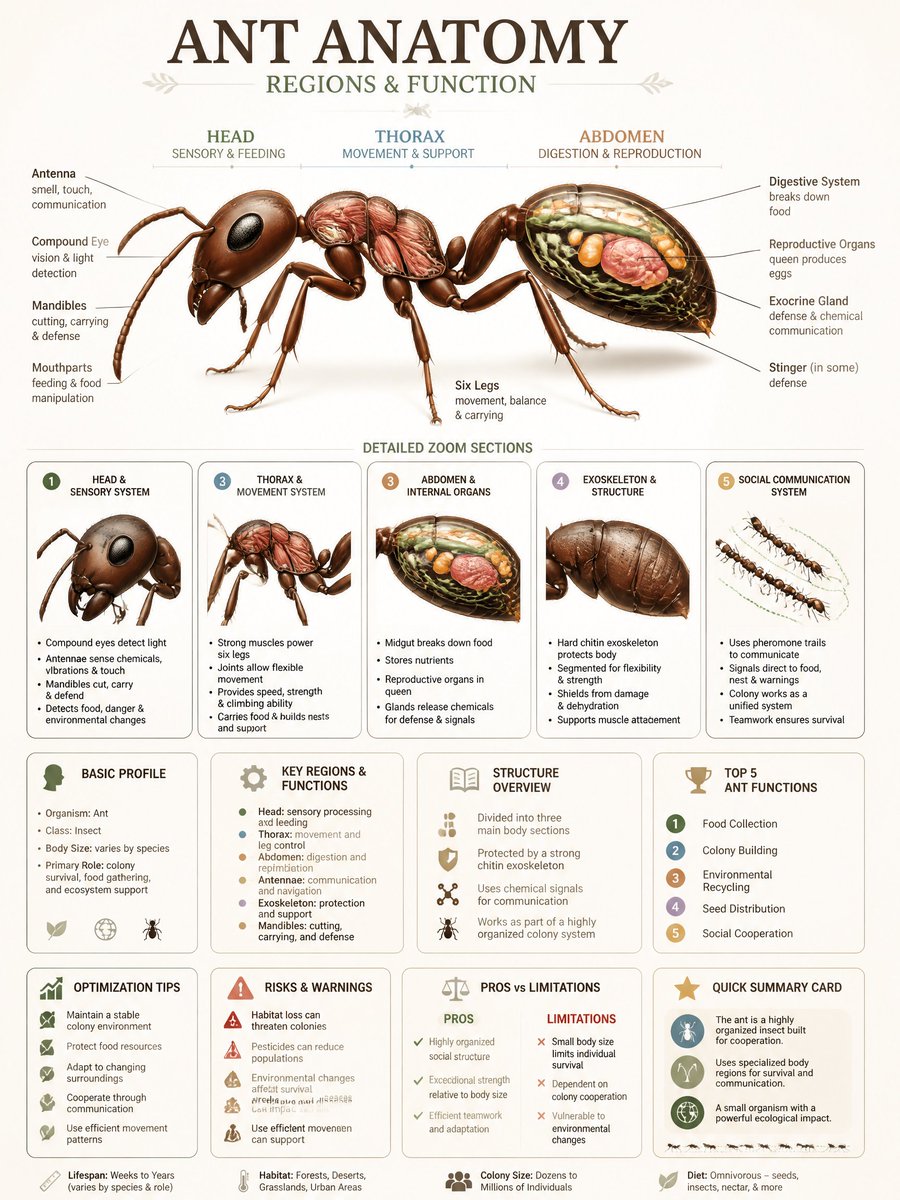
Preview results

Your prompt

Encyclopedia Infographics GPT Image 2 on @TapNow_AI prompt { "type": "image_prompt", "title": "Ant Anatomy Regions & Function", "style": { "overall": "premium natural-history guidebook meets modern editorial infographic", "tone": "educational, refined, collectible, highly structured", "background": "clean light-colored", "palette": "soft, elegant, muted scientific tones (earth browns, warm grays, subtle greens, gentle blues)", "lighting": "gentle shadows, soft highlights", "layout": "vertical, modular, high information density but uncluttered" }, "composition": { "main_subject": { "type": "detailed anatomical illustration", "description": "highly detailed ant with clearly defined body segments, internal organs, legs, antennae, and biological structures", "style": "semi-realistic scientific illustration with soft shading", "placement": "upper-middle focal area", "labels": "major ant regions labeled with fine callouts" }, "zoom_sections": [ { "focus": "head and sensory system", "description": "zoomed-in panel showing compound eyes, antennae, mandibles, communication, and environmental sensing" }, { "focus": "thorax and movement system", "description": "zoomed-in panel showing muscles, six legs, joints, and powerful movement mechanics" }, { "focus": "abdomen and internal organs", "description": "zoomed-in panel showing digestive system, reproductive organs, and defensive functions" }, { "focus": "exoskeleton", "description": "detailed view showing protective outer shell, body segments, and structural strength" }, { "focus": "social communication system", "description": "panel showing pheromone trails, colony communication, and teamwork behavior" } ], "info_panels": [ { "title": "Basic Profile", "content": [ "Organism: Ant", "Class: Insect", "Body Size: varies by species", "Primary Role: colony survival, food gathering, and ecosystem support" ] }, { "title": "Key Regions & Functions", "content": [ "Head: sensory processing and feeding", "Thorax: movement and leg control", "Abdomen: digestion and reproduction", "Antennae: communication and navigation", "Exoskeleton: protection and support", "Mandibles: cutting, carrying, and defense" ] }, { "title": "Structure Overview", "content": [ "Divided into three main body sections", "Protected by a strong chitin exoskeleton", "Uses chemical signals for communication", "Works as part of a highly organized colony system" ] }, { "title": "Top 5 Ant Functions", "content": [ "Food Collection", "Colony Building", "Environmental Recycling", "Seed Distribution", "Social Cooperation" ], "visual_style": "ranked list or icon-based scoring" }, { "title": "Optimization Tips", "content": [ "Maintain a stable colony environment", "Protect food resources", "Adapt to changing surroundings", "Cooperate through communication", "Use efficient movement patterns" ] }, { "title": "Risks & Warnings", "content": [ "Habitat loss can threaten colonies", "Pesticides can reduce populations", "Environmental changes affect survival", "Predators and diseases can impact colonies" ] }, { "title": "Pros vs Limitations", "content": { "pros": [ "Highly organized social structure", "Exceptional strength relative to body size", "Efficient teamwork and adaptation" ], "cons": [ "Small body size limits individual survival", "Dependent on colony cooperation", "Vulnerable to environmental changes" ] } }, { "title": "Quick Summary Card", "content": [ "The ant is a highly organized insect built for cooperation", "Uses specialized body regions for survival and communication", "A small organism with a powerful ecological impact" ], "visual_style": "highlight box with icons" } ] }, "visual_elements": { "icons": "small, refined, minimal scientific icons", "boxes": "rounded corners with subtle borders", "typography": { "title": "large, elegant, high contrast", "subheadings": "clear hierarchy", "body": "clean, readable, compact" }, "connectors": "thin lines linking labels to ant regions", "decor": "subtle grid or editorial alignment guides" }, "design_goals": [ "knowledge integration", "modular information design", "encyclopedia-style clarity", "high readability", "shareable infographic aesthetic", "non-commercial, reference-style presentation" ] }

Variable guide

Ant Anatomy Regions & Function

The infographic title shown at the top

$.title in the root JSON object

Example value

Ant Anatomy Regions & Function

highly detailed ant with clearly defined body segments, internal organs, legs, antennae, and biological structures

Description of the main anatomical illustration

$.composition.main_subject.description

Example value

highly detailed ant with clearly defined body segments

soft, elegant, muted scientific tones (earth browns, warm grays, subtle greens, gentle blues)

The muted scientific color palette of the design

$.style.palette

Example value

earth browns, warm grays, subtle greens, gentle blues

clean light-colored

General background description of the image

$.style.background

Example value

clean light-colored

What you get

  • A vertical encyclopedic infographic in premium natural-history guidebook style.
  • A semi-realistic scientific anatomical ant illustration with soft shading and fine callout labels.
  • Five zoomed panels: head and senses, thorax and movement, abdomen and organs, exoskeleton, and social communication.
  • Info panels covering basic profile, key functions, optimization tips, risks, pros vs limitations, and a quick summary card.
  • Minimal scientific icons, rounded boxes, and thin connector lines.

Use cases

  • Educational materials for insect biology in schools and universities.
  • Simplified science posts on social media.
  • Shareable study reference cards and posters.
  • Encyclopedic content for a digital knowledge library.

How to use

  • Copy the full template while keeping the JSON structure intact.
  • Replace the title, main subject description, palette, and background if you want to customize the studied organism.
  • Paste the template into the GPT Image 2 tool on @TapNow_AI.
  • Confirm the required output is a vertical, highly structured infographic before generating.
  • Edit the info panel contents if you need data for a different species or creature.
  • Regenerate until you get a balanced, uncluttered version.

Related prompts