Skip to content
ImagesFree

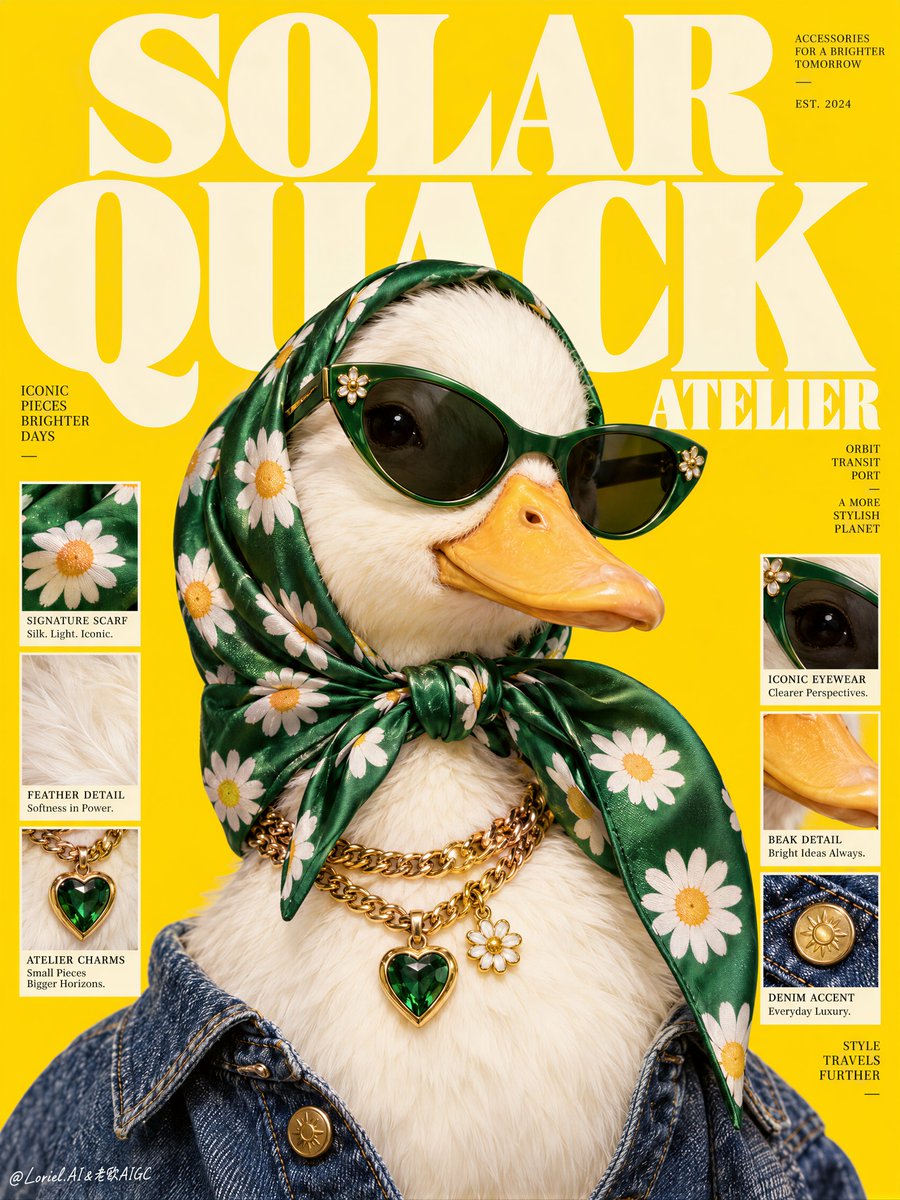
Luxury Fashion Spec Sheet Editorial Cover Poster with Styled Duck

An editorial fashion cover prompt fusing a hyper-detailed styled duck hero portrait with edge-aligned accessory spec boxes, monumental typography, and bold yellow backdrop.

OpenAI

Source previews

These example images come from the original source. DROPIDEA has not independently tested these examples; results depend on the model and settings.

Ready to personalize

Your prompt

English

Replace the red variables with your information. Copy the full prompt and use it with your preferred agent.

TXT MD English version
The side modules do not decorate the cover; they turn styling into products. 🪿 Keep one eccentric hero portrait at center, then crop the scarf print, eyewear hardware, feather texture, and jewelry into edge-aligned detail boxes. The accessories become inspectable without breaking the central image’s authority. 🍊 Give every inset one material and one short caption, using the same box size, border, and spacing rhythm. The page reads like a real fashion spec sheet, so the styling feels designed as a system rather than assembled as costume. GPT- image 2.5 prompt👇 Create the definitive Orbit + Transit + Port final cover poster for the fictional international street-luxury accessories house SOLAR QUACK ATELIER. Preserve the exact graphic architecture of the reference, but refine it into a sharper, rarer, more collectible fashion-cover campaign master visual with stronger character centrality, cleaner editorial structure, and more luxurious material hierarchy. Keep the same essential structure: a blazing saturated yellow flat background, one monumental pale off-white title wall spanning almost the full height behind the subject, one impeccably styled duck in a centered waist-up portrait, and a restrained system of editorial detail boxes aligned along the left and right edges. The final result must feel like a premium fashion magazine cover fused with a luxury accessories launch poster. The absolute hero is one perfectly styled duck shown in a centered waist-up portrait, facing slightly off-center with calm, aristocratic, ironic confidence. The duck must be rendered in hyper-detailed photorealism: soft white feather density, subtle layered fluff structure, clean warm orange-yellow beak geometry, glossy dark eyes partially obscured by fashion eyewear, and a poised fashion-icon attitude. It must feel like a true cover star rather than a comic animal. The duck reads first, before typography, side modules, or background color. The styling is the commercial product event and must carry the image. Wrap the head in a rich emerald-green silk scarf printed with white daisies and golden-yellow centers, tied elegantly beneath the beak with believable knot tension, glossy silk sheen, and controlled fold rhythm. Add sharp green cat-eye sunglasses with dark tinted lenses, sculptural premium frames, and tiny jewel-like floral accents at the corners. Around the neck, layer polished gold chain jewelry with one or two statement pendants such as a heart-shaped gem charm and a miniature symbolic icon, all rendered with believable metallic weight, reflective polish, and luxury-grade detail. If included, a cropped denim or workwear-style upper garment may frame the lower portion, but it must remain secondary to the scarf, glasses, and jewelry. The accessories define the brand. Behind the duck, place one giant oversized English title system in tall pale cream or off-white block letters stretching across the upper and central background like a typographic wall. The wording must be entirely newly invented in English only and should project attitude, irony, pastoral luxury, or icon confidence without copying any source text. The letters must feel monumental, flat, and graphic, acting as a printed architecture pierced by the duck’s head, scarf silhouette, and sunglasses. The title wall must be bold enough to anchor the image from far away, but always secondary to the duck portrait. The editorial side modules must preserve the magazine-cover logic but become cleaner and more premium. Build a small number of precise inset boxes along the left and right edges, each showing tightly cropped detail studies of the key materials: scarf print, feather texture, eye detail, beak sheen, jewelry hardware, or textile weave. Pair them with tiny newly invented English-only micro-labels or style-note captions treated like a high-end fashion spec sheet. These modules must remain secondary, precisely aligned, and visually quiet. They are there to enrich product storytelling, not to compete with the central portrait. The background must remain radically simple: a saturated sun-yellow to golden-yellow flat field with no environment, no scenery, and no narrative clutter. The emptiness is deliberate and luxury-coded. The duck, title wall, and side modules must generate the entire image tension through contrast, styling, and editorial rhythm alone. Lighting must be crisp, frontal, and editorial with subtle side shaping. The feathers must remain soft and dimensional, the silk scarf glossy and tactile, the sunglasses hard and polished, the gold chains luminous and weighted, and the beak smooth with fine natural texture. Keep shadows soft and minimal. The whole cover must feel bright, expensive, graphic, and instantly legible, with no muddy yellows and no blown whites. Use a disciplined 60/30/10 palette hierarchy: 60% saturated yellow background and warm beak tones, 30% emerald-green scarf and sunglass system, 10% white feather highlights, pale cream title letters, and gold jewelry glints. The palette must feel playful, luxurious, and unmistakably ownable as brand language. Material semantics are critical. Feathers must feel real and tactile. The scarf must feel like premium printed silk. The sunglasses must feel sculptural and luxury-grade. The jewelry must feel metallic and weighted. Any denim accent must feel textured and believable. The typography must feel flat, sharp, and printed. Every element should reinforce that this is a fashion-accessory campaign where one eccentric icon character and one tightly controlled styling system carry the entire visual identity. Orbit priority: maximize first-glance impact through the triad of yellow field, duck cover-star portrait, and green scarf-sunglass styling hit. Transit priority: make the cover clearly expandable into a larger fashion universe of scarf drops, eyewear chapters, jewelry capsules, denim accessories, and additional animal icon editions while preserving the same title-wall and editorial-module grammar. Port priority: reduce the side content to the minimum useful set, strip away all nonessential narrative, preserve a flat yellow void, and compress the image into a rare, internationally polished fashion-cover campaign key visual. Quality target and structured exclusions: photoreal fashion-editorial poster, accurate duck anatomy, realistic feather texture, realistic beak shape, premium silk scarf behavior, premium sunglass geometry, premium gold jewelry detail, readable invented English typography, no random letters, no cartoon duck styling, no warped beak, no extra eyes, no malformed glasses, no muddy yellows, no cluttered background, no sloppy editorial boxes, no style drift, no AI artifacts, no watermark, no real brand names, no real person names.
Preview results

Your prompt

The side modules do not decorate the cover; they turn styling into products. 🪿 Keep one eccentric hero portrait at center, then crop the scarf print, eyewear hardware, feather texture, and jewelry into edge-aligned detail boxes. The accessories become inspectable without breaking the central image’s authority. 🍊 Give every inset one material and one short caption, using the same box size, border, and spacing rhythm. The page reads like a real fashion spec sheet, so the styling feels designed as a system rather than assembled as costume. GPT- image 2.5 prompt👇 Create the definitive Orbit + Transit + Port final cover poster for the fictional international street-luxury accessories house SOLAR QUACK ATELIER. Preserve the exact graphic architecture of the reference, but refine it into a sharper, rarer, more collectible fashion-cover campaign master visual with stronger character centrality, cleaner editorial structure, and more luxurious material hierarchy. Keep the same essential structure: a blazing saturated yellow flat background, one monumental pale off-white title wall spanning almost the full height behind the subject, one impeccably styled duck in a centered waist-up portrait, and a restrained system of editorial detail boxes aligned along the left and right edges. The final result must feel like a premium fashion magazine cover fused with a luxury accessories launch poster. The absolute hero is one perfectly styled duck shown in a centered waist-up portrait, facing slightly off-center with calm, aristocratic, ironic confidence. The duck must be rendered in hyper-detailed photorealism: soft white feather density, subtle layered fluff structure, clean warm orange-yellow beak geometry, glossy dark eyes partially obscured by fashion eyewear, and a poised fashion-icon attitude. It must feel like a true cover star rather than a comic animal. The duck reads first, before typography, side modules, or background color. The styling is the commercial product event and must carry the image. Wrap the head in a rich emerald-green silk scarf printed with white daisies and golden-yellow centers, tied elegantly beneath the beak with believable knot tension, glossy silk sheen, and controlled fold rhythm. Add sharp green cat-eye sunglasses with dark tinted lenses, sculptural premium frames, and tiny jewel-like floral accents at the corners. Around the neck, layer polished gold chain jewelry with one or two statement pendants such as a heart-shaped gem charm and a miniature symbolic icon, all rendered with believable metallic weight, reflective polish, and luxury-grade detail. If included, a cropped denim or workwear-style upper garment may frame the lower portion, but it must remain secondary to the scarf, glasses, and jewelry. The accessories define the brand. Behind the duck, place one giant oversized English title system in tall pale cream or off-white block letters stretching across the upper and central background like a typographic wall. The wording must be entirely newly invented in English only and should project attitude, irony, pastoral luxury, or icon confidence without copying any source text. The letters must feel monumental, flat, and graphic, acting as a printed architecture pierced by the duck’s head, scarf silhouette, and sunglasses. The title wall must be bold enough to anchor the image from far away, but always secondary to the duck portrait. The editorial side modules must preserve the magazine-cover logic but become cleaner and more premium. Build a small number of precise inset boxes along the left and right edges, each showing tightly cropped detail studies of the key materials: scarf print, feather texture, eye detail, beak sheen, jewelry hardware, or textile weave. Pair them with tiny newly invented English-only micro-labels or style-note captions treated like a high-end fashion spec sheet. These modules must remain secondary, precisely aligned, and visually quiet. They are there to enrich product storytelling, not to compete with the central portrait. The background must remain radically simple: a saturated sun-yellow to golden-yellow flat field with no environment, no scenery, and no narrative clutter. The emptiness is deliberate and luxury-coded. The duck, title wall, and side modules must generate the entire image tension through contrast, styling, and editorial rhythm alone. Lighting must be crisp, frontal, and editorial with subtle side shaping. The feathers must remain soft and dimensional, the silk scarf glossy and tactile, the sunglasses hard and polished, the gold chains luminous and weighted, and the beak smooth with fine natural texture. Keep shadows soft and minimal. The whole cover must feel bright, expensive, graphic, and instantly legible, with no muddy yellows and no blown whites. Use a disciplined 60/30/10 palette hierarchy: 60% saturated yellow background and warm beak tones, 30% emerald-green scarf and sunglass system, 10% white feather highlights, pale cream title letters, and gold jewelry glints. The palette must feel playful, luxurious, and unmistakably ownable as brand language. Material semantics are critical. Feathers must feel real and tactile. The scarf must feel like premium printed silk. The sunglasses must feel sculptural and luxury-grade. The jewelry must feel metallic and weighted. Any denim accent must feel textured and believable. The typography must feel flat, sharp, and printed. Every element should reinforce that this is a fashion-accessory campaign where one eccentric icon character and one tightly controlled styling system carry the entire visual identity. Orbit priority: maximize first-glance impact through the triad of yellow field, duck cover-star portrait, and green scarf-sunglass styling hit. Transit priority: make the cover clearly expandable into a larger fashion universe of scarf drops, eyewear chapters, jewelry capsules, denim accessories, and additional animal icon editions while preserving the same title-wall and editorial-module grammar. Port priority: reduce the side content to the minimum useful set, strip away all nonessential narrative, preserve a flat yellow void, and compress the image into a rare, internationally polished fashion-cover campaign key visual. Quality target and structured exclusions: photoreal fashion-editorial poster, accurate duck anatomy, realistic feather texture, realistic beak shape, premium silk scarf behavior, premium sunglass geometry, premium gold jewelry detail, readable invented English typography, no random letters, no cartoon duck styling, no warped beak, no extra eyes, no malformed glasses, no muddy yellows, no cluttered background, no sloppy editorial boxes, no style drift, no AI artifacts, no watermark, no real brand names, no real person names.

Variable guide

one impeccably styled duck in a centered waist-up portrait

The central hero character or animal subject

In the hero character description section

Example value

one impeccably styled duck in a centered waist-up portrait

rich emerald-green silk scarf printed with white daisies and golden-yellow centers

Material, color, and print for the headscarf

In the styling and product accessories section

Example value

rich emerald-green silk scarf printed with white daisies and golden-yellow centers

sharp green cat-eye sunglasses with dark tinted lenses

Frame geometry and lens color of the sunglasses

In the accessories description section

Example value

sharp green cat-eye sunglasses with dark tinted lenses

saturated sun-yellow to golden-yellow flat field

Color and tone of the solid flat backdrop

In the background and palette hierarchy sections

Example value

saturated sun-yellow to golden-yellow flat field

What you get

  • A luxury editorial fashion poster fusing photoreal subject photography with high-end spec sheet detail insets.
  • A hyper-detailed hero portrait displaying intricate feather textures, tailored silk drape, and realistic jewelry.
  • Clean, edge-aligned detail modules highlighting accessories without cluttering the composition.
  • A balanced, high-contrast poster with flat bold background and monumental editorial typography.

Use cases

  • Avant-garde fashion brand campaigns and fictional luxury lookbooks.
  • Editorial magazine cover design and speculative branding projects.
  • High-concept collectible wall art and print posters.

How to use

  • Copy and paste the full prompt into a high-tier image generation model such as GPT Image 2.5 or Midjourney.
  • To customize the hero character, replace the duck description with another animal while keeping the waist-up editorial framing.
  • Adjust the scarf and eyewear palette if desired, ensuring you harmonize the 60/30/10 color rule accordingly.
  • Keep the structured exclusions and typography constraints intact to guarantee clean editorial boxes and sharp letters.

Related prompts