Skip to content
ImagesFree

Cinematic Lore Document From a Fictional Archive

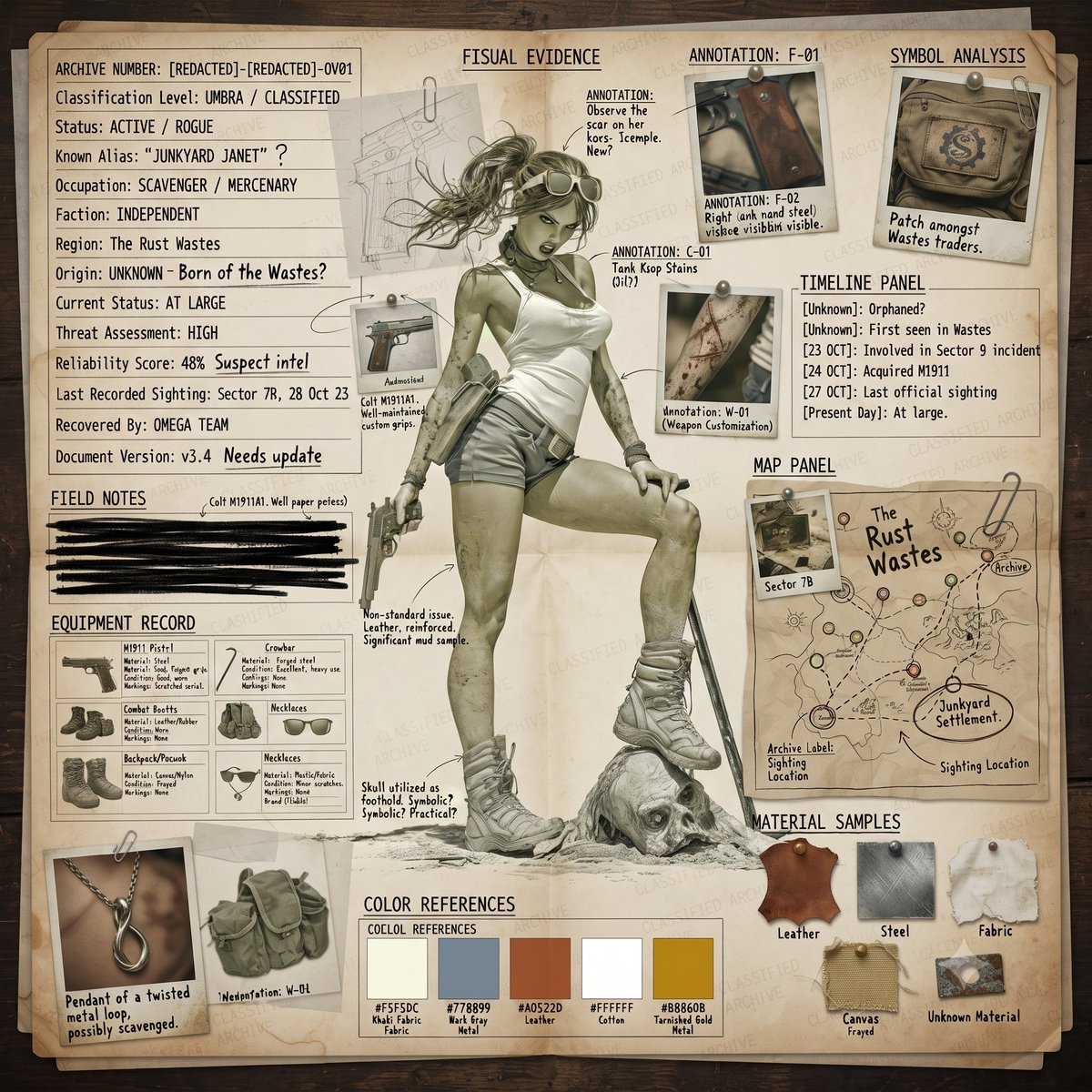
Creates a cinematic archive page styled like premium AAA game lore files, blending military intelligence and archaeological documentation while keeping the character identical to the provided reference.

OpenAI

Source previews

These example images come from the original source. DROPIDEA has not independently tested these examples; results depend on the model and settings.

Ready to personalize

Your prompt

English

Replace the red variables with your information. Copy the full prompt and use it with your preferred agent.

TXT MD English version
Nano Banana Lite 2 vs GPT Image 2 - Character sheet I think it's time to make a zombie battle scene with Seedance... Prompt Share Create a cinematic "Lore Document" based on the provided character reference. The result should look like a classified archive recovered from a fictional universe, not a poster. The original character must remain visually identical to the reference. The page should resemble a premium AAA game lore file, combining military intelligence, archaeological documentation, and world-building records. LAYOUT A weathered archive page filled with organized information. Large portrait or full-body character positioned prominently. Around the page place multiple documentation sections with handwritten notes, technical annotations, seals, evidence tags, archive numbers, stamps, diagrams, and small supporting illustrations. The composition should feel like an authentic historical record rather than promotional artwork. DOCUMENT SECTIONS ARCHIVE NUMBER Classification Level Status Known Alias Occupation Faction Region Origin Current Status Threat Assessment Reliability Score Last Recorded Sighting Recovered By Document Version VISUAL EVIDENCE Include smaller evidence windows showing close-up crops of important visual elements such as: Face Eyes Mask Weapon Hands Armor Symbols Accessories Scars Clothing details Each evidence image should have its own annotation label. EQUIPMENT RECORD Every visible object receives its own archive card. Include: Object designation Observed material Estimated craftsmanship Condition Visible markings Observed wear Recovery notes FIELD NOTES Several handwritten observation notes scattered around the page. These should read like investigators documenting what they discovered. Example tone: "Observed multiple repair marks." "Material unknown." "Weapon appears ceremonial." "Symbol repeated across equipment." Never reveal supernatural facts as certainty. TIMELINE Small timeline panel containing documented events. Use intentionally incomplete entries. Example: Unknown Unknown First Recorded Missing Records Present Day MAP PANEL Small fictional map showing an approximate region connected to the character. Include pins, circles, route markings, and archive labels. SYMBOL ANALYSIS Display enlarged versions of every visible emblem, crest, rune, logo, engraving, or insignia. Each accompanied by short documentation notes. COLOR REFERENCES Display official color swatches extracted from the character. MATERIAL SAMPLES Display sample chips for every visible material including: Leather Steel Fabric Wood Stone Glass Carbon Fiber Gold Copper Ceramic Unknown Material VISUAL STYLE Premium AAA game lore book Museum archive Military intelligence report Historical manuscript Archaeological research Dark fantasy codex Science fiction database Blueprint annotations Minimal UI overlays Evidence photography Document stamps Aged paper Coffee stains Fold marks Handwritten notes Redacted text Official seals Evidence tags Paper clips Pinned photographs Transparent tracing paper overlays Technical sketches Layered document collage Highly detailed Believable Immersive Every element should reinforce the feeling that this is an authentic document recovered from a living fictional universe.
Preview results

Your prompt

Nano Banana Lite 2 vs GPT Image 2 - Character sheet I think it's time to make a zombie battle scene with Seedance... Prompt Share Create a cinematic "Lore Document" based on the provided character reference. The result should look like a classified archive recovered from a fictional universe, not a poster. The original character must remain visually identical to the reference. The page should resemble a premium AAA game lore file, combining military intelligence, archaeological documentation, and world-building records. LAYOUT A weathered archive page filled with organized information. Large portrait or full-body character positioned prominently. Around the page place multiple documentation sections with handwritten notes, technical annotations, seals, evidence tags, archive numbers, stamps, diagrams, and small supporting illustrations. The composition should feel like an authentic historical record rather than promotional artwork. DOCUMENT SECTIONS ARCHIVE NUMBER Classification Level Status Known Alias Occupation Faction Region Origin Current Status Threat Assessment Reliability Score Last Recorded Sighting Recovered By Document Version VISUAL EVIDENCE Include smaller evidence windows showing close-up crops of important visual elements such as: Face Eyes Mask Weapon Hands Armor Symbols Accessories Scars Clothing details Each evidence image should have its own annotation label. EQUIPMENT RECORD Every visible object receives its own archive card. Include: Object designation Observed material Estimated craftsmanship Condition Visible markings Observed wear Recovery notes FIELD NOTES Several handwritten observation notes scattered around the page. These should read like investigators documenting what they discovered. Example tone: "Observed multiple repair marks." "Material unknown." "Weapon appears ceremonial." "Symbol repeated across equipment." Never reveal supernatural facts as certainty. TIMELINE Small timeline panel containing documented events. Use intentionally incomplete entries. Example: Unknown Unknown First Recorded Missing Records Present Day MAP PANEL Small fictional map showing an approximate region connected to the character. Include pins, circles, route markings, and archive labels. SYMBOL ANALYSIS Display enlarged versions of every visible emblem, crest, rune, logo, engraving, or insignia. Each accompanied by short documentation notes. COLOR REFERENCES Display official color swatches extracted from the character. MATERIAL SAMPLES Display sample chips for every visible material including: Leather Steel Fabric Wood Stone Glass Carbon Fiber Gold Copper Ceramic Unknown Material VISUAL STYLE Premium AAA game lore book Museum archive Military intelligence report Historical manuscript Archaeological research Dark fantasy codex Science fiction database Blueprint annotations Minimal UI overlays Evidence photography Document stamps Aged paper Coffee stains Fold marks Handwritten notes Redacted text Official seals Evidence tags Paper clips Pinned photographs Transparent tracing paper overlays Technical sketches Layered document collage Highly detailed Believable Immersive Every element should reinforce the feeling that this is an authentic document recovered from a living fictional universe.

What you get

  • A weathered archive page styled like a cinematic lore document from a fictional universe.
  • A prominent character portrait surrounded by documentation sections such as archive number, threat assessment, and timeline.
  • Close-up evidence windows for visual elements like face, eyes, weapon, and armor with annotation labels.
  • Archive cards for every equipment piece, handwritten field notes, a fictional map, color swatches, and material samples.

Use cases

  • Documenting game or story characters in a military-intelligence file style.
  • Creating immersive promotional content for AAA games or fantasy worlds.
  • Designing lore pages for rulebooks or fictional encyclopedias.
  • Building visual reference material for writing, illustration, and tabletop projects.

How to use

  • Upload a clear reference image of the character you want to document, since the result depends on matching the character visually to the reference.
  • Copy the template and paste it into an image generation tool such as Nano Banana Lite 2 or GPT Image 2.
  • To customize, edit creative values such as faction, region, or aliases without changing the template's technical sections.
  • Submit the template together with the reference image and wait for the full archive page to be generated.
  • Review the output and verify the character stays identical to the reference and all documented sections appear.

Related prompts