Skip to content
ImagesFree

Vertical Emotional City Poster in Mixed Media

A template guiding AI to create an original vertical emotional travel poster for any city and landmark, in an original mixed-media illustration style (oil pastel, charcoal, warm paper), with a three-layer composition, a flowing Memory Ribbon, and the city name in English uppercase.

OpenAI

Source previews

These example images come from the original source. DROPIDEA has not independently tested these examples; results depend on the model and settings.

Ready to personalize

Your prompt

English

Replace the red variables with your information. Copy the full prompt and use it with your preferred agent.

TXT MD English version
CITY: [ENTER CITY NAME IN ENGLISH] LANDMARK: [ENTER ONE MAIN LANDMARK] Create an original vertical emotional city poster featuring the specified CITY and LANDMARK. The LANDMARK should be the recognizable visual anchor in the middle distance, simplified into elegant geometric forms rather than rendered with photographic precision. Reimagine the surrounding area as a poetic memory of the city—not an exact copy of any photograph or existing artwork. COMPOSITION Build the scene in three distinct layers: FOREGROUND — Oversized local plants, seasonal flowers, architectural fragments, café furniture, street objects, or foliage associated with the city, partially entering from the bottom and sides. MIDDLE GROUND — A few small, naturally posed people enjoying an ordinary city moment: walking, reading, cycling, talking, resting, or looking toward the landmark. Keep them secondary and avoid staged tourist poses. BACKGROUND — The LANDMARK within a selectively simplified cityscape, framed by sky, trees, water, hills, or buildings appropriate to the location. Add a distinctive Memory Ribbon: an irregular flowing band beginning near a lower corner and naturally transforming into a road, river, shadow, flower bed, or beam of light as it leads toward the landmark. Add several tiny star-shaped color marks along its path. VISUAL LANGUAGE Use an original mixed-media illustration style combining broad oil-pastel color blocks, dry powdery charcoal outlines, handmade pressure variations, broken edges, imperfect overlaps, scraped-back highlights, warm uncoated paper grain, selective double contour lines, tactile pigment, uneven opacity, visible hand movement, and intentional negative space. Avoid smooth digital gradients, glossy 3D rendering, and photorealism. COLOR PALETTE Automatically derive the palette from the CITY’s emotional character, climate, season, and cultural atmosphere. Use one dominant background color, 2–3 supporting colors, and one bold contrasting accent repeated sparingly. TYPOGRAPHY At the top, display the exact CITY name in ENGLISH UPPERCASE LETTERS. Make it large, spacious, clearly readable, and manually drawn with charcoal or thick oil pastel. Display ONLY the CITY name. No slogans, captions, dates, logos, signatures, watermarks, borders, frames, or additional typography. Create an asymmetrical editorial composition with calm rhythm, strong framing, generous breathing space, and one surprising local detail. Make the final image feel like a rediscovered travel poster from an imagined city archive—intimate, contemporary, nostalgic, tactile, and unmistakably original. NEGATIVE: Photorealistic photography, exact imitation of reference artwork, copied composition, copied brushwork, artist signature, watermark, generic tourism advertisement, crowded skyline, excessive landmarks, distorted architecture, duplicated people, oversized people, smooth vector illustration, glossy 3D rendering, plastic texture, neon overload, muddy colors, excessive saturation, digital airbrush gradients, comic-book inking, anime style, childish clip art, illegible or misspelled city name, additional text, slogan, date, logo, border, frame.
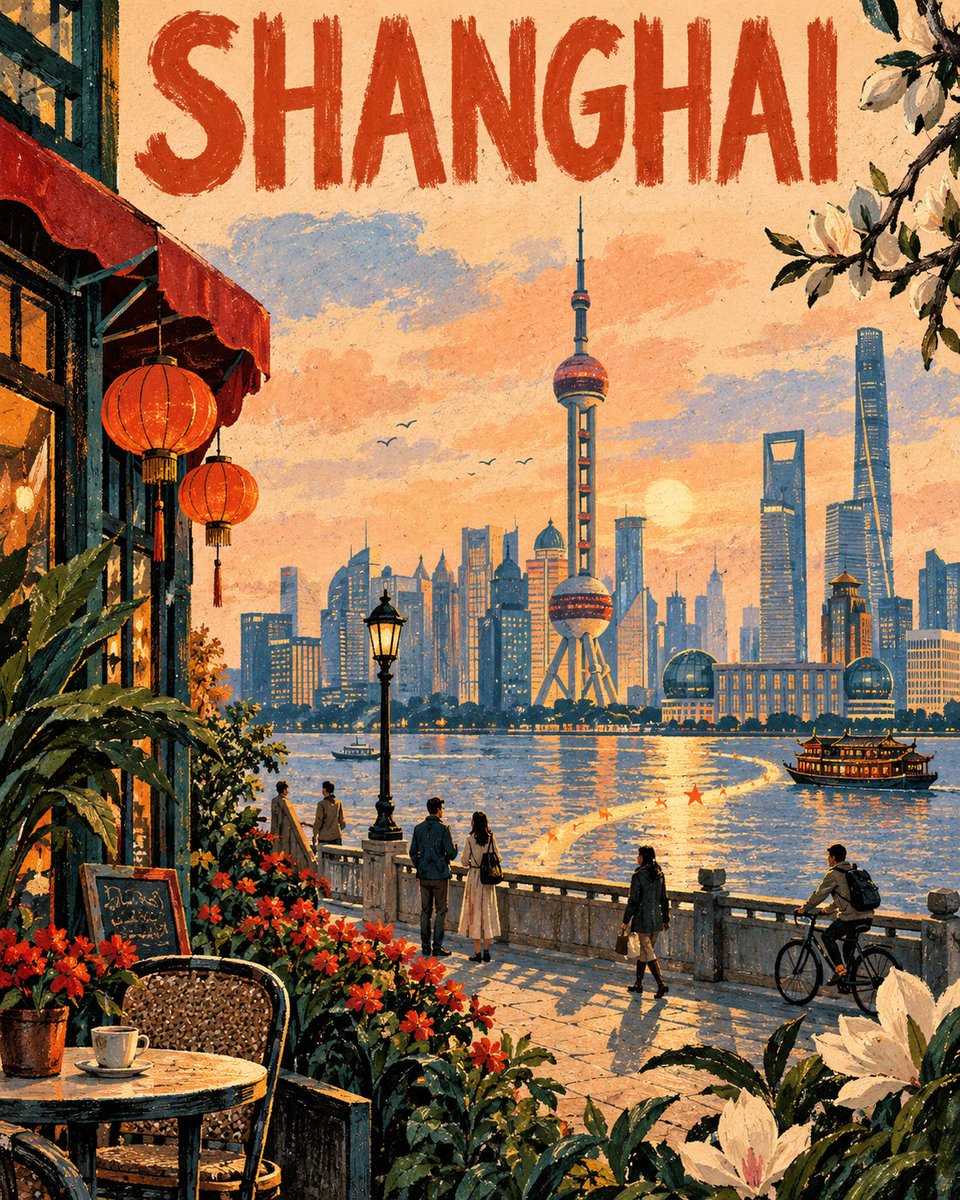
Preview results

Your prompt

CITY: [ENTER CITY NAME IN ENGLISH] LANDMARK: [ENTER ONE MAIN LANDMARK] Create an original vertical emotional city poster featuring the specified CITY and LANDMARK. The LANDMARK should be the recognizable visual anchor in the middle distance, simplified into elegant geometric forms rather than rendered with photographic precision. Reimagine the surrounding area as a poetic memory of the city—not an exact copy of any photograph or existing artwork. COMPOSITION Build the scene in three distinct layers: FOREGROUND — Oversized local plants, seasonal flowers, architectural fragments, café furniture, street objects, or foliage associated with the city, partially entering from the bottom and sides. MIDDLE GROUND — A few small, naturally posed people enjoying an ordinary city moment: walking, reading, cycling, talking, resting, or looking toward the landmark. Keep them secondary and avoid staged tourist poses. BACKGROUND — The LANDMARK within a selectively simplified cityscape, framed by sky, trees, water, hills, or buildings appropriate to the location. Add a distinctive Memory Ribbon: an irregular flowing band beginning near a lower corner and naturally transforming into a road, river, shadow, flower bed, or beam of light as it leads toward the landmark. Add several tiny star-shaped color marks along its path. VISUAL LANGUAGE Use an original mixed-media illustration style combining broad oil-pastel color blocks, dry powdery charcoal outlines, handmade pressure variations, broken edges, imperfect overlaps, scraped-back highlights, warm uncoated paper grain, selective double contour lines, tactile pigment, uneven opacity, visible hand movement, and intentional negative space. Avoid smooth digital gradients, glossy 3D rendering, and photorealism. COLOR PALETTE Automatically derive the palette from the CITY’s emotional character, climate, season, and cultural atmosphere. Use one dominant background color, 2–3 supporting colors, and one bold contrasting accent repeated sparingly. TYPOGRAPHY At the top, display the exact CITY name in ENGLISH UPPERCASE LETTERS. Make it large, spacious, clearly readable, and manually drawn with charcoal or thick oil pastel. Display ONLY the CITY name. No slogans, captions, dates, logos, signatures, watermarks, borders, frames, or additional typography. Create an asymmetrical editorial composition with calm rhythm, strong framing, generous breathing space, and one surprising local detail. Make the final image feel like a rediscovered travel poster from an imagined city archive—intimate, contemporary, nostalgic, tactile, and unmistakably original. NEGATIVE: Photorealistic photography, exact imitation of reference artwork, copied composition, copied brushwork, artist signature, watermark, generic tourism advertisement, crowded skyline, excessive landmarks, distorted architecture, duplicated people, oversized people, smooth vector illustration, glossy 3D rendering, plastic texture, neon overload, muddy colors, excessive saturation, digital airbrush gradients, comic-book inking, anime style, childish clip art, illegible or misspelled city name, additional text, slogan, date, logo, border, frame.

Variable guide

[ENTER CITY NAME IN ENGLISH]

The city name in English; displayed large at the top of the poster.

Replace [ENTER CITY NAME IN ENGLISH] on the first line (after "CITY:").

Example value

KYOTO

[ENTER ONE MAIN LANDMARK]

The main landmark shown in the middle distance.

Replace [ENTER ONE MAIN LANDMARK] on the second line (after "LANDMARK:").

Example value

Fushimi Inari Shrine

What you get

  • An original vertical emotional poster featuring your chosen city and landmark.
  • A three-layer composition: botanical foreground, small naturally posed people, and a simplified landmark in the background.
  • A flowing Memory Ribbon with tiny star-shaped marks leading the eye toward the landmark.
  • The city name in English uppercase, hand-drawn at the top, with no extra text.

Use cases

  • Wall art posters of your city or favorite cities.
  • Contemporary travel print or postcard designs.
  • Visual content for travel campaigns or city social media accounts.
  • Personal nostalgic gifts for cities that hold a memory.

How to use

  • Enter the city name in English in place of [ENTER CITY NAME IN ENGLISH] on the first line.
  • Enter one main landmark in place of [ENTER ONE MAIN LANDMARK] on the second line.
  • Copy the full template into your preferred image generation tool and run generation.
  • If the first result is not satisfying, regenerate without editing the template; results are stochastic and may vary each run.

Related prompts