Skip to content
Connected Business Solutions

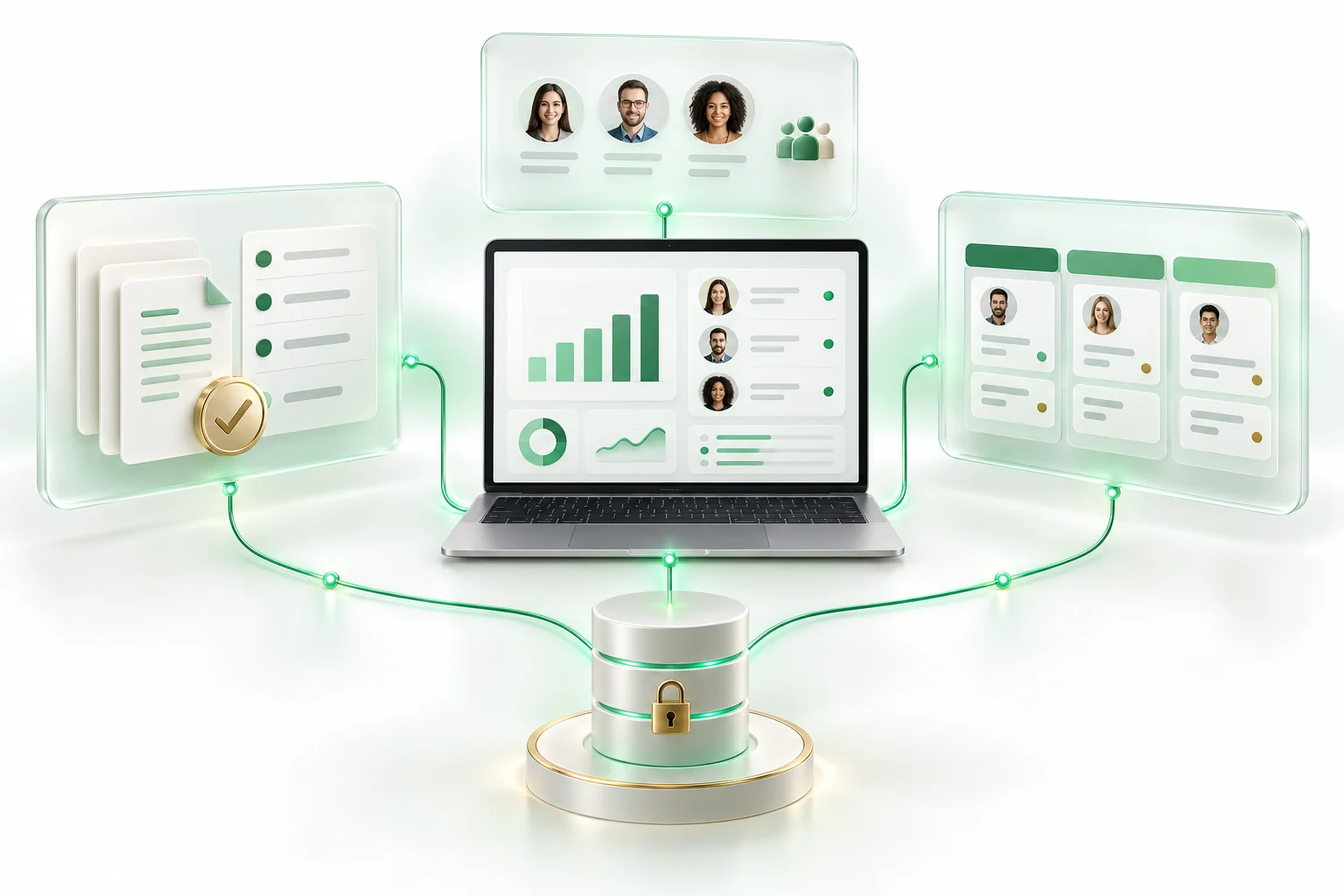
Accounting, HR and CRM in one experience

Two independent paths: a complete custom system, or integration with your existing software. The custom path requires no subscription to another platform.

What is included

Accounting, HR and CRM in one experience

Two independent paths: a complete custom system, or integration with your existing software. The custom path requires no subscription to another platform.

Accounting, HR and CRM in one experience

Choose how your business system is built

Two independent paths: a complete custom system, or integration with your existing software. The custom path requires no subscription to another platform.

Standalone custom business system

We design and build a complete system for your organisation, with your identity, workflows and a separate database. It runs without relying on Odoo, Wafeq or external integrations. Hosting, ownership of deliverables and handover scope are agreed in the contract.

  • Customer, sales, purchasing, inventory, invoicing, accounting and HR modules within the agreed scope.
  • Department and user permissions, approval workflows, audit trails, reports and internal dashboards.
  • Process discovery, prototypes, incremental development, acceptance testing, training, backups and agreed maintenance.
  • Approved data imports with field mapping and balance reconciliation, preserving the source. Currency and tax settings require specialist review; mandatory regulatory connections are scoped separately for the relevant country and activity.

Existing systems connected through APIs

Keep your existing software and connect it through authorised interfaces to a unified dashboard. We agree the source of truth, synchronisation direction and permissions before moving data, without requiring replacement of a working system.

  • Verify API availability, licensing and limits, with least-privilege access for each integration.
  • Field mapping and scheduled or real-time synchronisation, deduplication, retries and monitoring logs.
  • Test in a dedicated environment, reconcile results and obtain approval before enabling writes to original systems.
  • Accounting, HR, CRM and necessary regulatory integrations according to provider interfaces and local requirements.

API integration scope and delivery

  • Connect customers, sales, purchases, stock, invoicing and reporting within an agreed scope.
  • Employee records, leave, attendance and payroll with clear permissions and country-specific requirements.
  • Integrate systems such as Odoo, Wafeq and custom software through supported interfaces, or controlled file imports where APIs are unavailable.
  • Configure taxes, currencies and accounts for the relevant country with specialist review; Saudi projects can integrate with ZATCA Fatoora according to applicable phases and requirements.
  • Migrate gradually with backups, field mapping and balance reconciliation, testing and approval before cutover.

How we implement it

  1. Inventory systems, data, permissions and accounting/tax requirements.
  2. Design and test with reduced or de-identified data; prevent unapproved writes to the source.
  3. Reconcile records, balances and reports and test tax integrations in the designated environment.
  4. Perform the agreed cutover with a recovery plan, training and error monitoring.

Modules and data ownership

We map sales, contacts, quotations, invoices, purchasing, inventory, employee records, attendance, leave and payroll. Each data type has an authoritative system and explicit creation, editing and approval permissions. A unified dashboard does not give every employee access to every department.

How different applications connect

We prioritize official APIs, webhooks and supported import or export methods. Fields, currencies, dates and identifiers are mapped, with duplicate prevention, error handling and retries. If suitable interfaces are missing, alternatives and limits are documented before agreement.

Data, taxes and invoicing

Backups and test samples precede migration. Record counts, balances and relationships are reconciled before acceptance. Tax settings, currencies and chart of accounts are reviewed with a specialist for the relevant country and activity. Saudi e-invoicing integration is assessed for the applicable phase and requirements, then tested before activation.

Acceptance, handover and support

Handover includes data maps, integrations, departmental permissions, reports, operating guidance and training. Acceptance covers agreed outcomes such as reconciled balances and invoice delivery. Launch is gradual with monitoring and a rollback plan; the original system remains authoritative until transition approval.

Questions before you start

Must we replace our current system?

Not necessarily. We evaluate integration first and propose replacements or additional modules only within an approved scope.

Can you connect Odoo or Wafeq?

This depends on the edition, license, interfaces and permissions. We do not assume every feature is exposed through an API.

Can everyone see employee and payroll information?

No. Access is separated by role and department, with limited permissions, sensitive-operation logs and a backup plan.

Is tax compliance guaranteed worldwide?

Requirements are assessed for each country, activity and software version with a specialist. Authority-specific integrations or approvals are explicitly included in the project scope.

Tell us what you need. Do not submit passwords or sensitive customer data.

Request this solution

Tell us what you need. Do not submit passwords or sensitive customer data.