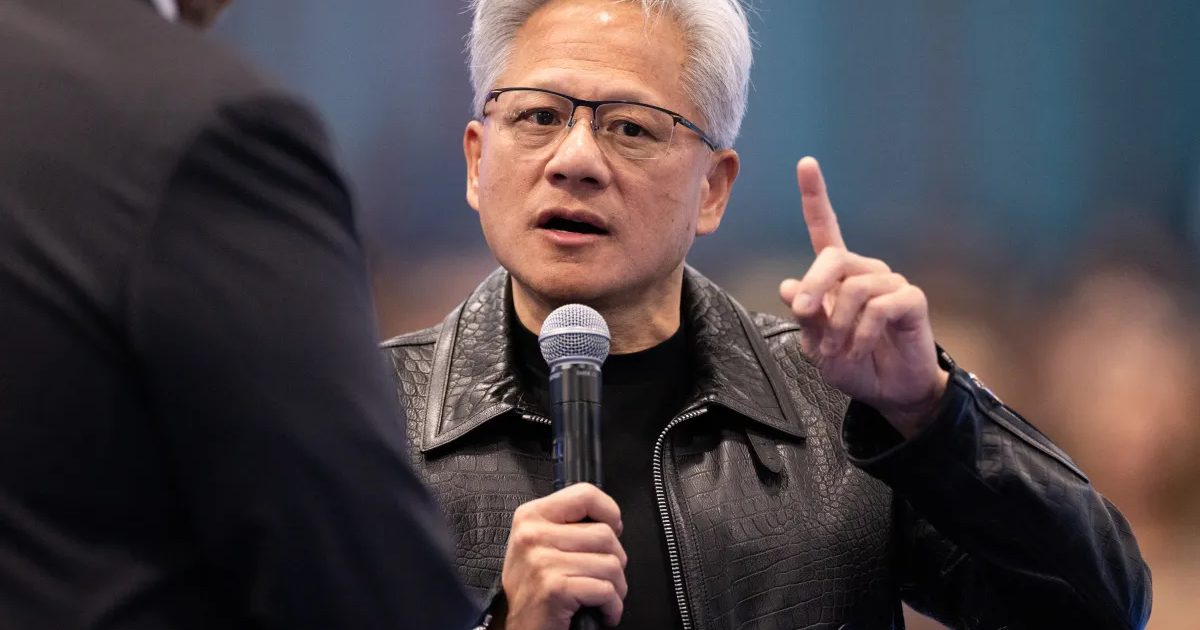
While markets greeted the news of Jensen Huang's return as Nvidia's chief executive with a wave of optimism, a sharply dissenting view came from one of the most prominent academic voices in the business management world. Professor Jeffrey Sonnenfeld of Yale University believes investors are celebrating the wrong decision, and that the company widely regarded as a symbol of American technological supremacy is, in his words, essentially "an obstacle to American industrial power" rather than its standard-bearer.
The Core Criticism: Advanced Chips in the Wrong Hands
Sonnenfeld builds his position on what he describes as documents and research indicating that Nvidia's latest processors have found their way to China despite US export restrictions. He goes further, arguing that some of these chips ended up inside systems linked to institutions connected to the military sphere, while the company insists that smuggling is not a material factor and that its scale is marginal.
The academic also draws a connection between the decline in shares of some American AI companies and the market's realization that the open-source models released by Chinese labs were not so much a miraculous leap as an intensive exploitation of the work of leading American labs. In this context, competitors' access to massive computing power accelerates the narrowing of the technological gap.
A Controversial Return Under Political Pressure
What stands out in this story is that Huang's return was not a quiet institutional decision. Just days earlier, the board chairman had effectively ruled out this scenario, before intensive calls from officials in the US administration intervened to persuade the board to reverse course, culminating in direct contact from the president himself. He later remarked that he was the one who "made the deal."
The news was received with similar enthusiasm in Asia, where state-linked Chinese newspapers celebrated the return of "the king" to his post — a detail Sonnenfeld deploys to reinforce his argument that the interests of the two sides are not as opposed as commonly assumed.
A "Historic" Legal Liability for Board Members
Sonnenfeld's harshest point concerns the board members who approved the return and even reinstated Huang as a board member at the very time the board was supposedly investigating the possibility that he had been targeted by foreign intelligence services. He argues they face a "historic level of individual liability," citing several points:
- Insufficient reliance on independent experts before making the decision.
- A legal investigation that began and then reversed course before being completed.
- Inadequate directors and officers liability insurance coverage.
- No actual review of any classified intelligence findings that might exonerate the chief executive.
He notes that the government-pressure argument is weak in Nvidia's case specifically, because US government contracts account for only a tiny share of its revenue, unlike other companies where roughly half of their business depends on the state. The board therefore faced no genuine commercial threat to justify what he calls "capitulation."
A Parallel Wave of Lawsuits and Investigations
The legal dimension has already begun to take shape. A prospective class action has been filed to compensate investors for their losses, followed by a derivative suit brought on the company's behalf against the board members themselves, alleging that warning signs regarding suspicious personal relationships were ignored. The number of cases is expected to rise significantly, all filed in Northern California where the company is headquartered.
Alongside this, Nvidia faces a multi-front regulatory challenge that includes an antitrust investigation, a potential review of its accounting practices, a state-level subpoena, and an export-controls file that led to one of its partners being placed on the trade blacklist — in addition to congressional hearings at which Huang has agreed to testify.
What This Means for the AI Market
Setting aside the sharpness of the rhetoric, this case raises a fundamental question: how do the companies dominating AI hardware balance global commercial growth against their countries' technological security requirements? Tightening export controls shrinks a massive market, but loosening them means transferring computing power — the most sensitive resource at this stage — to strategic competitors.
The coming months will be revealing: the outcomes of congressional investigations, the trajectory of the lawsuits, and Commerce Department decisions on tightening or easing restrictions. In any case, judging Nvidia's performance is no longer tied to its revenue figures alone, but to its ability to manage an extraordinarily complex governance and geopolitical risk portfolio.
✦ بقلم فريق دروب أيديا
DROPIDEA
We hope this article has added real value to you. At DROPIDEA, we always strive to deliver high-quality content that helps you grow and evolve in the digital space. Follow us for more useful articles and guides.
Tags
Admin
DROPIDEA
Latest Articles

لعبة GTA VI تثبت أن الكفاءة ليست فضيلة دائماً
Nvidia Halts AI Chip Shipments to Southeast Asia

Merging "Chat" and "Work" in ChatGPT: Shared Usage Limits Worry Subscribers
S&P Weighs Nvidia Downgrade Over Governance Concerns